- Sunday, 7 June 2026

Thorong Pass and Tough Mountain Bike Race
By Deepan Pokhrel
An 18-year-old from Dharan with no formal training,
no professional equipment and no grand plan finished second last week in Yak
Attack 2026, the world’s highest mountain bike race. Dipsagar Tamang’s
improbable ride across 5,416-metre Thorong Pass lit up an event that saw all 28
starters complete a grueling eight-day journey through the Annapurna Circuit —
a race that, its organisers say, remains one of Nepal’s best-kept secrets and
most underfunded treasures.
The adventure began quietly in Kathmandu, inside the
Thamel International Guest House. Riders gathered for registration while a
maintenance team checked every cycle. Duffel bags and race tags were
distributed, and 28 names were entered into the books. Noticeably absent was
defending champion Khusiman Gharti. A soldier in the Indian Army, India’s
national champion and originally from Kaski, he had travelled directly to the
start at Besisahar. With him came a six-rider team, prepared and purposeful.
The next morning, a bus ferried the racers to
Besisahar; their bicycles bounced along behind in a jeep. From that first
evening, a 6:30 race briefing became sacred ritual — organisers laying out the
next day’s terrain, altitude profiles and distances.
The race proper ignited at 9 a.m. with a loop stage
out of Besisahar (760 m). A marking crew had set out early, painting the route
with arrows and ribbons. Riders climbed hard towards the Ghandruk area before a
fast, technical downhill delivered them back to town. It was a sharp opening
chapter.
Then came the longest, most gruelling stage:
Besisahar to Chame. The valley tightened, the trail grew relentless, and the
racers’ faces told the story. I caught up with a group at a feed point. One
rider stared ahead and said simply, “Why am I here?” Another, slumped over his
bars, added, “I feel violated.” They remounted and kept moving.
The ride to Manang (3,519 m) offered a kind of
reward. The Octopus waterfall cascaded beside the trail; Blue Lake sat like a
jewel under the peaks. The Annapurna massif filled every horizon. Manang itself
felt like a held breath — a valley ringed completely by mountains, tranquil and
restorative. The riders were given a rest day there. Rafelle, a 70-year-old
Italian, sat in a courtyard soaking in the stillness. He would later say: “The
pain is temporary; the glory of these mountains lasts forever. Age doesn’t
matter when you’re riding among these mountains.”
From Manang, the road vanishes. Support vehicles can
go no further; everything essential — food, medical kits, tents — shifts to
horseback, swaying along trails that have carried supplies to Mustang from
Pokhara for generations. For two days, the support crew walked. We walked.
Riders pushed their bikes, we pushed our lungs, and we could hardly catch up.
It was an excruciating uphill grind through raw mountain terrain. When we
finally reached Base Camp at dusk, all 28 riders had already arrived — quiet,
hollowed out, and somehow whole.
The next morning arrived with a bitter cold: Thorong
Pass day. At 5,416 metres, you do not ride — you carry. Riders strapped
bicycles onto their shoulders and left before dawn, a thin line of figures
inching over snow and scree. From the summit, the reward was a sweeping
downhill to Muktinath (3,710 m), and then the final race stage from Muktinath
to Kalopani (2,530 m). That last stretch rolled through the hidden Mustang —
the ancient Lubra Valley, clattering suspension bridges over turquoise rivers,
pine forests smelling of resin and early winter.
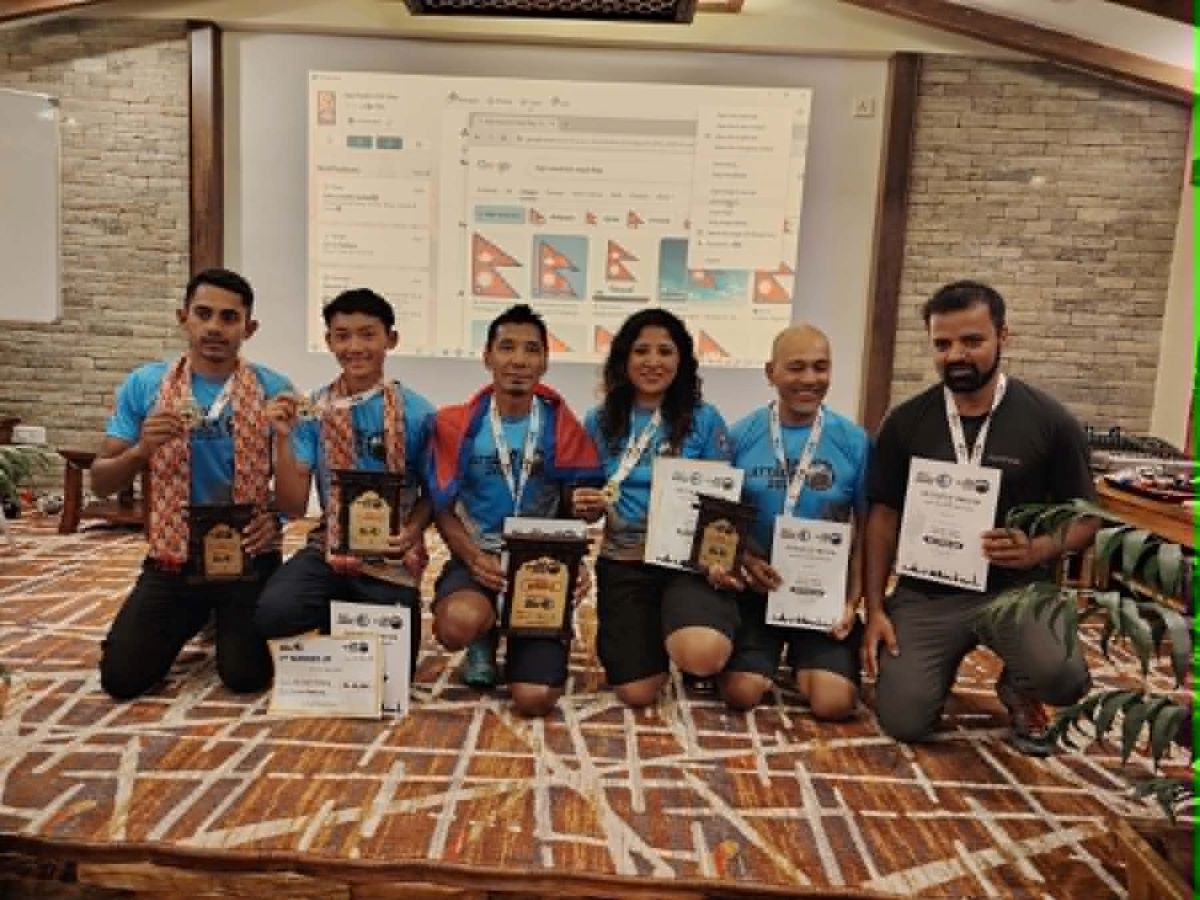
When the wheels stopped and timing chips were
tallied, Khusiman Gharti had won as expected. But the story of the day was
Dipsagar Tamang in second, with Nepal’s cross-country national champion Achyut
placing third. Every single racer finished — including 70-year-old Rafelle and
Dr. Bikash Parajuli of Dhulikhel Hospital, who doubled as the event’s medical
support and a finisher in his own right.
Standing at the finish, Khusiman took a long look at
the mountains he had just ridden through. “This race is never just about
winning,” he said. “The beauty up there — the passes, the lakes, the silence —
it’s overwhelming. The challenge is not the other riders. The challenge is the
mountain itself. That is what brings me back.”
Dipsagar Tamang, still dusty and dazed, kept his
words simple. “I didn’t have a strategy, I didn’t have a proper training
programme, I just kept pedalling. When they told me I was second, I thought it
was a mistake. Now I know what I’m capable of — if I get a chance.”
Achyut, the national champion, heard that “if” and winced. “I’m a national champion,” he said, “but I still struggle to buy good nutrition and maintain my bike. We are losing talents like Dipsagar because there is no pathway. Yak Attack could be a global brand — instead our riders are barely surviving.”
Race organiser Ajay Pandit, who has steered Yak Attack through years of logistical and financial thin air, watched the celebrations with a complicated expression. “This race is a window to Nepal’s soul on two wheels. It should be one of the world’s iconic endurance events. But we fight for basic funding every single year. We are not just an exotic curiosity — we are a story Nepal needs to tell much louder. Instead, we’re holding on by sheer will.”
A free ride was later held up to Maldhunga, and prizes were distributed in Pokhara. There were embraces and quiet pride, but also a lingering weight. Cycling remains a marginal sport in Nepal. There is no proper funding pipeline, no infrastructure, and no clear route from raw potential to professional career. Riders like Dipsagar Tamang, whose second-place finish should be making national headlines and attracting sponsors, face an uncertain future. Yak Attack, a race that could carry Nepal’s image across the globe on two wheels, barely survives — an escape for cycle dreamers rather than the world-class brand it ought to be.
For a handful of days in the high Himalayas, a 70-year-old Italian, a boy from Dharan and a doctor from Dhulikhel shared the same thin air and the same impossible trail. All of them finished. The race deserves to continue and make Nepal known to the world.