- Tuesday, 26 May 2026

Sungurkhal settlement deserted

Photo : Premraj Simkhada The deserted integrated settlement at Sungurkhal.

By Premraj Simkhada,Kalikot, May 26: The integrated settlement constructed at Sungurkhal in Naraharinath Rural Municipality of Kalikot now lies largely deserted.
Built without adequate consideration of geological studies and local needs, the settlement remains uninhabited, despite substantial public investment.
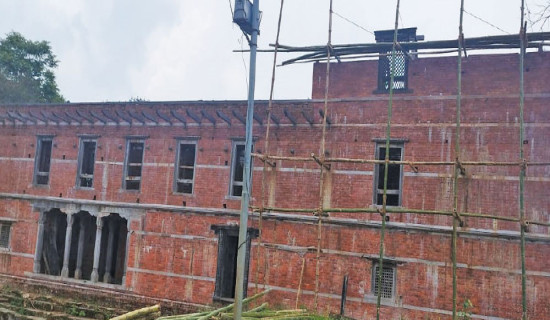
Rows of visually appealing houses roofed with blue corrugated sheets stand empty, turning what was once envisioned as a model relocation project into what many locals describe as a “ghost settlement”.
As a result, millions of rupees invested by the Karnali provincial government and local authorities appear to have gone to waste.
The integrated settlement, comprising 149 houses, a secondary school and a health facility, was built with significant government funding to relocate citizens vulnerable to natural disasters, floods and landslides to safer areas.
However, flawed planning and the failure to address employment and livelihood opportunities have left the settlement largely abandoned.
Chairperson of ward-4, Nanda Ram Bogati, said locals occupy the settlement during the rainy season but leave during the farming period. Local Hiramani Upadhyaya said the settlement had originally been established under a government plan to connect road access to the Ramaroshan region of Sudurpashchim Province, but the lack of employment opportunities had ultimately driven locals away from the settlement.
According to locals, the primary reasons are the lack of farmland and livelihood opportunities. Chairperson Bogati said that while local agricultural land lies in lower areas, the settlement had been built on the hilltop, making long-term habitation impractical.
Although the integrated settlement was designed to mitigate the risk of disaster, locals continue to stay at the ancestral land as they solely rely on farming and livestock rearing.
With no reliable source of income or employment in the new settlement, many locals have locked their homes and returned to their former, risk-prone settlements.
Locals also complain that the government failed to ensure reliable access to essential services such as drinking water, electricity, education and healthcare. “A school was built, but due to the cold climate there is no suitable environment for students to study there,” said local Pushpa Prasad Upadhyaya. He added that the distance between the their old settlements and the new housing area made daily activities, including farming and grazing livestock, practically difficult, forcing many locals to leave.
Critics say the project reflects a tendency to spend budgets hastily without conducting even basic studies of citizens’ practical needs and livelihoods, contributing to the misuse of public funds.
Although the original plan aimed to build 210 houses, only 149 were completed. At the time, officials had publicly promised that locals would permanently relocate, but practical difficulties have since caused many to abandon the settlement.
Locals argue that the government’s concept of an integrated settlement, intended to improve the living standards of poor and disaster-affected families, has remained largely ineffective due to poor coordination between government officials and user committees.
Today, the empty houses of Sungurkhal appear to serve mainly as backdrops for photographs and government reports showcasing “progress”.
“Although the houses are well built, what are we supposed to live on there?” one local said.
“There are no nearby farmlands, nor a reliable water supply. Even if we moved there to save our lives, we would eventually die of hunger, so we were forced to return to our old village.”