- Tuesday, 26 May 2026

Physical progress of fast track nears 48%

By Dipak Prasad Gautam, Birgunj, May 26: Although the construction deadline for the Kathmandu–Tarai/Madhes Expressway (Fast Track) has been set for mid-April 2027, the project has achieved only around 48 per cent physical progress so far.
The Nepali Army, which is responsible for managing the construction, disclosed the progress details during a site visit organised for journalists from Parsa, Bara and Makwanpur districts to the Kathmandu–Tarai/Madhes Expressway project area.
Providing updates on the project’s physical and financial progress, a team led by Army spokesperson and Brigadier General Rajaram Basnet, along with Project Chief Major General Dharmendra Jha of the Nepali Army, said that construction could be completed swiftly if the dispute over the 6.5-kilometre Khokana section is resolved.
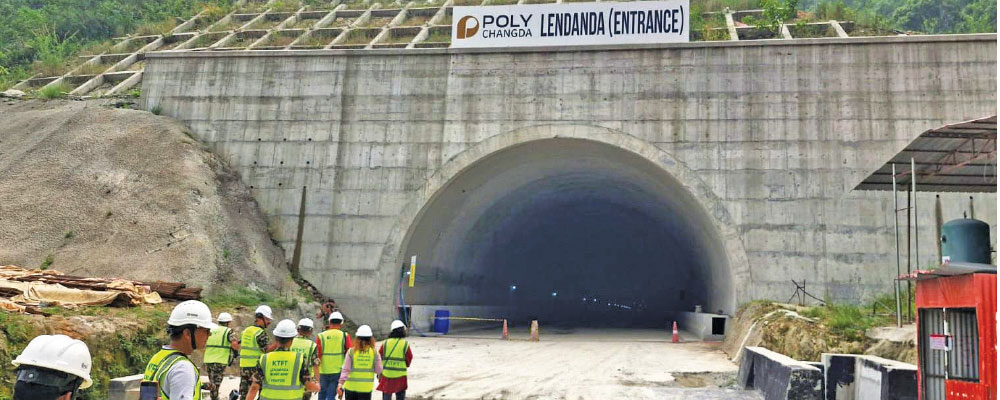
Project Chief Major General Jha said, “We have been working day and night. Seven tunnels along the expressway are currently under construction. Preparations are underway to achieve a breakthrough in the 3,355-metre Mahadevtar Tunnel by mid-July.
“Of the total 89 bridges, contracts have been awarded and construction work is ongoing at 85 sites. However, work on four bridges in the Khokana section has yet to begin.”
According to the Nepali Army, breakthrough work has already been completed at the Dhedre and Lendanda tunnels, where finishing works are currently underway.
Construction is continuing at the Chandram Bhir, Devichaur and Sisautar tunnels, while portal construction is ongoing at the Mauri Bhir tunnel.
Parallel twin tunnels are being constructed throughout the project, with one tunnel designated for travel from Kathmandu to Nijgadh and the other for traffic from Nijgadh to Kathmandu.
Although the expressway’s total length is 70.977 kilometres, only 10.901 kilometres consist of tunnels. However, as parallel tunnels are being constructed, the effective tunnel length has doubled.
Similarly, while bridges account for only 12.885 kilometres of the route, the construction of parallel bridges has effectively doubled the bridge length.
Of the 89 bridges under construction, foundation work has been completed on 56, substructure work on 38, while superstructure work has been completed on 16 bridges, according to the Army. However, work on the four bridges in the Khokana section has yet to begin.
Regarding road construction, sub-base work has been completed on 11.2 kilometres, base work on 5.5 kilometres, while only 0.2 kilometres has been blacktopped.
The Army stated that construction contracts have been awarded for Packages 1, 2, 3, 4, 5, 6, 7, 8A, 8B, 9A, 9B and 10 out of the project’s 13 construction packages, and work is currently ongoing.
No work has commenced on Package 11, which covers the Khokana–Dukuchhap section, as a decision on land acquisition is still pending.
Following a Cabinet decision on May 4, 2017, to assign construction management responsibility to the Nepali Army, the Ministry of Physical Infrastructure and Transport (now the Ministry of Infrastructure Development) officially handed over the project to the Army on May 10, 2017.
The project, originally scheduled for completion by mid-December 2024, had its deadline extended to mid-April 2027. However, with the work unlikely to be completed even within the first extended period, a second deadline extension appears likely.
The total estimated project cost, including VAT, stands at Rs 211.93 billion.


-square-thumb.jpg)