- Sunday, 7 June 2026

Embankment construction intensifies in Susta
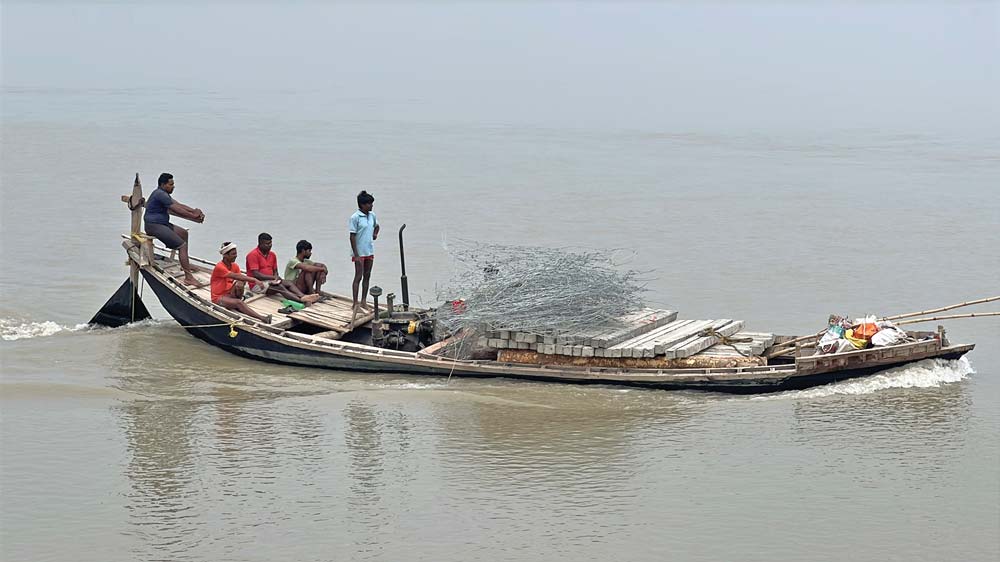
Workers ferrying wire mess, cement poles and other materials on a boat for construction of embankment in Susta.Photo: TRN

By Bomlal Giri
Nawalpur, May 12: Construction of embankments has been intensified in Susta Rural Municipality-5 of Nawalparasi after the Narayani River began inundating settlements every year. The work is being carried out using a new, low-cost and reliable RCC, “Porcupine” technology.
According to Dr. Narayan Prasad Subedi, Chief of the Irrigation and Water Resources Management Project in Bharatpur, river control and management works are currently underway across an area of nearly 900 metres east of the Susta bridge.
The project was initiated after annual flooding from the Narayani River increasingly threatened the Susta settlement.
The porcupine technology is regarded as an effective and low-cost method used for protecting riverbanks and controlling floods. It involves constructing triangular structures by fastening together three reinforced concrete pillars using nuts and bolts. The structures help divert the river’s flow and prevent erosion.
“Six cement poles measuring three to five metres in length and 10 centimetres in width are joined together to form a triangular structure, with iron mesh placed around the outer section,” said project engineer Bel Bahadur Bk. “The structures are installed in three layers up to 15 metres into the river and six metres deep. They trap trees, grass and debris carried by the river and help alter the river’s course.”
Engineer Bk said the Porcupine method had been adopted because the river is too deep in the area for gabion nets or other conventional techniques to be effective.
Two companies from Chitwan and Pokhara have been awarded contracts for embankment construction along the lower and upper sections of the river. KD Construction of Pokhara received a contract worth Rs. 46.6 million for the lower section, while Shivam Construction JV Pvt Ltd of Chitwan secured a Rs. 71.7 million contract for the upper section.
The work began on March 15, 2026, and both companies are required to complete construction by July 6, 2026. Dr. Subedi said the work was progressing rapidly in line with the agreement.
“We had very limited time, but we have managed to accomplish more than expected because our technical staff have been working around the clock,” he said.
In the first phase, efforts have focused on the most vulnerable parts of Susta. Dr Subedi warned that failure to manage the river could endanger the future of the entire settlement. River control and management work is currently underway in an approximately 900-metre stretch severely eroded after last year’s floods entered the settlement and threatened the historic area of Susta.
While Porcupine structures are being installed on the front side facing the river current, stone walls are being built on the rear side to strengthen the embankment. The project estimates that nearly 10,000 cubic metres of stones will be required.
However, Dr. Subedi said obtaining stones had become a major challenge as the banks of the Narayani are mostly sandy.
“Workers have to travel four to five kilometres away and remove sand to collect stones one by one, which takes considerable time,” he said. “The collected stones are then transported by tractor to the riverbank and ferried across the river by boat.”
Engineer BK said tractors could not cross the bridge, while India has not allowed tractors or trucks to pass through its territory, leaving boats as the only available option for transporting materials.
During last year’s monsoon, locals spent the night filling sacks with sand to protect the settlement after floodwaters entered from the northern side of Susta.
Concerned that Susta could be swept away if strong river-control structures were not completed before the monsoon, residents drew the attention of then Minister for Physical Infrastructure Kulman Ghising. Following this, the federal government allocated a budget, called tenders and immediately initiated the project.
Susta is surrounded by the Narayani River on three sides and India on the other, making rescue operations extremely difficult if floodwaters enter the settlement. Around 3,200 Nepalis from nearly 350 households live in the area.