- Wednesday, 10 June 2026

Nepal okays ethanol blending for fuel security
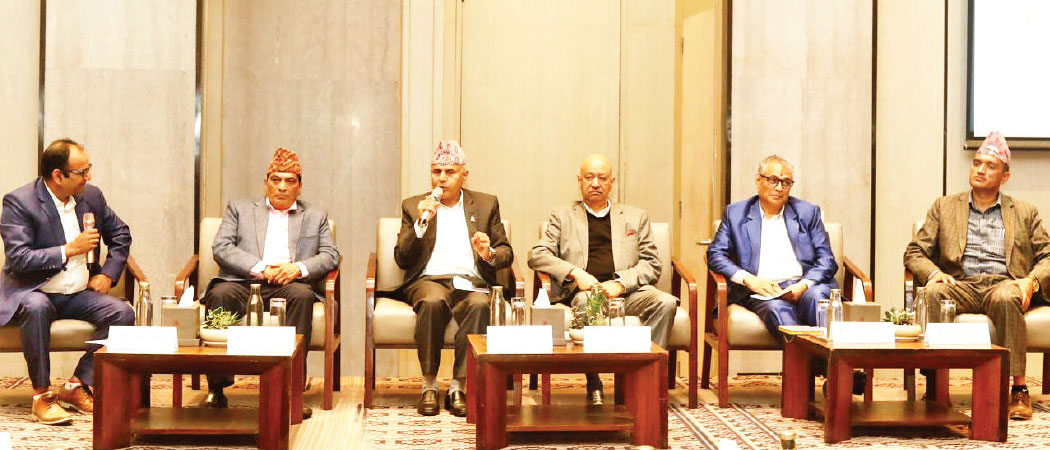
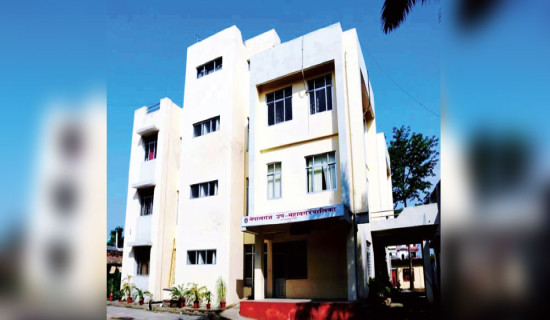
Photo: TRN NOC officials during a panel discussion in Kathmandu.

By A Staff Reporter,Kathmandu, Feb. 23: Stakeholders have said that the process of blending ethanol in petrol will benefit multiple sectors.
At a programme on 'Ethanol Blending Policy in Nepal: Opportunities and Challenges and Implementation Strategies' organised by the Society of Economic Journalists-Nepal (SEJON) on Sunday, representatives from both the government and private sector said they are ready to implement the initiative.
The long-discussed issue has moved toward implementation after the Cabinet recently approved the “Formation Order on Blending Ethanol in Petrol and Its Use, 2082.”
They said that this decision is expected to significantly contribute to the country’s fuel security, import substitution, and foreign currency reserves.
Around Rs. 6 billion to be saved annually
Minister for Industry, Commerce and Supplies Anil Kumar Sinha said that by blending 10 per cent ethanol in petroleum products, Nepal can reduce petroleum imports worth about Rs. 6 billion annually.
He said that the decision to blend ethanol in petrol has reached the implementation stage after long studies and discussions.
Studies on ethanol blending have been going on for two decades, he said, adding that the Formation Order on Blending Ethanol and Its Use 2082 has been approved and the policy is in the process of being published in the gazette and implemented.
Minister Sinha said that blending ethanol in petrol is an important step towards clean energy.
“Blending 10 per cent ethanol in petroleum products could reduce petrol imports by 130 million liters annually,” he said. “This will save nearly Rs. 6 billion in foreign currency each year. The money earned through hard work in Nepal will be saved, and that savings can help create a separate economic cycle at the local level.”
Stating that his first decision was to use local products as a first priority in government offices, Minister Sinha said that after the Election Commission adopted a policy requiring goods available locally to be purchased within local areas rather than being bought in Kathmandu and transported elsewhere, local economies became more dynamic.
Minister Sinha expressed confidence that agricultural production such as sugarcane for ethanol production will increase, agricultural land use will expand, and it will help make the domestic economy dynamic.
He admitted that there are challenges in areas such as establishment of new industries, industrial environment, security, employment, and raw material production.
Stating that there is a possibility of foreign investment in this sector, he stressed that although competition is necessary, it should not be unhealthy competition.
To make ethanol competitive, its price must be lower than petrol, and related procedures will be introduced soon, he added.
Secretary to the Office of the Prime Minister and Council of Ministers Govinda Prasad Karki said that the government has paved the way for blending up to 10 per cent ethanol in petrol and has moved forward with the formation order.
Karki clarified that this decision of the government has accelerated the work that has not been progressed for decades and that the government has moved forward with this policy because it has many positive aspects.
According to him, the formation order issued by the government has clarified issues such as raw materials for ethanol production, price determination mechanism, the role of Nepal Oil Corporation and the industry, and the responsibility of the quality measurement body.
Secretary Karki said that no energy source is 100 per cent beneficial and said that the government has taken steps after analysing all the positive and negative aspects of ethanol blending.
He also claimed that this decision was not inspired by any industry or political interest.
He expressed confidence that the process that started during the previous government was resolved by the elected government and will continue in the future as well.
Karki said that ethanol blending is like Nepal producing petrol using its own raw materials.
Managing Director of Nepal Oil Corporation Dr. Chandika Prasad Bhatta presented a working paper on blending ethanol in petrol on the basis of the approved formation order.
He said that raw materials for ethanol production could include molasses from sugar industries, napier grass, agricultural and forest biomass waste, straw, maize stalks, wheat residues, and yam-like tubers.
However, food grains used for human consumption will not be permitted for ethanol production under the directive. Industries producing ethanol will be required to sell it exclusively to Nepal Oil Corporation.
Price determination, procurement process
A committee will be formed under the coordination of the Secretary of the Ministry of Industry, Commerce and Supplies to determine the purchase price of ethanol.
The Council of Ministers will approve the price recommended by the committee.
Nepal Oil Corporation will formulate separate procurement regulations to manage the procurement process.
MD Bhatta said that it is believed that mixing ethanol with petrol reduces carbon emissions and will help keep the environment clean.
This is also expected to increase engine efficiency and reduce greenhouse gas emissions.
In addition, as ethanol is produced domestically, it will reduce the import of petrol, reducing the trade deficit and helping in foreign exchange reserves, he added.
However, there are some challenges. The main challenge is to make the price of ethanol competitive with petrol. As the current production of ethanol in Nepal is low, supplying it according to demand will be another challenge, said Bhatta.
For this, it is necessary to attract investors and increase production. In addition, it is equally important to spread public awareness about the use of ethanol and its benefits, Bhatta said.
President of Consumer Rights Investigation Forum Madhav Timalsina said that while this policy has the positive aspect of providing fair prices to sugarcane farmers and creating employment, consumer rights should be kept at the centre.
He said, "There should be no compromise on the quality of fuel after ethanol blending. What is the mechanism to maintain and monitor purity above 99.5 per cent? How does this affect vehicle mileage? Consumers should get clear answers to these questions."
Bed Prasad Kharel, chairman of Kiaan Chemical Industries Private Limited, said that although they were ready to invest in ethanol production, the project had not progressed for years due to bureaucratic delays and non-cooperation.
Shashikant Agrawal, President of the Nepal Sugar Manufacturers' Association, stated that although the formation order was issued 20 years late, the working procedure has yet to be issued.
He said that the private sector is still hesitant to invest and move the process forward due to the lack of a working procedure.