- Saturday, 2 May 2026

Japan Towards Defence Shift

Cashing in on her soaring public approval rating, Japan’s first female prime minister took the plunge into an early election and delivered a scintillating performance that has vastly strengthened her position within the Liberal Democratic Party (LDP) and with the general public. Prime Minister Sanae Takaichi has secured a landslide majority in the snap polls on February 8.
She is expected to push for conservative policies pertaining to vital issues, from security, immigration to the economy. Ever since being tossed into power as the leader of the long-ruling coalition led by her LDP, the thrust has been on making the Pacific country “strong and prosperous”, which could come into clash with Russia and China, with North Korea close behind.
Unlike in the previous popular chamber of parliament, when the party had to compulsorily share power with a partner, the LDP is now armed with a supermajority—316 seats in a 465-member house, or 70 per cent of the total capacity. The victory sends an unambiguous message as to what the voters’ key issues are. The opposition cannot overlook this factor when dealing with Takaichi, who is listed among the “most conservative” heads of government today.
LDP’s triumph was actually not much of a surprise in that opinion polls on election eve had indicated a big win for it. It now has a strength of 316 in the 465-member Diet, the lower house, in what registers as the highest ever single-party strength recorded since its inception in 1955. Of the total seats in the Diet, 289 are single-seat constituencies while 176 account for proportional representation.
In the previous house, LDP’s share of seats was 198. The previous record of 300 seats was held by the party headed by the country’s charismatic and popular Prime Minister Yasuhiro Nakasone in 1986. Takaichi performed even better in the latest electoral battle.
Now, for the action
Takaichi reads the massive mandate as voters’ green signal for going ahead with her economic agenda and tap Japan’s potential military power for what is explained as “defence capabilities”. The approach is bound to attract attention and consternation from two superpowers in the neighbourhood, which are at loggerheads with the No. 1 superpower, the United States, Japan’s indisputably closest ally. Russia and China will watch the government’s military moves closely.
The new opposition alliance, Komeito and the Constitutional Democratic Party of Japan, have to pick up the pieces together from the manner in which voters handed them such a drubbing. It will take time for them to first regain the ground lost before hoping for a credible chance to start making a noticeable dent in the ruling party.
With a new world order taking shape fast, Japan’s first female prime minister will be watched for how she gauges the existing political landscape at the global level, manages the ground reality, and moves ahead with the anticipated agenda.
Will she pursue a sink-or-swim policy like that of President Donald Trump of the United States, still the No. 1 military might and the largest economy, at a time when even Europe begins showing signs of unease with Washington’s drastic drive with unprecedented and uncomfortable measures? Trump praises Takaichi's anti-China stance. Japan, Australia, and South Korea are the most important American allies in the Asia-Pacific region. Takachi sees the alliance with the US as the cornerstone of her foreign policy.
At the ground level, however, the risk-strewn road ahead cannot be ignored. Several key players of the 27-member European Union are making overtures to Beijing for expanding trade and investment. Australia, too, has been taking a step forward in line with the US and two paces backwards to engage with the next top economy, overtaking the No. 1 slot the US enjoyed in the post-World War II decades.
Nakasone was a charismatic leader whose leadership in the 1986s steered the LDP through a strong phase with the public. Now, Takaichi is at the helm of state affairs at a time when the world order is taking a new course, with power shifts on a significant scale.
That Takaichi musters so strong public approval in her first 100 days in office—inheriting a coalition team to the recent supermajority—should go a long way in enabling her to pick and choose her agendas. Before completing her first 100 days in office, she announced the decision to opt for the snap polls. She wanted to capitalise on her public approval rating of 70 per cent with the hope of not having to be dependent on any coalition partner for crucial issues in a coalition cabinet.
‘Country first’
In her ride on the crest of such enviable public support so soon after inheriting a shaky government, Takachi will have to deliver on the economic front—a challenge that entails very careful planning. Competitions are stiffer, and barriers of various shades stare at trade, commerce, industry and investment, both domestic and foreign. These are times when traditionally close allies have sought to take courses sharply different from what they engaged in for many decades. “Country first” fever grips many a nation. “Friends” for exclusive trade and investment interests reads differently from yesterday’s interpretation and today’s expectations.
Japan’s pacifist Constitution envisages a defensive militarist policy after the disastrous militarism that led to its crushing defeat in World War II, rendering it a small military force, accepting the presence of American troops for its own security. South Korea, too, hosts and pays for American troops on its soil since the Korean War in the 1950s.
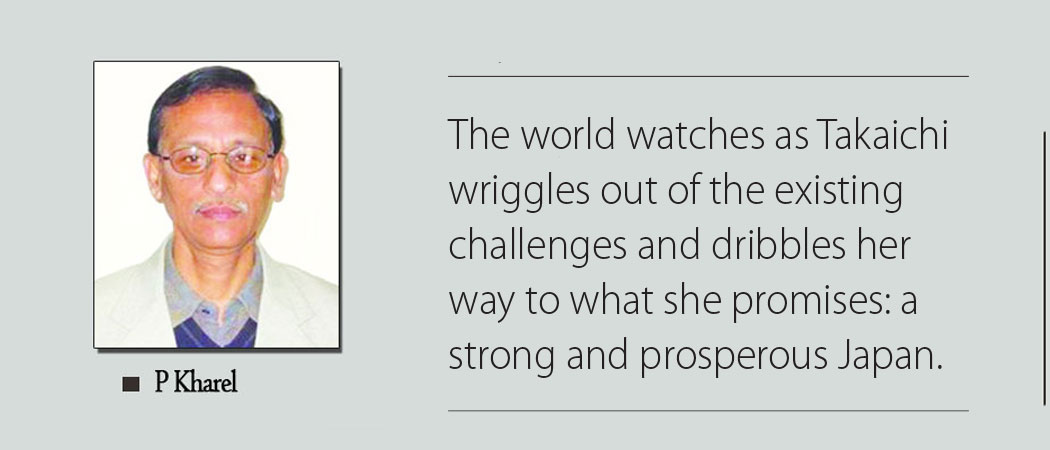
Russia holds on to the Kurile islands off Japan’s northern territory, of which Tokyo claims ownership, one of the reasons for the two countries not having yet signed a formal end to the Second World War. A landslide win means massive expectations and matching challenges. The world watches as Takaichi wriggles out of the existing challenges and dribbles her way to what she promises: a strong and prosperous Japan.
(Professor Kharel specialises in political communication.)


-square-thumb.jpg)