- Saturday, 2 May 2026

How false content lands in textbooks
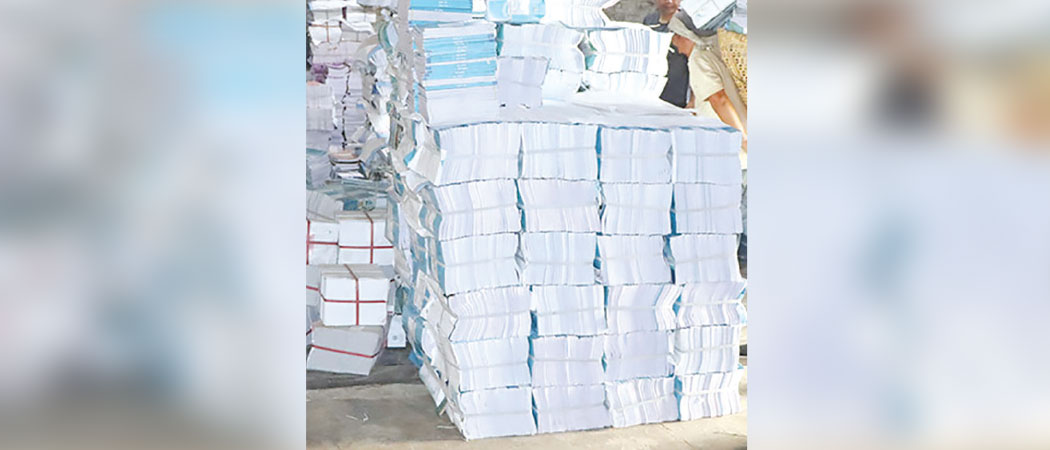

By Raman Paudel, Kathmandu, Feb. 19: Inappropriate and silly content appeared in the textbook of Grade 6 that “killing dogs is a good option” to prevent rabies.
This statement offended many teachers, parents, students, and animal rights activists, who argued that such terminology could normalise cruelty and violence among children.
Not only teachers but also many stakeholders criticized the content, claiming that it undermined trust in the entire textbook development process.
There was widespread criticism regarding how such material passed the editing process and made its way into classrooms.
The author and publisher were urged to immediately acknowledge the error and revise the text. Critics also argued that this incident raised serious questions about the textbook review process and quality control mechanisms.
A few months ago, a letter supposedly written by former American President Abraham Lincoln to the principal of his son’s school shocked many readers.
Despite a long preparation process, the textbook lesson titled “What Will My Son Have to Learn?” was found to be completely incorrect.
The letter published in the contextual lesson on page 243 of the Grade 10 Nepali textbook went viral on social media for months. The reason was that the letter was fabricated; Lincoln had never written such a letter, yet the Nepali curriculum had included it in the textbook.
After concerns were raised about the content, the Abraham Lincoln Presidential Library and Museum in the USA officially confirmed that Lincoln had never written such a letter.
This is just a representative incident. Every year, numerous mistakes and incorrect data are published in textbooks.
These are not just minor mistakes; fake information and incorrect data are repeatedly published in many books, despite the Curriculum Development Centre (CDC) following a lengthy process in developing textbooks.
This suggests that the CDC included content without conducting proper research, resulting in students getting exposed to misinformation.
Similarly, the textbook incorrectly stated that Lincoln’s assassination occurred on February 4, 1882 (he was assassination on April 14, 1965). Like the fabricated Lincoln letter and the incorrect date of his assassination, numerous mistakes and false information are published in textbooks every academic year.
Last year, the organizations Education in Every Home and the Self-Reliant Development Organisation (ESDO) exposed several errors in textbooks.
According to Homraj Acharya, Chairman of ESDO Nepal, during a one-year study, they contacted the Lincoln Presidential Library and Museum in Illinois, USA, to confirm the authenticity of the letter. The library later confirmed that it was inaccurate.
Many experts, including Acharya, argued that teaching such false history to students creates mistrust in the entire textbook publication process.
Raju Shrestha, Director at the Curriculum Development Centre (CDC), stated that the letter supposedly written by Abraham Lincoln has been removed from the textbook. “After the issue was raised, we revised the text in the book. However, the audio version has remained in the listening chapter,” Shrestha said.
Speaking to The Rising Nepal, Director Shrestha added that the CDC will hold discussions with an expert team regarding the issue.
“We will conduct a meeting with the expert team very soon and will further investigate the source of the text or remove the audio content from the listening chapter as well,” Shrestha said.
According to Yuva Raj Paudel, Director General of the Curriculum Development Centre, a textbook selection committee comprising experts is formed every academic year to select appropriate books for students.
Speaking with The Rising Nepal, DG Paudel stated that the CDC corrects mistakes pointed out by readers and other concerned stakeholders.
“There are errors in the content, including mistakes in the names of creators of songs and poems. Recently, similar errors occurred in textbooks for Grades 9 and 10. However, after receiving complaints from concerned individuals, we corrected them,” DG Paudel stated.
DG Paudel added that they cannot identify who specifically made the errors. It is also difficult to hold any one person accountable, as textbooks are prepared through a lengthy and multilayered process.
“For example, our Nepali language expert team reviews the Nepali subject textbook, while various expert members finalize the English textbook. Despite this multilayered process, mistakes are repeated. However, after receiving complaints, we revise the content,” Paudel said.
According to DG Paudel, there were recent complaints pointing out several mistakes in the Grade 9 Nepali textbook and the Grade 10 Social Studies textbook. The CDC corrected the content afterward.
Dr. Bidyanath Koirala told The Rising Nepal that it is essential to conduct independent reviews, rechecks, and thorough proofreading before sending textbooks to print.
Dr. Koirala also argued that the entire textbook preparation process is problematic. “Almost all textbooks prepared for schools lack proper fact-checking and cross-verification after writing, which creates mistrust among readers,” he said.
Bias and unfairness in book selection
Several stakeholders, including rights activists, have argued that many school textbooks contain not only false data but also bias and discrimination against particular castes and communities.
For example, for several years, textbooks at different grade levels have included content about Mother Teresa and Junko Tabei, glorifying them rather than highlighting iconic Nepali women. Additionally, the religious mission of Mother Teresa is not fully discussed in the textbooks.
Textbooks have also been accused of presenting biased narratives about Nepali historical figures such as Yogmaya and Sita.
Similarly, many textbooks have been criticized annually for being discriminatory toward Dalit and other marginalized communities. According to rights activists, stories and other content published in textbooks perpetuate discrimination.
A Grade 12 Social Studies textbook written by a reputed Tribhuvan University professor was widely criticized for discriminatory content against the Dalit community.
Independent writers and activists pointed out that a paragraph in the textbook written by Professor Balaram Adhikari mentioned that in Nepal, Brahmins, like Dalits, face cultural issues when they eat pork and buffalo meat.
After concerns were raised, the CDC revised the content in the following year’s edition. However, the professor was not held accountable for including such discriminatory text.
Dr. Sachin Ghimire, an independent writer and rights activist, argued that the CDC and Tribhuvan University have even rewarded individuals who have spread discriminatory content through textbooks.
“Authors themselves must be serious and sensitive. But the irony is that when such writers become biased, regulatory bodies remain silent,” Dr. Ghimire said.
-original-thumb.jpg)