- Saturday, 2 May 2026

Elections must be driven by policies, principles: Bhandari
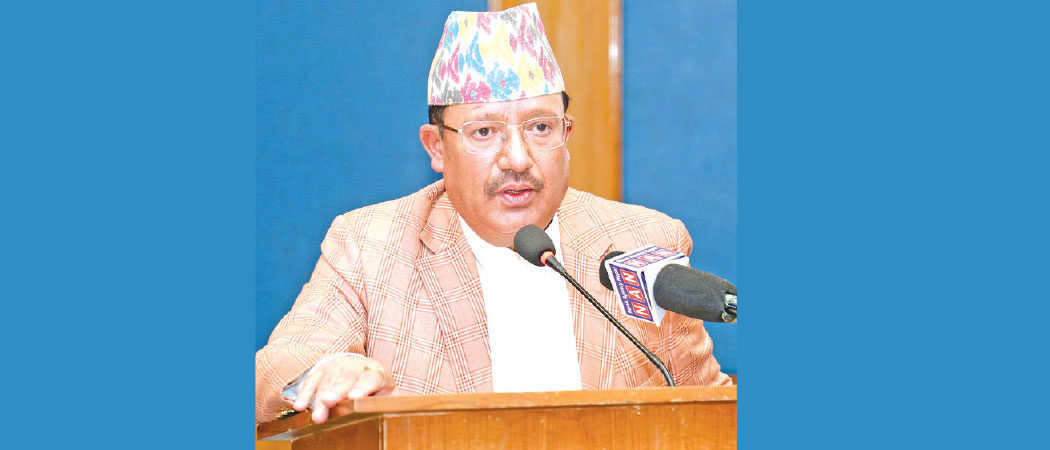

By A Staff Reporter,Kathmandu, Feb. 17: Acting Chief Election Commissioner Ram Prasad Bhandari has said that elections must be driven by policies and principles rather than money, warning that excessive campaign spending weakens fairness, integrity and good governance.
Speaking at an interaction with chief executive officers and heads of various banks and financial institutions on the use of bank accounts by House of Representatives candidates and measures to ensure transparency in election spending, Bhandari said a money-dominated election cannot uphold ethical standards and would ultimately undermine governance.
“If elections are driven by wealth rather than ideas and programmes, they cannot remain clean or credible,” he said.
The Election Commission has set expenditure ceilings for candidates and political parties, with limits varying by constituency based on geography, voter outreach requirements and logistical considerations such as travel and accommodation, he said.
He informed that these limits were determined on scientific grounds after analysing the size and terrain of constituencies and the costs involved in meeting voters.
He reiterated that all election-related spending must be conducted through bank accounts to ensure transparency and prevent the use of undeclared funds.
“Spending outside the banking channel increases the risk of black money influencing the election,” he said, adding that the code of conduct was formulated in consultation with political parties.
Responding to concerns that financially weaker candidates may struggle to open dedicated bank accounts, he maintained that equal and transparent financial practices were essential to maintaining a level-playing field.
Reflecting on past elections, Bhandari stated that campaign spending has increased significantly over the decades. He recalled earlier elections where candidates with limited resources relied on public support rather than personal wealth.
“In earlier times, some candidates won on the strength of their ideas and grassroots backing, not on lavish spending,” he said. “Today, the commercialisation of politics risks distorting democratic competition.”
He warned that if excessive spending continued unchecked, it could foster inequality in political participation and erode public trust in the electoral system. The Commission has repeatedly cautioned that candidates exceeding the legal spending limit could face disqualification.
Bhandari also urged political leaders to discourage extravagant campaigning and to promote clean, disciplined and dignified elections. “Fair competition must not be replaced by financial muscle,” he said. “Only a restrained and transparent campaign environment can produce representatives capable of delivering good governance.”
On women’s representation, Acting Chief Election Commissioner Bhandari acknowledged constitutional provisions requiring at least 33 per cent participation of women. However, he said that while parties often advocate greater inclusion publicly, implementation within party structures remains inconsistent.
He also encouraged political parties to ensure meaningful participation of women not only through proportional lists but also in direct electoral contests. “True inclusion must go beyond formal compliance and reflect genuine commitment,” he said.
Speaking at the programme, EC’s Secretary Krishna Bahadur Raut said that periodic elections should deliver a fresh mandate and help form a stable, accountable government capable of ensuring peace, good governance and economic prosperity.
Stating that clean, free and credible elections are a shared responsibility of the Commission, political parties and candidates, Raut said the Commission has made it mandatory for all House of Representatives candidates and parties to open dedicated bank accounts for campaign transactions and conduct all election-related expenses through that account.
The provision, introduced under existing electoral laws and procedures, requires all election-related income and expenditure to be channelled through banks, with donations above Rs. 25,000 accepted only via financial institutions and properly recorded.
“If cash donations are received from Nepali citizens or organised institutions as financial support, a receipt must be issued and the amount deposited into the designated campaign account,” he said.
Candidates are also legally required to maintain detailed expenditure records and bills and submit them to the relevant election offices and the Commission within the prescribed format and timeframe, he said, adding, “These measures aim to strengthen transparency, financial discipline and public trust in the electoral process.”
Officials of the EC and chief executive officers and heads of various banks and financial institutions were present at the event.
-original-thumb.jpg)