- Sunday, 3 May 2026

Federalism in form, dependency in practice
Provinces still struggle to stand on their own fiscal feet
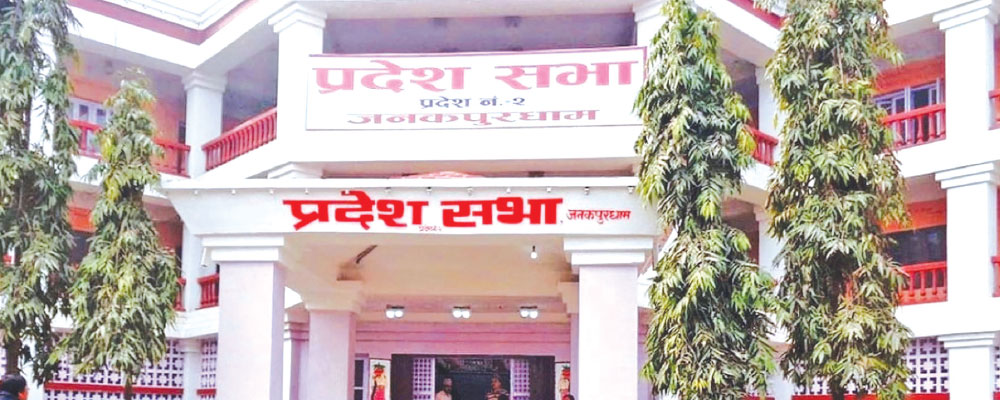

Kathmandu, Jan. 4: In the past eight years since their creation, the provinces have failed to demonstrate their interest or innovation in finding new sources of internal revenue and expand their tax base. Reliance on the traditional sources and weak revenue administration have miserably restrained the provinces from strengthening their economy.
Currently, provinces are banking on transportation, agriculture, natural resources like construction materials and house-rent for their revenue while experts say that agriculture is not and should not be a major source of revenue. As it is in the phase of development and directly connected with the livelihood of many, it should rather be facilitated, except the commercial farming and agro-processing industries.
However, the provincial governments couldn’t effectively tax the construction material industries such as collecting and distributing sand, gravel and stones. “All the provinces are following a similar traditional trend. All of them lack innovative approach and long-term strategies for revenue growth,” said Keshav Raj Dhakal, Spokesperson of the National Natural Resources and Fiscal Commission (NNRFC).
A trend analysis of the Provincial Revenue (2018/19-2025/26) by a team led by Dr. Khim Lal Devkota – a Constitutional Assembly Member and expert in federalism – for the Federalism and Localisation Centre (FLC), found that agriculture’s contribution is the lowest in the local tax revenue of the provinces.
“Excluding revenue sharing and royalties, motor vehicle tax contributes the largest share to the country’s local tax revenue, with 32.83 per cent. This is followed by land and property registration fees, which account for 31.21 per cent. The contribution of business registration fees stands at 18 per cent,” concluded the report.
Spending priority, earnings unheeded
While the governments at all levels required to follow a mandatory rolling three-year budget plan – the Medium-Term Expenditure Framework (MTEF) which requires the resource forecasts and performance targets along with detailed expenditure strategies, the sub-national governments are more focused on expenditure. As the plans and budgets have been the tools to accommodate the political and development commitments of the political leaders, projects are included in the budget at a whim of a leader or the ruling political party.
The NPC and the NNRFC have observed that revenue mobilisation plan has rarely been the priority of the provincial governments, even their budgets are largely dependent on federal grants and revenue sharing.
Former Member of the National Planing Commission (NPC) Min Bahadur Shahi said that provincial governments failed to exercise the rights stipulated for them. “At the least, they could effectively collect revenue from public commons like forests, and river and mine-based construction materials,” he said.
According to Dhakal, most of the interactions with the federal government or planning agencies are centred on grant and revenue distribution. Tax expansion plan, revenue growth and reforms generally don’t get priority in such meetings.
According to the Schedule 6 of the Constitution of Nepal 2015, land and property registration fees, motor vehicle tax, entertainment tax, advertisement tax, tourism tax, tax on agricultural income, service charges and fees, penalties and fines fall under the rights of the provinces.
Need for risk-takers
The autonomy of provinces has remained limited to the Constitution and policy documents as they look up to the federal government for financial support and development execution. They seem to be shying away from exercising their autonomy in critical areas such as tax. This is because no leaders want to take a risk of displeasing their voters. The house-rent tax is a case in this regard.
For example, Karnali projects to raise just Rs. 1.37 billion in revenue in the current Fiscal Year 2025/26 from internal sources against its annual budget of Rs. 32.99 billion. The province raised Rs. 100 million in the first quarter of this fiscal.
Likewise, Sudurpaschim estimates to manage Rs. 1.65 billion from internal sources for its budget of Rs. 33.47 billion. Koshi and Gandaki aim to raise Rs. 5.5 billion and Rs. 5.46 billion in revenue, Lumbini Rs. 7.78 billion, Madhes Rs. 9.5 billion and Bagmati Rs. 28.8 billion. Average share of internal revenue to the provincial budget ranges from about 5 per cent to 20 per cent with Bagmati being an exception.
According to FLC’s analysis, internal revenue constitutes about 20 per cent share in the total income of the provinces. Including the revenue sharing, its share rises to 54.58, and share of federal grants is 45.42 per cent.
There are not only failures. Bagmati has collected 31.44 per cent of its annual revenue in the first five months of the current FY 2025/26 while the federal government’s achievement stands at about 27 per cent. Bagmati collected Rs. 1.50 billion in internal revenue against the annual target of Rs. 4.77 billion. But overall receipt of the province in the five months is 24 per cent.
Discouraging scorecard
All seven provinces in Nepal have performed poorly in the annual evaluation by the NNFRC in 2023/24, with only Koshi scoring above the 40 – which is pass mark. The remaining six failed, with Madhes Province recording the lowest score of 20.5, Karnali 25.9, Sudurpaschim 26.1, Lumbini 34.4, Bagmati 36.1 and Gandaki 38.5.
The assessment, based on 19 fiscal, budgetary and governance indicators, found the provincial average score to be 32.25. In contrast, local governments performed better, with most scoring above 50.
According to Dr. Devkota, delay in the formulation of basic legal instruments such as Civil Service Act in provinces has also serious repercussions on their performances. He suggested the CMs to remain united to exert legitimate pressure to the federal government and their respective party committees. To the least, they should learn from the local bodies, he said.
The federal government exhibited negligence in formulating the umbrella frameworks to facilitate the sub-national governments. The latter designed the laws related to civil servants and police personnel but in absence of the umbrella legal instruments from the federal government, they remained idle. The intergovernmental council has also turned into a mechanism that only conducts meetings but achieves no progress.
While speaking at the establishment day of the PAs in 2024, former CM of Karnali, Raj Kumar Sharma, aptly defined the situation of freedom to the provinces, “How can you swim in deep water when you are thrown into it with your hands and legs tied. I don’t know if saying this is appropriate, but the situation has been the same for us.”
However, although the provincial leaders agree that their failure is partially caused by the federal government’s failure in building the required legal and policy framework in time, they never get united for the same cause.
41 governments in eight years
In a sheer display of political instability in the federal republic, the seven provinces got 41 chief ministers in the past eight years.
Lal Babu Raut of Madhes Province has remained so far the only Chief Minister to complete his full term at office. But the same province turned into political battleground in its second Provincial Assembly (PA) with five CMs from five different parties in just two-and-a-half years. Jitendra Prasad Sonal of Loktantrik Samajwadi Party and Saroj Yadav of CPN-UML served for 24 days each as Madhes CM. Meanwhile, Province Chief Sumitra Subedi Bhandari lost her post after appointing Saroj Yadav the CM and administering the oath of office at a hotel in Bardibas.
The provinces were created on September 20, 2015, while provincial assemblies were formed after the elections on November 26 and December 7, 2017. The first provincial government was formed in Karnali on February 15, 2018.
In general overview, Karnali is comparatively more stable than the other provinces with four CMs so far with two each – Mahendra Bahadur Shahi and Jeevan Bahadur Shahi, and Raj Kumar Sharma and Yam Lal Kandel – serving during the first and second PAs.
While Gandaki, Lumbini and Bagmati witnessed six CMs each in the past eight years, Koshi went through the worst experience in political stability with eight CMs – five in the last two-and-a-half years. Currently, Hikmat Kumar Karki is serving as the CM for the third time during this PA along.
Likewise, Sudurpaschim Province got five CMs.
Lack of political autonomy
It is no secret that the provincial governments and political leaders make their moves at the signal of federal government and their party central committees. “Provincial committees of the political parties are not autonomous while senior and competent leaders do not want to go down to the provinces. As a result, governments there have become an appendage of the central government,” said Dr. Devkota.
To their worst, this is happening at a mutual consent of the political party, federal government and the provincial governments.
According to Dr. Devkota, Madhes led by Lal Babu Raut, Gandaki led by Prithvi Subba Gurung and Lumbini led by Shankar Pokhrel had a courage to resist the pressure from the federal government.
Within a year, Gurung called a meeting of the CMs in Pokhara and exhibited a unity among the provincial governments. A 29-point federal legal roadmap was also developed during that period. The centre had a majority government led by powerful Nepal Communist Party (NCP) that, in the beginning, assured a political stability which also sent a similar message to the provinces, said Dr. Devkota. He added that while the first inter-state council was called after 40 years in India, it was convened in a year after the formation of the first provincial governments.
While Madhes was vocal against the federal government for various other reasons and fought for its cause, Gurung and Pokhrel fought against their own party leadership to make their way through to institutionalise federalism.
But during the second Provincial Assembly, senior leaders joined the batch of leaders at the federal level which turned the provincial politics more immature. They are more centre-oriented and pay less attention to the public issues and political stability. As the governments formed and fell every now and then, provinces miserably failed in effective development planning, resource mobilisaion and revenue collection. This further detached them from the masses.
An official at the NPC said that the situation has deteriorated to such an extent that chief ministers are meeting even the section officers at the NPC and Ministry of Finance to get their projects included in the federal budget or get financial assurance for provincial projects.
Dancing to the tunes of centre
Later, the number of ministries at the provinces was increased multiple times to adjust the leaders from the ruling coalition which mostly happened at the direction of the federal government and central committees of the parties participating in the coalition.
“A new culture has been developed – the provinces seek centre’s opinion and the latter directs the former,” said Dr. Devkota.
This political culture is rooted so deep that the provinces couldn’t function independently even when the country has a civilian government and large political parties are hesitant to exercise their political muscle.
Shahi, who is also the founder chairperson of Karnali Integrated Rural Development and Research Centre and General Secretary of the Former Planners Forum Nepal, said that the senior leaders discourage the youth leaders and federal government discourages the provinces on the pretext of lacking ‘capacity’.
“We have developed a system that bars the sub-national governments from being progressive. Entire system is process-oriented and no one cares for the outcome and its impact on people,” he said.
Shahi maintained that Kathmandu takes decision about the ministers and alliance in the provinces. The provincial committees of the parties neither have power nor desire to intervene in such affairs.
According to Dr. Devkota, the power of the government was devolved and restructured in the federal model but the political parties didn’t restructure them according to the newly evolved system.

-square-thumb.jpg)