- Sunday, 3 May 2026

TRN: Architect Of My Career In Diplomacy
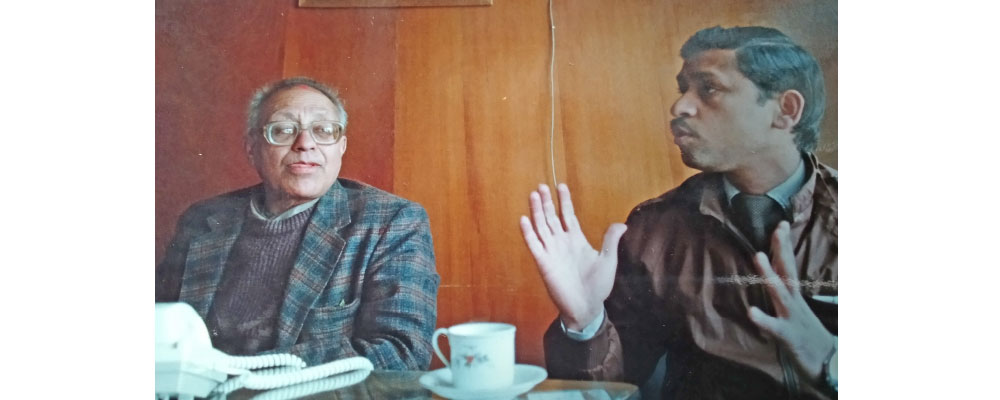
First Editor-in-Chief Barun Shumsher Rana and former Editor-in-Chief P. Kharel are seen interacting in this file photo.
 Madan Kumar Bhattarai
Madan Kumar Bhattarai
Madan Kumar Bhattarai
It is a matter of extreme satisfaction and pride that Nepal's premier English broadsheet daily, The Rising Nepal, has completed sixty years of publication today, reaching maturity in terms of presenting both news and views. The red letter day associated with the anniversary is a milestone, both for summing up accomplishments and stocktaking the debit aspects of the newspaper.
While there is an impression that the daily has not received its legitimate due from stakeholders in the post-1990 era, it is operating in an ambience of the rule of law, respect for democracy, human rights, freedom of expression, and commitment to basic values of journalism, despite being an organ of the government.
One major problem is that while the daily attracts the tag of mouthpiece of the establishment, the possible leverage in terms of the advantage of government advertisement that it, along with sister publication, Gorkhapatra, enjoyed for a long time, has constantly eroded, posing severe strains on the financial position of the Gorkhapatra Sansthan as a whole.
Association
Our association goes back to 1975, when a wonderful gentleman, Barun Shumsher Rana, whose son Ajay Rana toed his father's line and became Editor-in-Chief later, was the head of the English newspaper as Editor, as the nomenclature of Chief Editor had not come into practice within Gorkhapatra Sansthan.
It so happened that within a few months, Barun Shumsher, better known as Madhav Raja, in popular parlance, was appointed Consulting Editor, and one of his close colleagues, Mana Ranjan Josse (nickname Billy), took over as the new Editor with whom I was destined to spend more than two years in close association. He also had a stint with the United Nations as our Deputy Permanent Representative.
It is possibly a Nepali culture that when someone is to be replaced or sent to hibernation, the words, consultant and adviser, are frequently in vogue as they are neither consulted nor sought advice. Even those with other than the best of records or even a questionable integrity are found appointed advisers despite strong reservations on the part of the government.
Barun Shumsher had also served as Editor earlier and also taught at the newly established Tribhuvan University for some time. He had close liaisons with people like Prime Ministers, Dr. Tulsi Giri, Surya Bahadur Thapa and Kirti Nidhi Bista, Rishikesh Shaha and Professor Yadunath Khanal.
The Rising Nepal attracted noted talents like Bharat Dutta Koirala, who was appointed Editor of the Gorkhapatra Daily after some time, Aditya Man Shrestha, Shyam KC, Ratna Kaji Tuladhar, Krishna Bhakta Shrestha, Lal Dhoj Deosa Rai, Mohan Bir Singh Bajracharya, who soon shifted to the national news agency (Rastriya Sambad Samiti later with a new nomenclature, Rasstriya Samachar Samiti, RSS), Gautam Prasad Manandhar, and Parshu Ram Kharel, only to name a few. Gokul Pokhrel and Mukunda Parajuli from Gorkhapatra side used to regularly contribute to the daily.
There was also a system of publishing articles under pseudonyms as and when the government or editorial management thought it appropriate. There were also occasions when the importance of particular news and interviews was synchronised in such a manner that editorials on the same topical subject were also included on the same day.
One such instance, quite earlier, with a telling impact on Nepal's foreign policy was Prime Minister Kirtinidhi Bista's interview on June 25, 1969. One stakeholder attributed the language of the interview to no other than Professor Yadunath Khanal, who was in his second term as Foreign Secretary after completing his assignment in New Delhi as Ambassador.
I joined The Rising Nepal along with two noted Anglophones, Shrish Shumsher and Poonam Thapa, both being products of elite Christian schools of the Kathmandu Valley. Coming from a humble rural background and studying at local schools, I was very conscious of my weak spots as far as the English language was concerned. Though I had a relatively short stint (1975-78), there is absolutely no doubt that The Rising Nepal and its illustrious family members taught me so many things, including the use and usage of English that was to serve a great deal in my diplomatic life and especially in tactfully dealing with journalists.
That the Ministry of Foreign Affairs was inclined to appoint me the Spokesperson of the Ministry of Foreign Affairs as many as four times, as a few diplomats relished the job even once, proves volumes for the contributions the daily made in shaping my future career.
Over the years, I have found some of the staunch supporters of The Rising Nepal, with some being its regular columnists in earlier days. People of erudition like Professor Ram Prasad Manandhar and Professor Yadunath Khanal, both assuming key positions as Ambassador and Foreign Secretary, not only read the daily with all seriousness but also contributed to its quality with their valuable articles.
Visiting intellectuals
The other scholar to write for the newspaper was Rishikesh Shaha. At the same time, some people did not have as favourable an opinion about the daily. Professor Sardar Narendra Mani Dikshit, the first Foreign Secretary and a veteran scholar, told me several times that he did not relish going through the newspaper basically due to its title. In Dikshit's reading, the article, The, in our paper is grammatically incorrect and unnecessary.
When we served, The Rising Nepal used to also attract a lot of intellectuals who used to come to take a brief of the events and occasions, as the Gorkhapatra Sansthan was the only organisation to publish two broadsheets and all other publications were mere tabloids.
Those frequenting the office included Dr. Dilli Raman Regmi, Tirtha Raj Tuladhar, Renu Lal Singh, Chiran Shumsher Thapa, Daman Raj Tuladhar, Kumar Khadga Bikram Shah, Manindra Raj Shrestha, Bhola Bikram Rana, Gopal Das Shrestha, Ram Pradhan, and Dr. Pinaki Prasad Acharya, benefiting newcomers like us.
As I attach significance to its immense contributions, I wish The Rising Nepal a great future and continued service to the growth of English journalism in the country.
(The author is a former foreign secretary, ambassador and writer.)