- Sunday, 3 May 2026

Corruption crackdown will continue alongside poll preparations: PM Karki
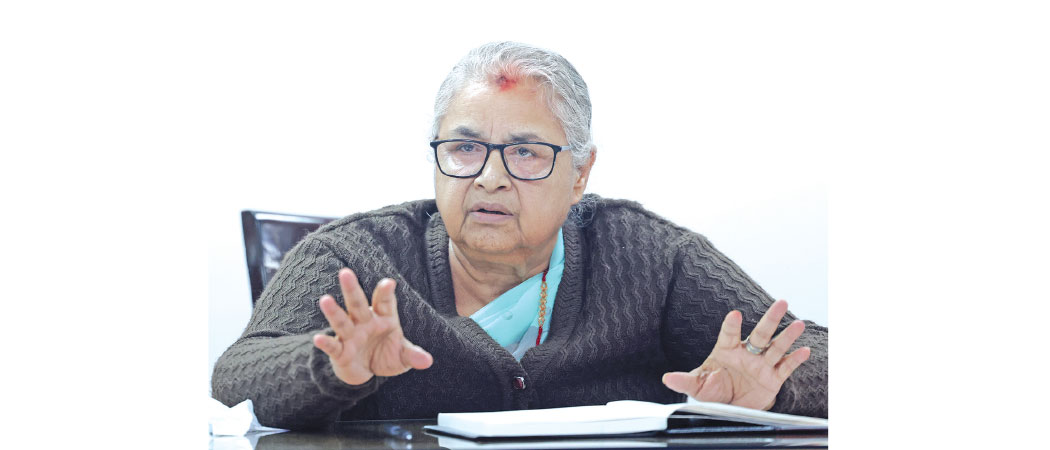

By A Staff Reporter,Kathmandu, Dec. 4: Prime Minister Sushila Karki has assured that the government’s crackdown on corruption would not stop and would proceed alongside preparations for the upcoming elections.
During a meeting with a delegation led by Sudan Kiranti, chairman of newly formed Pragatisheel Loktantrik Party, at Singha Durbar on Wednesday, the Prime Minister clarified that the government is committed to addressing corruption in line with the spirit of the youth-led Gen Z movement.
She said that the government’s role is to work and deliver, without making excuses. “We have come to work. We are doing what we can. As per the demands of the youth-led movement that comes with the cost of their sacrifices, we must work in alignment with that spirit. We will not be deterred by any excuses,” she stated.
The Prime Minister also explained that, alongside election preparations, efforts to establish good governance are underway. She further clarified that additional commissions to investigate corruption are not necessary, as existing state mechanisms are already equipped to handle such cases.
“We have the Commission for the Investigation of Abuse of Authority (CIAA), the Department of Money Laundering Investigation, and the Central Bureau of Investigation,” she added.
“In the past, these bodies might not have functioned effectively, possibly due to political interference. But we will not exert any pressure. These bodies must operate with full autonomy and work efficiently,” the Prime Minister said.
“Creating parallel structures will not necessarily yield better results. The key now is to provide an environment where these bodies can function properly,” she added.
The Prime Minister also acknowledged that the CIAA is accelerating its work in investigating major corruption cases, with several prominent individuals now under scrutiny.
“You must have seen news reports about significant corruption cases and influential figures being investigated by the concerned authorities,” she highlighted.
While pointing out the negative impact of extreme politicisation across all sectors of society, she stated that such an environment has hindered the country’s progress.
She cited examples of corruption in sectors like agriculture, where political interference has prevented farmers from accessing necessities like fertiliser, while political leaders have all the luxuries.
“Politics has also crept into the name of farmers. Farmers cannot even get fertiliser, but the farmer’s leaders are traveling abroad and domestically. They are becoming ministers and MPs. The activists are being given positions here and there,” the Prime Minister said, adding, “The subsidised fertiliser, seeds, and loans are all being monopolised by them.”
“The same thing is happening with people in other businesses as well. Instead of focusing on their own profession or business, a tendency to engage in politics has developed. Corruption is deeply rooted here too. In such an environment, how can the country progress?” she questioned.
Prime Minister Karki stressed that the youth have raised their voices to end such practices and emphasised the importance of sending young people to parliament to institutionalise change.
The delegation had demanded that the voice of Gen Z be addressed promptly.
The delegation led by Kiranti also raised concerns over the ongoing treatment of injured, who were involved in the Gen Z movement.
They also drew the government’s attention towards the issue that while the police were arresting the protesters, some political parties had openly deployed goons.
They warned that if any party openly organised and engaged in gangster-like activities, Gen Z might be forced to resist in return.
The meeting also highlighted the increasing polarisation of political and social spheres in Nepal and the need for strong, independent institutions to counter corruption and ensure sustainable progress.