- Saturday, 6 June 2026

Gateway Embodies Essence Of Nation
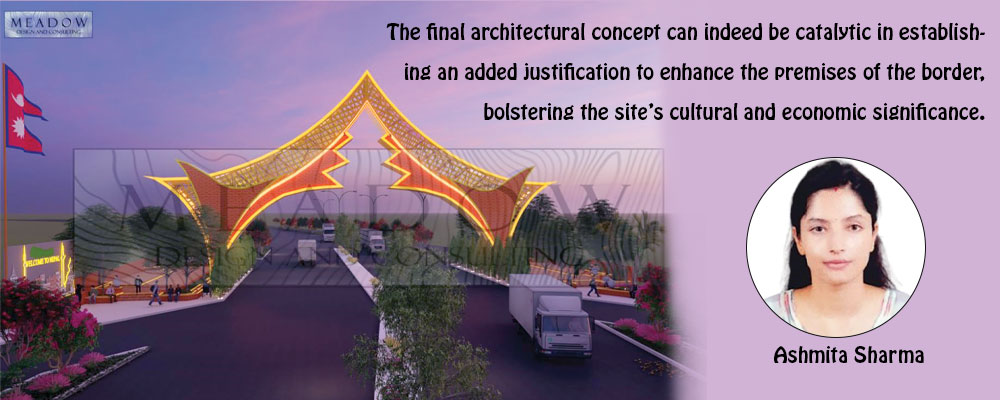
A portal standing tall and proud at the edge of a country is more than just a physical structure. It adds an element of story as it welcomes and reflects the spirit of where one is headed. The presence of an entrance/exit gate in an inland nation like Nepal has greater significance. Covering around 1751 kilometers, Nepal is bordered by India to the east, west and south, with the busiest crossings in the Tarai belt. Furthermore, the Belahiya-Sunauli border is the most popular among the five crossings.
As per the Department of Customs (2019/20), the Immigration Office at Belahiya is present to efficiently cater to the two busiest border crossings in Nepal, with a 16.61 per cent share of total import value. Bustling with all sorts of vehicles and a multitude of pedestrians, this area has major concerns relating to the existing Belahiya border gate and its capacity to accommodate the rapidly growing flow. Additionally, the unequal setback — 40 metres from Nepal’s gate compared to 12 metres from India’s — further highlighted the imbalance.
Landscape architect
There is also congestion and a lack of proper pedestrian walkway, which led to the planning of 6- 6-lane road expansion after the demolition of the dilapidated gate. Thus, in the urgency of such a state of affairs, a new welcome gate at the entrance of Nepal was sought after. Landscape architect and the owner of “Meadow Design and Consulting”, Amrita Poudel, is the mastermind behind the comprehensive design of the present entry gate. With over a decade of experience in the field, she shared some insights on her design inspirations for the gate, which is now on the verge of completion.
As we discussed the project from inception, she highlighted that the emphasis was on making the gateway a reflection of what Nepal is and truly influence the visitor’s experience. Non-nationals were asked what they think of when Nepal is mentioned. The answer would definitely be Pashupatinath, mountains, stupas, namaste, dhaka topi and more. As we break down the elements of the structure, it has indeed succeeded in incorporating most of them. The design is a contemporary interpretation of traditional Nepali architecture, which has been developed in the concept of mass and void.
Nepal’s ancient architecture is mostly monumental, which is mirrored in our temples, stupas, and monasteries. The “void” section of the gate comprises the architectural skyline, i.e., outline of pagoda-style Pashupatinath adjoining the dome structure of Swayambhu Nath Stupa. A home to Sagarmatha (Mt Everest), the world's highest peak, Nepal also hosts eight tallest peaks out of fourteen. The concept ideation has also embraced this feature of Nepal in the “mass” section of the design.
The concept of mass and void assembled an ideal completion of the inner and outer layout of the gate structure. To the sides, two winged structures are extended, representing the authentic Nepali attire dhaka topi. The complete design concept has therefore announced “Nepal” in the most subtle yet translucent manner. A particular segment of the structure is proposed to have a “fair face” brick wall, i.e., brick exposed finish, one of the finest traditional Nepali elements since the time of Gautam Buddha, which is a major architectural feature of Lumbini.
The gate, which measures 774 meters in width and 544.45 meters in height, is proposed as a steel structure. Approximately 200 loaded trucks traverse the border every day. Therefore, the architect has framed the design of a steel structure that is both low mass and highly ductile. To combat the wind load in an elevated structure, the composition consists of a steel truss that has ample space to maneuver potential wind forces. The design visualisation has come to life with a practical and sustainable structural integrity.
The present design has also incorporated a proper pedestrian walkway and resting place with added space for travelers’ luggage. The landscaping around the assembly incorporates both functionality and visual harmony, with softscape and hardscape elements arranged in proper scale and proportion. A digital board is projected to the south, which states, “Welcome to Nepal.” It also includes the major attractions of Nepal on the wall display.
Transition point on the south, the longest border of all, this border has more prominence as it has an added value beyond the “open border” established by the 1950 Treaty of Peace and Friendship between Nepal and India. This threshold is highly frequented due to its proximity to the UNESCO World Heritage site and a major attraction in Nepal, Lumbini, only 28 kilometres from the border. Further, the presence of Gautam Buddha International Airport (GBIA) in Bhairahawa caters to the influx of Indian and other tourists via this entry point.
Boosting tourism
Bhairahawa is also on the verge of expansion as an industrial hub in Nepal, especially known for its Special Economic Zone (SEZ) and industrial corridors. It is home to dynamic sectors of industry and has emerged as a site for increased investments. This area certainly has an encouraging potential to enhance domestic and international tourism due to significant political, cultural, economic as well as social factors. This adds up to the relevance of a more structured and bona fide welcome gate at this transit.
The gate proposed to be inaugurated shortly is a paradigm of functional aesthetics. On top of that, it manifests all three major styles of Nepal’s architectural history- pagoda, stupa, and shikhara.
The project initiated by Siddhartha Municipality is an ideal illustration of how Nepali architecture has evolved. An increased flow of local and international tourists can be anticipated due to the addition of this masterpiece on Nepal’s side of the Border. The final architectural concept can indeed be catalytic in establishing an added justification to enhance the premises of the border, bolstering the site’s cultural and economic significance.
(The author is a civil engineer.)
-original-thumb.jpg)

-square-thumb.jpg)