- Saturday, 6 June 2026

Mesmerising Mustang

Sugam Gautam
Enigmatic, majestic, and dreamlike. That’s how everyone who has visited Mustang describes this place. Taking comfort into consideration, I, along with my friends, decided to book a Scorpio jeep, which would ferry us all the way to Upper Mustang. Everyone was excited about the trip – and why wouldn’t they? Travellers across the nation often place Mustang and its beauty above other places. People even go as far as to say that a Nepali who doesn’t visit Mustang in their lifetime isn’t a ‘real Nepali’.
“Are we going to hell or a holy land of Muktinath? Look at the roads!” one of my friends sniggered and pointed at the peeling asphalt. Once we entered the Myagdi district, we were all disappointed owing to the poorly managed road. The road, which was perhaps black-topped initially, spewed clouds of dust once vehicles plied it. When we were on the roads there, we didn’t open our windows even once. We had to wait for around 10 minutes at Kavre Bhir, a landslide-prone area, due to the narrow lane and bustling traffic.
On seeing the treacherous road, I felt stupid about my decision to visit Mustang. Thankfully, it didn’t rain that day or the day before. To be on the safe side, one shouldn’t be visiting Mustang during the monsoon season. Also, it wouldn’t be a prudent move to travel Mustang by two-wheeler. If you choose two-wheeler, it’s more than certain that the dust will make you sick even before you reach the destination. To dodge the dust, as a precautionary move, one should not leave their masks and glasses behind.
As our jeep trundled up the bumpy road, I wondered how tourism in Mustang would flourish more if the government and the stakeholders related to tourism exerted force on improving the road conditions. Another alternative to reach Mustang is via an airline from Pokhara, but not every tourist can afford the expensive airfare. To attract tourists – both poor and affluent – improving the road conditions in Myagdi is a must, and if done so, Mustang will see a surge in the number of tourists. To our surprise, roads were smooth and immaculate once we entered Mustang. But making Mustang roads safe isn’t enough, as people suffer more on the roads below Mustang.
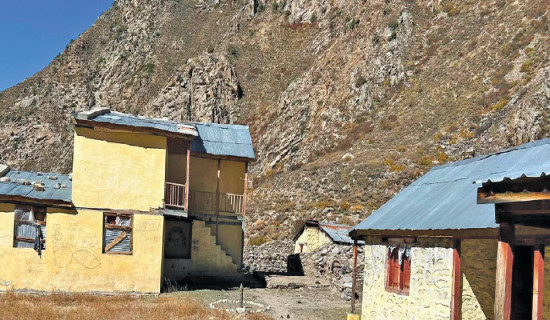
It’s almost cliché to describe the breathtaking landscapes and towering cliffs. The air felt fresh and made unique, swooshing sounds. Dumba Taal looked as blue as the sky itself, and the reflections of white mountains on the lake were simply magnificent. At Lo Manthang, we stopped by caves and monasteries, which looked like they were built ages ago. Shija Jhong Cave, a five-story structure, had my heart beating for a while - both literally and metaphorically. I ran down the ladder quickly before I could get to the top. I felt my body couldn’t cope with the low oxygen supply.
The most disappointing stop was our final destination: Upper Mustang. I came to know later that the beautiful part was the journey to Upper Mustang, but not the destination itself. Natural shapes of the cliff led me to interpret them in my own ways, as my eyes formed dogs, humans, poop, and whatnot. The major highlight for me was Marpha Village, with its narrow stone-carved pavements and shops on either side. The village looked like Bandipur, but had a more rustic touch. It was where we bought apples and gifts to take back home.
-square-thumb.jpg)

-original-thumb.jpg)