- Monday, 4 May 2026

Drawbacks Of MEC’s Common Entrance

The Medical Education Commission (MEC) in Nepal was established to address the wide disparities in medical education by streamlining regulation, standardisation, and centralisation of medical education across the country. It conducts entrance examination, matching, institutional quota allocation, and hence mandated with ensuring medical education aligns with the health manpower needs of the country. Although MEC has succeeded in restructuring some of its processes, its entrance examination system has numerous drawbacks that leave many quotas in pharmacy, laboratory sciences, optometry, physiotherapy, public health, and other co-medical sciences unfulfilled year after year.
These structural flaws have severe consequences for the healthcare system of the country. In a country where the healthcare system is overstretched and struggling with shortages of manpower in critical areas, such flaws deepen the problem and erode public trust. The MEC conducts a common entrance examination for different medical education disciplines, from laboratory sciences, pharmacy, radiography, perfusion technology, public health, nursing to MBBS, and BDS. Although the purpose was to centralise the examination process, the system has inadvertently created barriers for aspirants of disciplines other than MBBS and BDS.
Biased
The examination system is biased to medicine and dental sciences, and candidates aspiring to join pharmacy, medical laboratory technology, perfusion technology, physiotherapy, and optometry programs find the examination system unfavorable, as they have only one choice among many. The date for the entrance examination falls on the same day for many entirely different medical sciences courses. This way of a common entrance system discourages students from choosing those subjects.
In many countries, pharmacy, nursing, and allied health sciences have separate exams customised to respective fields, whereas MEC performs a single uniform examination. This denies opportunity to many healthcare disciplines, leaving quotas in pharmacy, medical lab, and other allied health sciences vacant, while demand for medicine and dentistry overshoots. The MEC examination system reinforces hierarchical bias, as MBBS and BDS seem the most competitive programmes, leaving pharmacy, lab sciences, and other co-medical programmes regarded as second options. This discourages students from applying for those subjects in the first place.
The MEC allocates seats in government and private institutions every year in all fields, from pharmacy, laboratory sciences, radiography, public health to nursing. However, because fewer students qualify or apply through MEC’s exam, hundreds of seats go unfilled, wasting institutional resources, public investment, and national opportunity, especially in a country like Nepal where the shortage of skilled pharmacists and laboratory technologists is acute.
Many students from rural and underserved communities aspire to study pharmacy, lab sciences as more cost-effective career paths. The examination system of MEC is heavily biased to medicine and dentistry, encouraging students to focus their preparation only on those areas. Even quotas reserved for marginalised groups in pharmacy, lab sciences remain empty, which not only defeats the policy of inclusiveness but also causes wastage of investment. The country’s healthcare needs are complex as it seeks to get qualified manpower from all medical disciplines, not merely from medicine and dentistry.
MEC’s current system creates an imbalance, producing an oversupply of doctors and dentists relative to other professionals, and weakening interdisciplinary healthcare delivery. The failure to fill these quotas has serious long-term consequences due to the shortage of skilled professionals. Moreover, students who might have pursued pharmacy or lab sciences in Nepal may seek admission abroad, where admission is easier and exams are discipline-specific. These conditions encourage brain drain and exhaust the talent pool. The inability to fill quotas year after year undermines confidence in MEC’s fairness and effectiveness, making the commission look more like a bottleneck than a facilitator.
To solve these systemic flaws, MEC must urgently reform its examination and matching system. Therefore, it is suggested that to conduct separate and independent entrance exams for pharmacy, laboratory sciences, physiotherapy, optometry, and perfusion technology so that students are evaluated on relevant competencies. MEC could adopt a modular system where a common general paper is followed by discipline-specific sections if separate exams are not possible. Students could attempt the module relevant to their chosen field. This would preserve centralisation while respecting disciplinary diversity. Another way is to let students prioritise their interests by choosing their fields of interest.
Alternative pathways
Another way to fulfill the quota is for MEC to allow for alternative pathways, such as institutional entrance exams, lateral entry from related fields, or bridge programmes. The rigid adherence to a flawed system should not prevent the country from producing the professionals it desperately needs. MEC must acknowledge the country’s need for healthcare manpower to ensure that exam policies align with actual demand. For example, if projections show a severe shortage of pharmacists, then admission processes should be flexible enough to prioritise filling those seats.
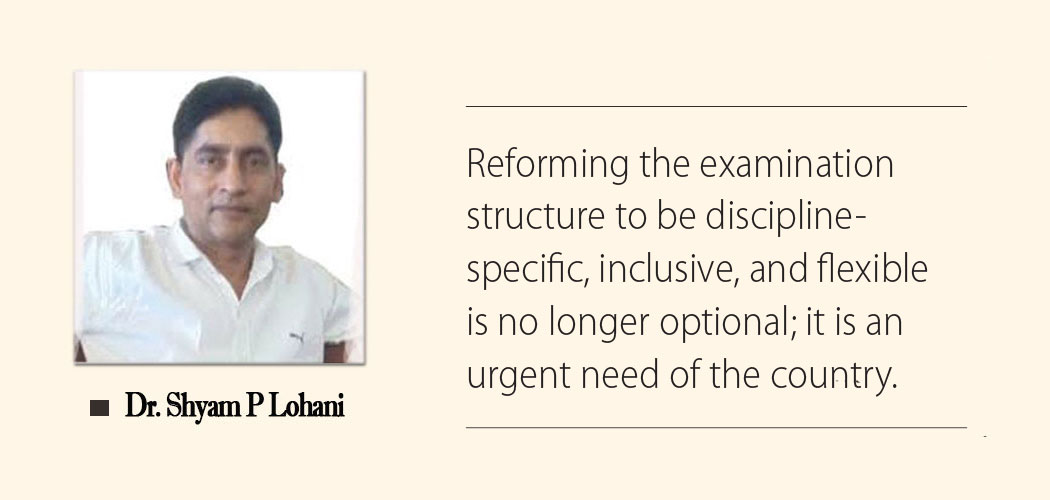
Not only is MEC over-centralised, but it is also biased to the medicine-type examination system. This has inadvertently left many quotas in pharmacy, lab sciences, physiotherapy, and allied medical fields unfulfilled. This not only wastes resources but also undermines the very foundation of healthcare delivery in Nepal. Reforming the examination structure to be discipline-specific, inclusive, and flexible is no longer optional; it is an urgent need of the country.
Should things go forward on the current path, the country will face severe shortages of pharmacists, technologists, and public health experts while producing graduates ill-equipped to address the real health challenges. By addressing these systemic flaws, MEC can fulfill its promise of creating a balanced, competent, and equitable healthcare workforce. This mismatch drives away capable students who could have contributed significantly to medical sciences but fail to secure seats because the system prioritises medical-style knowledge.
(Dr. Lohani is the clinical director at the Nepal Drug and Poison Information Centre. lohanis@gmail.com)