- Monday, 8 June 2026

Embrace BP's Vision For Development

History takes us back to our roots. It tells us about our origin and ancestry. It portrays the journeys of life of our forefathers, and the society in which they lived. It recounts their struggle for survival. In short, it is a story of our evolution. Above all, it helps us to design our future course. Now we are citizens of a federal republican state. We are ruled by ourselves. The law is formulated by the representatives we elect. But it was not the case some 75 years ago. They ruled with an iron fist. What they said was law. During the Rana regime, Nepalis were subjects of the rulers, not citizens. They did not have civil rights at all.
One of the anecdotes of that time goes like this. Once, prime minister Junga Bahadur was delivering a speech in English. He happened to use a word just opposite to what he meant to say. His aide, standing behind him, whispered the right word. In response, he ordered his aide to change the meaning of the word he uttered in the dictionary. Ranas deprived people of education. Opening a school was a crime. Once, some people, including the great poet Laxmi Prasad Devekota, humbly submitted an application to the Rana ruler seeking permission to open a public library in Kathmandu. But the request was not accepted; instead, the applicants were punished. Devkota was fined Rs. 100.
Great martyrs
The four great martyrs –Dasrath Chand, Dharmabhakta Mathema, Sukraraj Shastri and Gangalal Shrestha – were brutally killed by the Rana rulers in 1941 for demanding a democratic system and civil rights. Many others were sentenced to life. At the same time, some Nepali youths were getting united in India to fight against the tyrannical family rule of the Ranas in Nepal. One of them was BP Koirala. He went to Kathmandu secretly to organise the youths there as well, but the police nabbed him and put him behind bars. BP Koirala got his education in India. India was a British colony then. The people of India demanded self-rule and launched a struggle for independence under the leadership of Mahatma Gandhi. As he was in India, BP Koirala also joined the independence movement along with Gandhi, Jawaharlal Nehru, and other leaders.
In Nepal, Koirala was confined to a small, almost dark room without even a toilet. He urinated and relieved his bowel on a small hole in the wall and flushed it with water. He was given some rice and a handful of firewood pieces. An elderly sweeper woman, pitying poor Koirala, gave an old jar-like small pot to carry water for washing after toilet. He cleaned it by burning it in the fire and cooked his meal in it. After some time, Koirala staged a hunger strike. The news of his hunger strike was flashed in Indian newspapers. Along with the news, a letter from Koirala describing the inhuman environment of his custody cell was published. It is said that tears fell from the eyes of prime minister Jawaharlal Nehru after reading the letter.
Mahatma Gandhi and Nehru sent telegrams to the then Rana prime minister, requesting him to take care of Koirala’s health in custody. The telegram of Nehru mentioned that Koirala’s mother would be in Kathmandu soon to deliver his letter, too. After 29 days of hunger strike, Koirala was finally released. After a few days of convalescence, Koirala called on Prime Minister Mohan Shumsher. He said to Koirala, "How could you dare to think of getting to this throne, little Brahmin chap? It has to be destined for this." Koirala politely replied, "No, I am not trying for that throne. We just want democracy as per modern times."
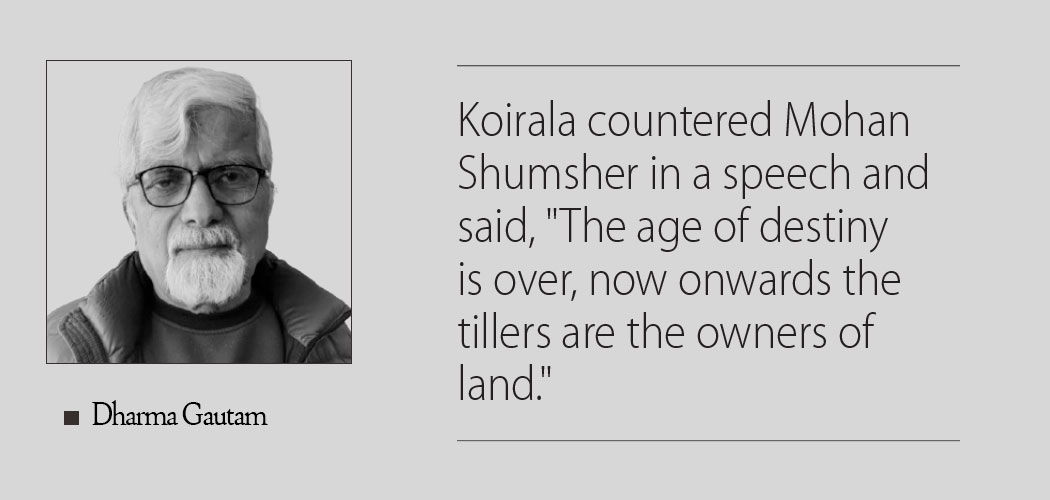
With a threat not to repeat the blunder, Mohan Shumsher let Koirala go. Then he went to India and led the armed struggle that overthrew the Rana regime in 1951. Once democracy was established, Koirala countered Mohan Shumsher in a speech and said, "The age of destiny is over, now onwards the tillers are the owners of land." When Mahendra was the king, a general election was held for parliament. Koirala’s party secured a two-thirds majority in the parliament. BP Koiral became the first elected prime minister of Nepal. He started introducing result-oriented programmes for the transformation of the country. He abolished the Birta system, nationalised the forest, reformed the civil administration, and implemented an economic development plan, focusing on rural peasants. New schools were opened across the country.
A new wave of enthusiasm for development was spreading all over the country. BP Koirala was becoming more popular at home and abroad. Perhaps, to read his mind, one day, King Mahendra asked Koirala what his next desire was. BP said, "Well, people have given me the highest post a citizen deserves. It’s enough for me. But I have responsibilities towards people. I want every Nepali to have a house to live in, a small plot of land for farming, some cows to get milk, and income enough to provide education to the children and medical treatment when necessary. I need 15 years to achieve all this - that is, three consecutive general elections."
Sacrifice
But after a couple of months of this conversation, King Mahendra sacked Koirala and threw him into army custody along with his ministers and friends. Parliament was dissolved and civil rights snatched. But Nepali people longed for a democratic system and started fighting for it. Many youths sacrificed their lives. It took three decades to restore democracy. But BP Koirala had breathed his last before the establishment of democracy.
In the course of time, the monarchy was abolished, and Nepal became a republic. But the present ageing leadership has not been effective in meeting the people's expectations. Poor performance in good governance and service delivery has not improved. Thus, it seems the new generation, equipped with wide knowledge, new technology, and skills, should dare to hold the driving seat to take the country ahead in the path of development with social justice as envisaged by BP Koirala. Today is the 112th birth anniversary of BP Koirala. The youth of today, who belong to the Alpha generation, should not delay in preparing themselves to lead the country to realise the dreams of BP Koirala.
(Gautam, a former NC leader, is now a freelance journalist.)