- Monday, 4 May 2026

Parliament Library
Most MPs spurn it while general public remain unaware
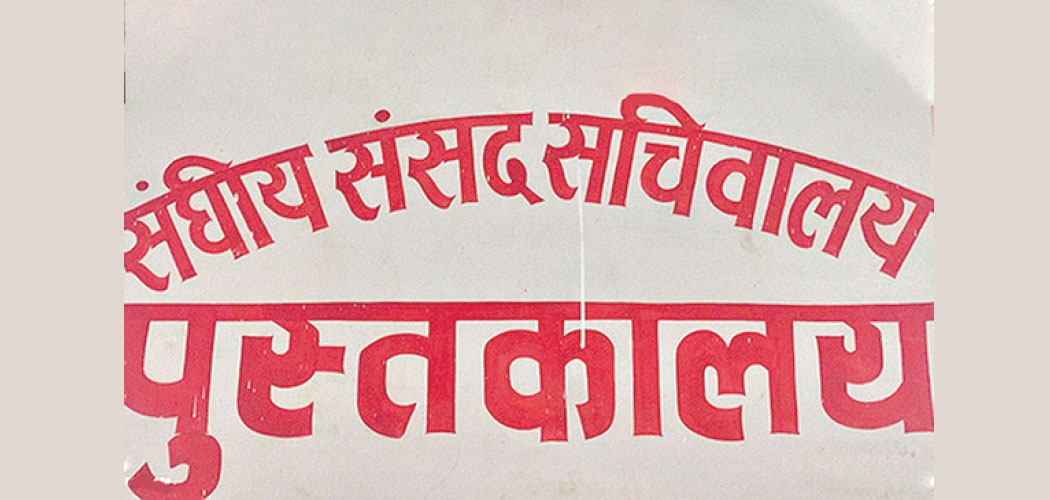

By Raman Paudel,Kathmandu, Sept. 6: Madhav Sapkota (Subodh), a Member of Parliament from the CPN (Maoist Centre), often visits the Parliament Library at Singha Durbar, as most books and documents he needs are available there.
“My objective of visiting the library is to acquire knowledge about historical documents related to politics, history, and other parliamentary practices, which is also regarded as the most valuable aspect of this library," said MP Sapkota.
Interestingly, the question frequently asked to the library staff is, "Who is the most frequent visitor to this library?" The common response is Madhav Sapkota.
Sapkota mentioned that he dedicates most of his days in the library reading books or collecting documents. “Rare documents that are not available in other libraries can be found here, which is the primary reason I visit this library. It has facilitated me and fellow MPs in collecting important documents and acquiring specific knowledge necessary for our work," Sapkota explained.
Shakti Basnet, Member of Parliament and Deputy Secretary General of the Maoist Centre , is also a frequent visitor to the library. Former Forest Minister Basnet mentioned that the library contains useful materials for lawmaking.
Likewise, Hem Raj Rai, Member of Parliament representing CPN-UML, also regularly visits the Parliament Library, primarily to read journal articles and gather reference materials. This library is invaluable for him for studying historical documents such as treaties, international agreements, and important decisions of past governments.
"The library houses various books and historical documents. I often visit to study these materials, which facilitate understanding the operational procedures of the parliament. Usually, after concluding parliamentary committee meetings, I visit the library,” said MP Rai.
Leaders and MPs, such as Gopi Bahadur Achhami from Morang, Maoist leader and former MP Dev Gurung, Dina Nath Sharma, a former MP, and Rama Koirala, frequently avail of the library.
Talking to The Rising Nepal, most visitors indicated that the library is instrumental in collecting historical documents and reference materials, and in learning about specific issues. Despite its significance, the library remains largely unrecognised by the public and, in certain circumstances, even within the parliamentary community itself.
Established in 2016, the Parliamentary Library houses at least 25,000 books and documents, but has not achieved widespread recognition.
Shanti Chaudhari, a former Member of Parliament from CPN-UML, commented on the library a year prior. During a parliamentary committee meeting, MP Chaudhari stated she was unaware of the library’s existence at Singha Durbar. "As a new Member of Parliament, I was unaware that there is a library at Singha Durbar," she said.
Deputy Speaker of the House of Representatives, Indira Rana, also noted that many books are unmanaged and remain disorganised within the library, expressing disappointment over the lack of proper management and space. "The disorganised books and lack of space have been disappointing," she remarked.
MP Roshan Karki of RPP also criticised the library for not being updated or technologically accommodating in the modern era. "When I visited the Parliamentary Library, I could not find the document I needed, which led me to cease visiting," she stated.
Several MPs who do not frequent the library cite insufficient space and inadequate reading environment as primary reasons for their absence. Madhav Sapkota, the library’s most frequent visitor, concurred that the facilities are inadequate, particularly in terms of space and modern technology.
Ekram Giri, spokesperson for the Parliament Secretariat, announced that the library will be relocated to the new Parliamentary Building under construction in the northern part of Singha Durbar. "Yes, our library requires modernisation and improved management, which we have initiated to ensure proper operation," Giri stated. Plans are also underway to launch an e-library following the move. Nonetheless, access to the library for the general public and students remains restricted.
Dikshya Bhandari from Bhaktapur, engaged in academic research for her BA-LLB studies, has been visiting the Singha Durbar Parliamentary Library for several days. Her research is centred on local governance issues, yet she has seldom encountered other ordinary readers.
Bhandari noted that gaining entry to the library is complicated for the general public. "Most students are unaware that there is a library inside Singha Durbar, and securing an entrance pass is quite difficult," she explained.
Library officials state that individuals wishing to use the facilities must arrange a gate pass themselves, which is often challenging for general public. Additionally, due to the absence of a formal operational framework, the library faces several challenges, including issues related to fines for lost books.
Some officials admitted that many MPs have taken library books and have not returned them. A few years ago, an official recalled calling MPs to return the books, but they instead paid the fines, which could not be levied due to the lack of guidelines, said an official.