- Monday, 4 May 2026

Indian Diplomacy In Practice

Diplomats worldwide are normally found to write their reflections after their superannuation or completion of terms. This system is quite in vogue in India, as the Indian Foreign Service (IFS) prides itself on being one of the best diplomatic services in institutional and personnel terms.
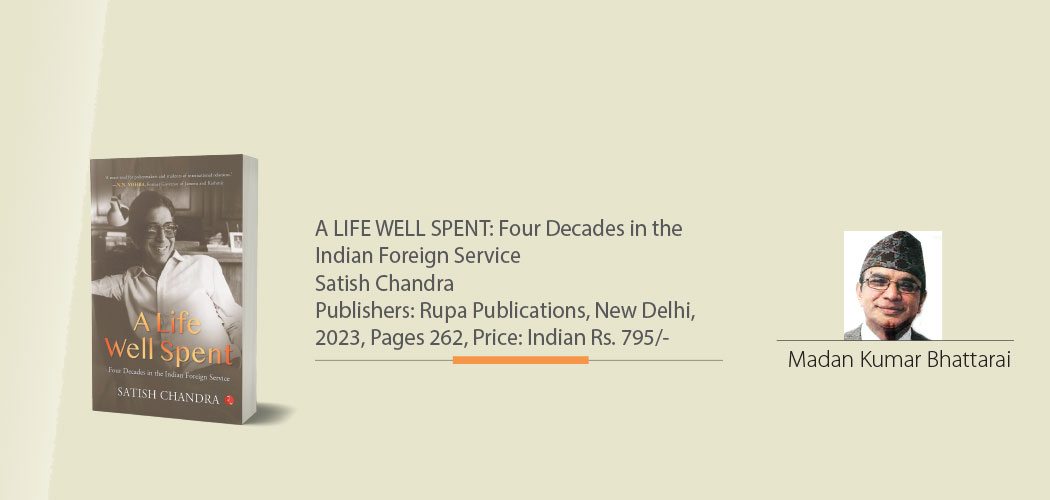
Satish Chandra, a 1965 batch officer taken as one of the cerebral diplomats, has come out with a scintillating work that sheds light on Indian diplomacy, diplomats, and issues of contemporary importance, including security.
The book has a self-explanatory title, A LIFE WELL SPENT: Four Decades in the Indian Foreign Service, illustrating satisfaction with the service Chandra was destined to serve for four decades with both bilateral and multilateral exposures, as well as a considerably longer stint with the freshly inaugurated National Security Committee Secretariat.
Apart from the introduction and epilogue, the work has 13 chapters. The first chapter deals with the author's probationary days in India, and the thirteenth focuses on his association with the national security. The rest of the chapters, from the second to the twelfth, concentrate on the pith and marrow of India's diplomacy.
Out of 11 chapters, three deal with the writer's assignments at headquarters, and seven are related to essential strands of bilateral ties, with two of his assignments being in Pakistan, which is considered one of the most critically challenging places for an Indian diplomat. This may reciprocally apply to Pakistani diplomats posted to India, as we find both governments posting senior diplomats in each other's capitals.
While his stay in Vienna can be taken as a mix of bilateral and multilateral relationships, the eleventh chapter is essentially related to multilateral diplomacy, as he considers his Geneva posting to be the most challenging and most demanding assignment of his entire career.
Chandra defines his four-decade-long stint with diplomatic service as a saga of varying accidents starting from his induction into the service. He was first selected for the Indian Revenue Service (IRS) and got into the IFS after being prompted by his ICS father, C.N. Chandra. He also gives insight into what are called comfortable ("A") and difficult ("B") postings, despite a lack of full justifications to classify posts as such.
Even after induction into the IFS, he was saved by providence, as one lady officer formerly allotted to the IAS got into the IFS based on marks. Still, his early entry into the IFS some months ago, without the foundation course he had previously completed in joining the IRS earlier, had already earned him supporters in the diplomatic service.
While lamenting the declining preference for IFS as a career option among new generations, the author holds with conviction that IFS was still among India's least politicised government services. He also decried erosion in the standards of all government services as political people started to assert their supremacy.
The author calls his first ambassadorial assignment in the Philippines the most enjoyable and relaxed phase of his career, despite Manila station being what he prefers to call 'at the bottom' in terms of importance or priority from an Indian perspective. Even as a probationer, Chandra was lucky enough to be directly associated with the Pillai Committee in its initial period.
In terms of individuals, Chandra paints an impressive story of leading diplomats like Brajesh Mishra and Jyotindra Nath Dixit, who both excelled as National Defence Advisers. He also depicts some bosses, all from the professional career service, as those trying to impose dictates, prompting the author even to seek a premature transfer from one station.
Likewise, he gives a detailed account of the infamous saga that abruptly cost senior diplomat A.P. Venkateswaran the position of Foreign Secretary and resulted in his replacement by suave and experienced K.P.S. Menon Junior, more as a damage control exercise during the time of Rajiv Gandhi.
The author also gives an account of the most challenging days engulfing the Indian capital after the assassination of Prime Minister Indira Gandhi, with innumerable doses of arson, loot, and murder.
Chandra's book is illuminating for diplomats and others interested in knowing the nuts and bolts of Indian foreign policy from a practitioner's perspective. One aspect keeps the readers somewhat puzzled about the real identity of the persons concerned, as he prefers to keep them unnamed. These oblique references test the knowledge of the readers.
The author highlights the hindering role of personal predilections on the part of foreign secretaries or ambassadors that tend to cast a negative shadow on
the country's interest or effective utilisation of talents of the IFS. The book tends to obliquely place foreign secretaries Jagat Mehta and Krishnan Srinivasan in a negative light.
On the debit side, the book has some proof and even factual mistakes that might have inadvertently crept into the book. In an endeavour of such proportions, such shortcomings are, of course, only minor anomalies.
One example is the IRS, an acronym for the Indian Revenue Service, which has mistakenly been called the Internal Revenue Service (xii), as the author first joined before his second attempt for entry into IAS/IFS.
Another mistake is that Sir N.R. Pillai, ICS, first Cabinet Secretary and longest-serving Secretary-General of the Ministry of External Affairs, was the second and not the last Secretary-General, as stated on page 2.
Two more foreign secretaries, R.K. Nehru and M.J. Desai, both ICS, also took over as third and fourth secretary-generals, respectively. The position was allowed to have a natural death in 1964 when the government under Prime Minister Lal Bahadur Shastri refused to appoint anyone as the fifth secretary-general, a position initially thought to apply to the first incumbent, Sir Girja Shanker Bajpai, ICS, as a possible one-time experiment.
After 1964, the Foreign Secretary became the real head of the IFS, controlling, supervising, and administering the entire diplomatic machinery born as an integrated diplomatic service when Jawaharlal Nehru assumed leader ship, keeping foreign affairs concurrently until he died in 1964.
The book is a solid addition to the literature on Indian foreign policy, as it gives a practitioner's perspective without any bias or prejudice. Ambassador Satish Chandra deserves full congratulations for his fruitful endeavours.
(Dr. Bhattarai is a former foreign secretary, ambassador, and author. kutniti@gmail.com)