- Monday, 4 May 2026

'Mainstream care economy'
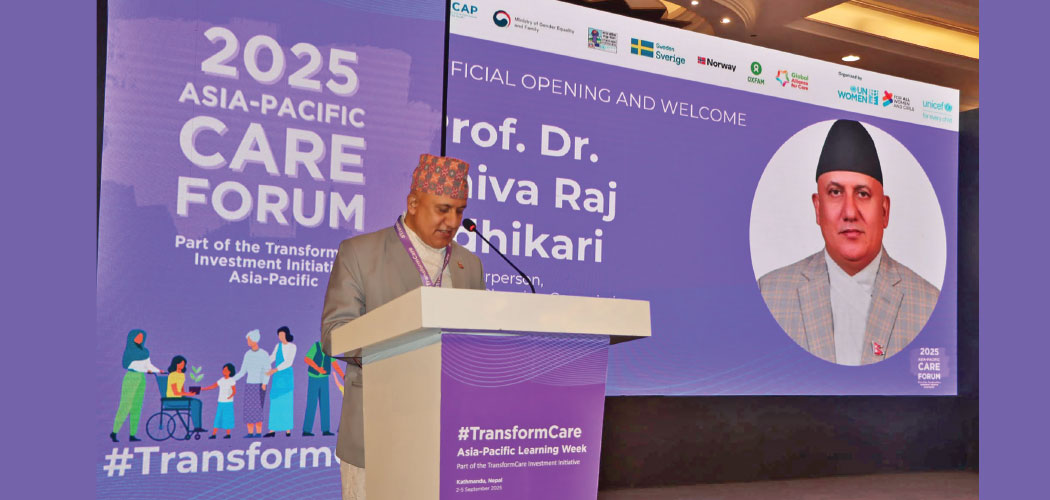
Photo: TRN NPC Vice-Chairman Prof. Dr. Shiva Raj Adhikari during Asia-Pacific Care Learning Week in Kathmandu.

By A Staff Reporter,Kathmandu, Sept. 5: Vice-Chairman of National Planning Commission Prof. Dr. Shiva Raj Adhikari has said that it is necessary to mainstream the care economy.
Addressing the Asia-Pacific Care Learning Week 2025 in Kathmandu on Thursday, Vice Chairman Adhikari said that “unpaid care work and undervalued care jobs are the invisible foundation of society.”
He said that mainstream economic measures fail to capture it and ignoring care leads to cost inequality, fragility, and reduced productivity, as well as lost development opportunities.
Dr. Adhikari said that Nepal’s 16th Plan aims to formalise care work, create jobs, and emphasise women’s economic empowerment, transforming care work into decent employment through a dignified labour promotion programme.
He said that women are bearing the brunt of caring for children, the elderly, and people with different ability, which has limited their participation in education and employment.
Stating that Nepal has been practicing gender-responsive budgeting since 2007 B.S, he pointed out that gender-sensitive financial management and resource allocation at the local level are essential.
Saying that organising this programme on the eve of Nepal’s graduation to a developed country is significant in itself, he said that Nepal’s transformation is not limited to income and growth alone, but is based on tolerance, inclusion, and shared prosperity.
Dr. Adhikari said that although half of our population is women, structural barriers still hinder their full participation in the formal economy, emphasising that women’s economic empowerment is essential for sustainable and irreversible LDC graduation, and for this, unpaid care work must be valued and recognised.
He said that Nepal is moving forward with a national care policy that will integrate care into a broader macro-economic plan.
He stressed that this includes investing in care infrastructure, expanding public services, and encouraging the private sector to become care providers.
He said that these steps are not only socially progressive but also economically sound, which will have an impact on women's employment, labour market participation, productivity, and inclusive growth.
He said that for sustainable fiscal sustainability, a gender perspective should be integrated into public finance management, and that local governments should have the necessary capacity to prioritise and allocate resources for care services.
He also said that investment in local-level care should be viewed as a strategic economic investment, not as welfare spending, and that close coordination with development partners is necessary for this.
Vice Chairman Dr. Adhikari said that governments alone cannot create a care economy, and multilateral engagement is also indispensable for this. He said, “Investing in care is not just social or ethical—it is a smart economy that creates employment and productivity, and enables inclusive economic growth.”
He called on the private sector, civil society, and development partners to invest in care infrastructure and workforce development, and said that regional cooperation is also necessary for this. He said that new models of inclusive and financially sustainable care delivery can be developed through public-private partnerships.
As the care economy is a common challenge and opportunity for the Asia-Pacific, such forums will promote South-South cooperation and regional solidarity will be important for this, which will help build economically sustainable and socially just care systems, he said.
He called for a commitment to use such forums to transform care systems into engines of gender equality, inclusive economic growth, and social justice.