- Thursday, 28 May 2026

Temperature rise blamed for drying up of water sources

By A Staff Reporter,Kathmandu, Dec. 23: Participants at the “Capacity-building workshop on Climate Crisis Response” have said that most of the water resources are drying up from underground and temperature rise might be the reason behind it.
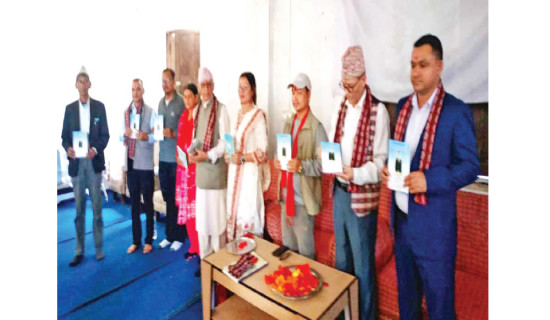
In a workshop organised by the United Nations Educational, Scientific and Cultural Organization (UNESCO) in collaboration with the Nepal Forum of Science Journalists (NFSJ) on Wednesday, representatives from the local government and experts said that along with the water crisis, there have been issues of landslides in the upper region and flooding in the lower region. Former Minister for Forest and Environment Ganesh Shah said climate issues should be discussed in every family and every household.
“As Nepal is considered rich in water resources, we have not been able to address the clean drinking water issues,” he said. Shakti Bahadur Basnet, a former minister, said that the impact assessment should be done properly, and the nature of the problem should be analysed accordingly. “It is vital to understand and work towards how we should collectively work towards adaptation and mitigation of the climate crisis,” he said.
Newly elected Member of Parliament Roshan Karki said, “We have local government, provincial government and federal government and all three levels of government should have a common understanding of the climate crisis. It needs to be addressed how it has been affecting the health, economy and well-being of the communities. We do have a budget at the local government for that matter.”
Herpetologist Prof. Dr. Kalu Ram Rai said he had been working in the field of environmental conservation for a long time and now he had handed over the responsibility to the younger generation. “I expect that the younger generation will come forefront to address the climate crisis in more innovative ways,” he said.
Province Assembly Member Prakash Jwala said there are so many issues of the climate crisis that need to be addressed. The government is responsible for developing a proper budget and policies to address the crisis.
Another MP Rekha Yadav said that people’s lives have been affected by climate-induced disasters and that the government should formulate policies and plans to address those affected people.
At the programme, assistant Professor at Kathmandu University Dr. Nani Raut presented a paper on “Climate-Induced Crises and Disaster Risk in Kathmandu Valley”.
She said the tendency of the rain is increasing but within a short period only. The summer is becoming hotter and the winter has become colder. There is no even equal distribution of rainfall patterns in Nepal.