- Thursday, 28 May 2026

Israel rushes to protect marine life as Mediterranean warms
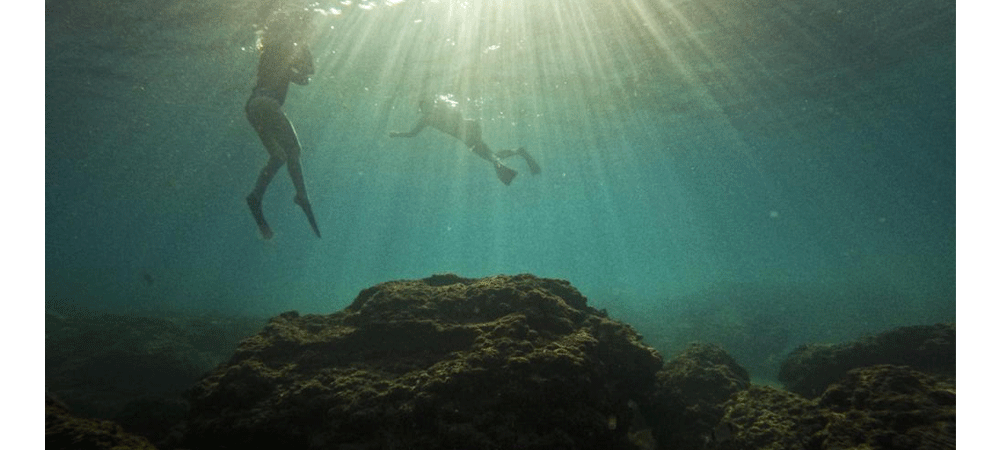

Rosh Hanikra Marine Reserve, Israel, Nov. 14: Between the cliffs and crags of Israel’s submerged prehistoric coastline, a Mediterranean ecosystem is surging back to life.
Giant groupers flourish among the rocks, a psychedelic purple nudibranch sea slug clings to an outcrop, and a pair of rays skate along the undisturbed sandy bottom.
Israel is blazing forward with a plan to protect sections of its 118-mile coastline, a measure experts say is crucial to maintain biodiversity and shield ecosystems from humanity. Rosh Hanikra, just south of the Lebanese border, is the centerpiece of this effort, providing what scientists believe can be a blueprint for rescuing seas ravaged by pollution, overfishing and climate change.
Climate change, invasive species and explosive human activity are threatening what remains of the eastern Mediterranean’s severely impacted ecosystems. Scientists warn that without protection, remaining marine ecosystems will be devastated.
But there is a glimmer of hope. In recent years Israel has taken steps to better protect critical habitats along its Mediterranean coast, like the Rosh Hanikra Marine Reserve, and researchers say key species have bounced back even after just a few years of protection.
“If we won’t maintain the resilience and the functionality of the ocean, it will collapse,” said Ruth Yahel, a marine ecologist at Israel’s Nature and Parks Authority. Conservationists say the best way to do that is creating zones where human impact is reduced.
Last month, an Associated Press team joined park rangers diving beneath the waves off Rosh Hanikra, which Yahel calls “the jewel in the crown” of Israel’s marine protected areas, where commercial fishing, drilling and sewage runoff are prohibited. An underwater canyon and sloping hills — vestiges of the Mediterranean coastline submerged by rising seas at the end of the last Ice Age — provide oases for underwater life to gain a foothold.
Since 2019, Israel has increased these protected areas from roughly 0.3% of its coastal waters to around 4%. Another roughly 4.5% are earmarked for protection.
While those measures fall short of the international target of 10% by 2020, and broader global efforts to protect sea-life have faltered, it shows Israel has started taking the issue more seriously.
Last year, Israel signed on to U.S. President Joe Biden’s 30 by 30 initiative of “ conserving 30 percent of our lands and waters by 2030.” Around 24% of Israel’s land area is now designated as nature reserves, along with just over 2% of its total maritime territory, including its Exclusive Economic Zone stretching some 200 kilometres beyond its territorial waters. This summer the government declared a fishhook-shaped 175-square-mile (450-square-kilometer) protected area that’s home to a deep-sea ecosystem several dozen miles off the coast of Tel Aviv outside its territorial waters.
These protected areas are not just lines on a map. Marine rangers patrol them along Israel’s Mediterranean coastline and “protect an ecosystem that is supposed to be less disturbed by humanity,” said Eyal Miller, one of the rangers.
But that ambitious target faces major obstacles due to Israel’s fast-growing population, limited available land, offshore gas exploitation, commercial fishing and shipping, and military use.
Tamar Zandberg, the country’s outgoing environmental protection minister, said a main challenge is Israel’s lack of an overarching government strategy concerning the Mediterranean.
“This is a very sensitive ecosystem that can very easily change from a solution to a problem if we don’t conserve it,” she said, expressing worry that environmental issues have become politicized and that Israel’s incoming government may abandon them. (AP )