- Tuesday, 26 May 2026

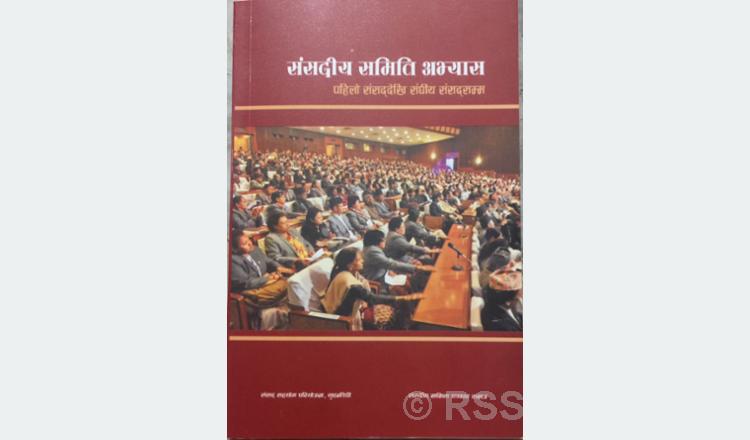
Book Review: Parliamentary committees to keep tab on government
Narayan Prasad Ghimire
Kathmandu,
Nov 13 : Nepal is holding the elections to the House of
Representatives and Provincial Assembly after a week- November 20- the second
after the country got a new constitution in 2072 BS.
As a result, the
political parties, leaders, cadres, candidates and their well-wishers are
engrossed on the election campaigning across the country. The political leaders
and candidates are making promises and sharing development dreams before the
voters.
One of the
common views they have is- they will make good policy and laws for development
and prosperity if elected. They are requesting and urging the people for their
votes to be parliamentarians. We need to wait some more weeks whether they best
utilize the parliament to be formed after the November 20 elections and work
really for the people and country.
In a multi-party
democracy, election and parliament are essential systems. Nepal has practiced
parliamentary system for six decades, but with disruption and unease time and
again. We got the first parliament in 2015 BS which elected BP Koirala as the
first people elected Prime Minister in Nepal. The book under review,
“Parliamentary Committee Practices: First Parliament to Federal
Parliament" looks into the parliamentary system of Nepal, focusing more on
parliament committees, which are also called the ‘workshop of the
parliament’.
The parliament
committees are formed to study any issue thoroughly and assist the parliament
in making its stand clear on it. In Nepal too, the thorny issues surfaced in
the parliament are taken to the related parliament committees for discussion
and consultation with experts, stakeholders and in-depth study.
The committees and even the sub-committees formed under the parliament are for strengthening the parliament. An informed and robust parliament is pre-requisite to making effective laws that address the pressing issues in the country. The book dwells well on how the parliament committees were formed and whether they worked effectively.
Just a decade
had passed since Nepal got democracy, it witnessed tumultuous political
development caused by the royal coup in 2017 BS. It nipped in the bud the
parliament, which lasted not more than one and half year. The parliament formed
after the first people’s election had formed committees, but in vain.
The party-less
system took a toll for 30 years, thereby causing severe dent in Nepal’s
parliamentary committee practice. Referencing the information available at the
Parliament Secretariat, the book mentioned that ‘the House of Representatives
Regulation-2016BS had provisioned advisory committee, supreme committee,
application filing committee, public account committee, estimate committee and
prerogatives committee.’ Five committees were formed to study birta elimination
bill, aquatic conservation bill, alcohol bill, parliament’s privileges bill,
and a mobile court bill.
The concerned
ministers had presented separate reports of the committees, the book mentioned.
It reflects that the lawmakers were keen to discuss the burning issues of the
time. Effort to make aquatic conservation bill at that time indicates how
sensitive Nepal was for protection of biodiversity. It was indeed a democratic
exercise.
Although it was
party-less panchayat system after 2017BS, there was unicameral parliament
called ‘Rastriya Panchayat’. It also formed the parliament committees,
including accounts committee, and estimate committee. However, Rastriya
Panchayat was all guided to fulfill the vested interest of the royals and their
near ones. Despite the formation of the parliament committees, they were not
allowed to dwell on governance agenda in the beginning of the panchayat system.
Later, half dozens of thematic committees were also formed.
Similarly, seven
parliament committees were formed after the establishment of government since
restoration of democracy in 2046BS. The parliament formed after the 2051BS
election added two more committees. These were under the lower House- House of
Representatives.
There were two committees under the Upper House in 2048BS, and four committees under the Upper House in 2051BS. Common among them were, remote region committee, and delegation and government assurance committee.
There were
thematic committees in the restored parliament with 2062/63BS people’s movement,
interim parliament, constituent assembly-I and constituent assembly-II. A new
practice of parliamentary hearing committee was adopted after the second
amendment of Interim Constitution, 2063BS. Both the first and second
Constituent Assembly also functioned as parliament.
There were eight thematic committees, two special committees and six other committees under the first CA (parliament). The formation of these committees was inclusive reflecting the spirit of the second people’s movement and the Interim Constitution.
The Second CA
however witnessed comparatively fewer presence of women in its committees.
There were only two committees out of 12 headed by women lawmakers in the
CA-II. Again, after the promulgation of constitution in 2072BS, women chairmanship
of parliamentary committee was on rise.
The women lawmakers heading the parliamentary committees under the House of Representatives Nepal got with first election since the promulgation of constitution-2072 were Pabitra Niraula Kharel, Purna Kumari Subedi, Nirudevi Pal, Sashi Shrestha, Kalyani Kumari Khadka, Jaypuri Gharti, Nira Devi Jairu. Similarly, Dilkumari Rawal Thapa (Parbati) headed a parliamentary committee under the National Assembly.
While reading
the book, the ‘account committee’ is in practice since origin of parliament. It
has dealt important issues that kept tab on the government activities. The book
has hailed the committee as the body making a ‘history.’
The Dhamija scam was one of the burning problems the committee had pointed before the parliament, people and government. As the government led by then Girija Prasad Koirala in 2048BS took a non-transparent way to pick an agent for RNAC- Dinesh Dhamija- it had created furor. Interestingly, Koirala dissolved the parliament in 2051BS while the debate on Dhamija was on its peak. As per observer, this scam tarnished the image of Nepali Congress.
Similarly, the
book has mentioned other scams that were raised by different parliamentary
committees. One of the unforgetting ones was the investigation done by the
State Affairs Committee which ultimately led the former Inspector Generals of
Nepal Police behind the bar. Yes, it was Sudan Scam.
The State Affairs Committee had found with investigation that millions of rupees were embezzled while purchasing armed personnel carrier (APC) to the police persons deployed in Darfur of Sudan under the UN peacekeeping mission.
In addition to
this, the book has explained how different parliamentary committees were
involved in the same case, thereby overlapping jurisdiction and wasting time.
Similarly, furnishing impractical direction by the committee is equally
worrying. For example, when the country was gripped by COVID-19, the law,
justice and human rights committee directed the government to immediately
arrange 10,000 ventilators and ICU beds in the wake of rising cases of
coronavirus infection. This direction was beyond the State capacity to cope
with crises.
However, the
government’s apathy to implement committee’s direction is also worth noting. In
case of Kathmandu-Tarai fast-track, the government repeatedly ignored
committees’ recommendation. Although the parliament committees’ investigation
and study are for making government accountable to parliament, and parliament
to people, some decisions of the committee were impractical. It is finely
depicted in the book.
The stories brought forth by the book also show how some executives- prime ministers- ignored the parliament committees. Despite the call by parliament committees, failure to appear can be interpreted as denigrating the value of parliament in democracy.
The book has
been divided into five chapters- evolution of parliamentary committee,
parliamentary monitoring: committee in perspective of effectiveness, women in
parliament: women presence growing in committee leaderships, parliamentary
oversight and challenges of the implementation of committee directives, and
what experts say.
The book can be
a mirror to study Nepal’s parliament system and effectiveness of parliamentary
committees. A further research and study can be done based on it. The extensive
references and footnotes have substantiated the points made by the writer. At
the same time, it can be taken as a comprehensive note on parliamentary
committee practices in Nepal.
However, while
reading, curiosity drives what had the parliamentary committees in the BP
Koirala-led government furnished recommendations on various bills. The book
fails to mention, possibly because of the lack of related archive and
documentation. It is worrying that Nepal’s historic archives are not available
to study thoroughly.
At a time when
Nepal is holding election for the new parliament- second time after it got the
new constitution, the book certainly is a worth reading text. The book,
published by the Journalists Society for Parliamentary Affairs in Nepali
language, is edited by journalist Thir Lal Bhusal.
It is published with the support of Parliamentary Support Project of the UNDP. Undoubtedly, it is an important contribution to the institutional documentation of parliamentary affairs, especially the committees in Nepal. (RSS)



-original-thumb.jpg)