- Thursday, 28 May 2026

Threat Of Drug-resistant Tuberculosis

The statement that “all deaths from drug-resistant tuberculosis account for about one-third of all antimicrobial resistance deaths worldwide” tells the gravity of dangers looming around humankind in the coming days. The antimicrobial resistance that results owing to drug-resistant tuberculosis (DR-TB) is difficult in terms of both duration of therapy and the cost of successful treatment.
The tuberculosis bacteria that are resistant to at least one of the first-line medicines lead to drug-resistant tuberculosis, for which we have limited treatment options and increased mortality rates. Tuberculosis bacilli that are resistant to the two most important TB medicines, isoniazid, and rifampicin comprises multidrug-resistant TB (MDR-TB) whereas when additional medicines including fluoroquinolones and injectable are resistant, extensively drug-resistant tuberculosis is said to have occurred.
Fatalities
Around 4,400 people die of Tuberculosis every day around the world. Tuberculosis (TB) is a disease caused by bacteria called Mycobacterium tuberculosis making it the world’s leading infectious killer disease, by far. The bacteria not only infect the lungs, but other parts of the body can also be damaged. The bacteria causing tuberculosis spread through the air droplets. It spreads when someone with the active form of untreated tuberculosis coughs, speaks, sneezes, spits, laughs or sings.
In 2021, a total of 1.6 million people died from TB which includes 187, 000 people with HIV making it the 13th leading cause of death and the second major infectious killer disease after COVID-19. It kills more people than HIV/AIDS. An estimated 10.6 million people fell ill with tuberculosis (TB) worldwide in 2021 including six million men, 3.4 million women, and 1.2 million children (WHO, 2022). Moreover, one-third of the world’s population is infected with TB (CDC, 2016). And those infected with TB bacteria have a 5–10 per cent lifetime risk of falling ill with TB. People with compromised immune systems, such as those living with HIV, malnutrition, or diabetes, or people who use tobacco, are most at risk of falling ill with active TB (WHO, 2022).
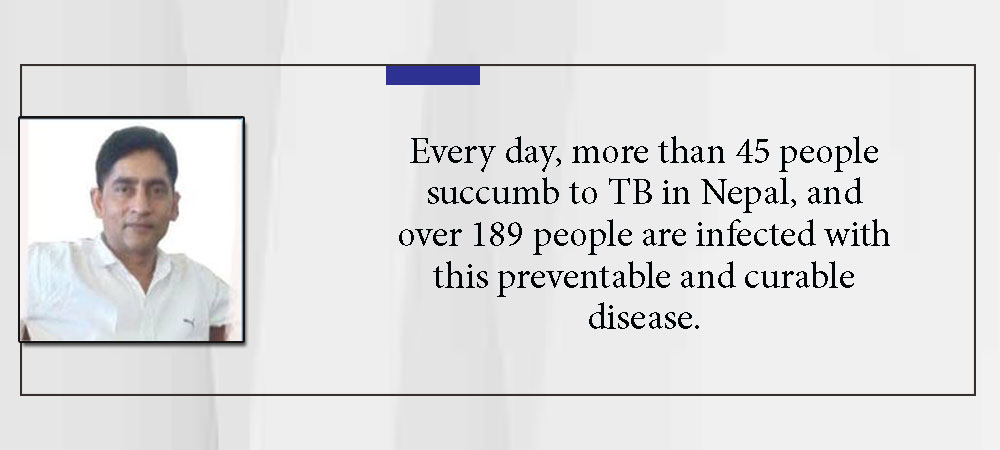
People with active TB can transmit the infection to 15 other people through close contact over the course of a year. It has been speculated that without proper treatment, 45 per cent of people with TB on average, and nearly all HIV-positive people with TB will die (WHO, 2022). Every day, more than 45 people succumb to TB in Nepal, and over 189 people are infected with this preventable and curable disease. A round 117,000 people are currently living with TB in Nepal while 69,000 people developed active TB in 2018. It has been shown that the case incidence was higher than previously speculated (National TB Prevalence Survey 2018-2019, MoHP).
Multidrug-resistant TB (MDR-TB) remains a public health threat and is feared to kill millions if untreated. In 2019 alone, a global total of around 200,000 were diagnosed with multidrug- or rifampicin-resistant TB (MDR/RR-TB), a 10 per cent increase from 2018. In 2021, an estimated 450 000 (95 per cent UI: 399 000–501 000) people fell ill with Rifampicin Resistant TB (RR TB). It has been estimated that less than 60 per cent of MDR-TB patients who initiated treatment were successfully treated, mostly due to high mortality and falling out of treatment programmes. Outcomes for individuals with XDR-TB were even worse, with approximately only one-third of patients successfully treated (The Global Fund, 2020). The global incidence of MDR-TB is 3.4 per cent in new cases and 18 per cent in previously treated cases (Sivekar et al, 2020). Globally, 78 per cent of the rifampicin-resistant TB (RR-TB) cases were multidrug-resistant.
Almost half of Nepal’s total population is infected with TB (they may have higher chances to develop active TB in their lifetime) which corresponds to nearly 15 million populations. In Nepal, 392 MDR /RR-TB cases were enrolled (out of 635 notified) in 2018/19; 0.6 per cent among new TB cases and 20 per cent among the previously treated cases (NTP Annual Report, 2018/19). A total of 4,321 TB treatment centres, 96 urban health centres, 581 microscopy centres, and 27 GeneXpert centres have been providing TB treatment services in the country. Similarly, treatment services for drug-resistant TB have been provided through 14 drug-resistant TB treatment centres and 81 sub-centres.
For those DR TB patients needing inpatient facilities, 7 DR TB hostels are providing residential services throughout the country, which should gradually be incorporated into hospitals and communities. It has also started community-based DR TB with considerable success. Since 1996, Nepal had adopted the DOTS strategy and the Stop TB strategy in 2006.
Strategy
As per the SDGs goal, Nepal has entered a new era of End TB Strategy from 2015 with the targets to reduce TB deaths by 95 per cent, and to reduce new cases by 90 per cent between 2015 and 2035. It has also envisioned making sure that no family is burdened with catastrophic expenses. Nepal’s national strategic plan for TB prevention, care, and control (2020) aims to have arrangements for psycho-social counselling for patients with TB and their families in all of the DR TB treatment centres and sub-centres.
Lastly, the Drug-Resistant Tuberculosis Centres run by non-government organisations (NGOs) with support from international donors should gradually be incorporated into the government’s system for their sustainability, community-based DR TB treatment programmes should be scaled up throughout the country and psycho-social counselling service provision be started as soon as possible.
(Dr. Lohani is the clinical director at the Nepal Drug and Poison Information Centre. lohanis@gmail.com)