- Thursday, 28 May 2026

Combating Corruption On Global Scale
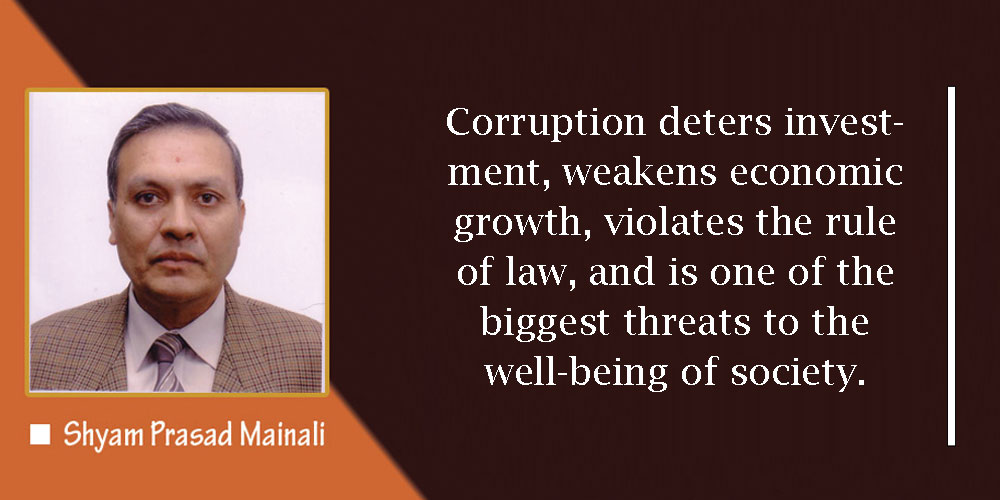

Corruption is a complex phenomenon. Globally speaking, the problem of corruption has been at the center of political agendas. Bureaucracy, politicians, and the business sector of the developing world especially are most seriously affected by, and inextricably involved in corruption. One prominent opinion polls showed that people believed “more than ninety percent politicians are corrupt.” According to the World Economic Forum report, the estimated cost of corruption in a global context is about $2.6 trillion annually. Corruption disproportionately affects the most vulnerable people in society. Corruption deters investment, weakens economic growth, violates the rule of law, and is one of the biggest threats to the well-being of society.
Especially in developing countries, expensive elections cause corruption. Political parties receive donations through businesspersons and industrialists in exchange for political favours when in power. Conversely, employees are paid low wages, facing difficulties securing their basic needs. Due to the lack of job opportunities, many opt to bribe authorities to get jobs. The insufficient punishment of direct corruption promotes corrupt practices. Public awareness and unity against such corruption is lacking. If all people get united against corruption and no one offers bribes, then officials will be compelled to work in a corruption-free manner.
Corrupt practices
There has been lack of transparency in the government activities, lending themselves to loopholes allowing for corruption. Authorising politicians’ detective agencies to investigate their own corruption is a non-starter. As a consequence, those in authority are encouraged to get involved in corrupt practices. In a popular democratic system, anyone can freely establish political parties. When they win an election, the party members desire to expand networks throughout the nation, requiring financial backing, which breeds corruption.
Geographically large countries with low population densities may be more corrupt, as they have increased difficulty monitoring public officials in such extensive and dispersed locations. Countries that recently transitioned from authoritarian regimes to democracies may face more corruption since disproportionate and inappropriate disbursement and public sector monopoly over the distribution of natural resources rights furnishes exploitable economic opportunities. Political instability, lack of rule of law, failure of governance, conflicts of interest, and the nature of bureaucracy are the determinants of corruption everywhere.
Singapore’s strong anti-corruption policy is the result of the legislative measures taken by new catalyst leaders, who revamped laws to give the controlling agency (CPIB) more power. Examples include replacing seconded police officers with permanent civilian investigators, giving powers to the CPIB to work freely, and reminding government contractors at the time of signing that bribing public officers administering the contracts may result in contract termination and debarment lasting five years from any public contract unless they cooperate fully. The primary responsibility of controlling corruption is given to the permanent secretary of the concerned ministry, followed by periodic supervision by the competent authority. Dedicated support from the general public and other concerned officers has been clearly seen in the process, deterring most corruption.
Denmark is another example of a country that has adopted strong legal framework and techniques to combat corruption. Both involved parties, including the private sector are punished equally if found guilty. Politicians and public servants are bound to declare assets and disclose conflicts of interest, which are published and disseminated to the general public. Whistleblowers are respected and protected. With few exceptions, Denmark grants easy access to public documents. It has a number of institutions aiming to tackle corruption, promote transparency, and monitor public sector integrity. The Money Laundering Secretariat is responsible for analysing potential money laundering, financing of terrorism, and other illicit financial transactions.
Herculean task
Countries such as Singapore and Denmark are determined to control corruption, applying multidimensional techniques to this end. Legal provisions are insufficient, should the socially sanctioned sphere be ignored. Economic and political competition, transparency, accountability, and the democratic principles of checks and balances are necessary to curb corruption and the abuse of power. Civil society should culturally and socially boycott corrupt people. State donations to political parties can minimise corruption to some extent. To effectively fight corruption, it needs corruption control framework with its four key pillars - laws, adjudication, enforcement, and public administration - underpinned by political will and leadership.
Combating corruption is a herculean task. For this, serious attention needs to be paid to expose corrupt activities, keep the public sector honest, transparent, and accountable, stop dishonest practices, and ensure that public sector employees act in the public interest. Anti-corruption authorities must be free from political interventions.
(Mainali is a former government secretary)