- Thursday, 28 May 2026

In Quest Of A Humanist Leader

I was in quest of the context in which Abraham Lincoln talked about ‘government of the people, by the people, for the people’, as no study of democracy is complete without this reference. To my pleasant surprise, I got it about three months back in the book, ‘Lincoln The Unknown’ written by Dale Carnegie in 2012, which was gifted to my wife by her student who is settled in the U.S. These words were the last line of his speech delivered at the inauguration of Gettysburg cemetery during the American Civil War.
The battle of Gettysburg had left a pathetic scene. There was little time to dig graves. So, in many instances, a little dirt was scooped over a body where it lay. Within a few days, the rains half-exposed many of the dead bodies. The corpses of Union soldiers were gathered from their temporary graves, and buried in one place at Gettysburg. The Gettysburg cemetery organised the dedication ceremony of the ground for which the president was to speak. Lincoln was not formally invited as the main speaker. He was requested to make only ‘a few remarks’ after the main speaker’s address.
Great task
However, without caring for any due courtesy as a president, he reached there and spoke. To everyone’s surprise, he spoke for two minutes by delivering only 10 lines. I quote here only two lines: “The world will little note, nor long remember what we say here, but it can never forget what they did here”…“ It is rather for us to be here dedicated the great task remaining before us - that from these honoured dead we take increased devotion to that cause for which they gave the last full measure of devotion - that we here highly resolve that these dead shall not have died in vain - that this nation, under God, shall have a new birth of freedom - and that government of the people, by the people, for the people, shall not perish from the earth”.
The writer has tried to throw light on the superb qualities of Lincoln. He paints him as a humanist, a kind and a lover of the Shakespearean dramas. He quotes his speeches to magnify the unknown aspects of his personality. The closing words of his second inauguration are the most noble and beautiful utterances. He quotes, “…With malice toward none; with charity for all; with firmness in the right, as God gives us to see the right, let us strive on to finish the work we are in; to bind up the nation’s wounds; to care for him who shall have borne the battle, and for his widow and his orphan - to do all which may achieve and cherish and just and lasting peace among ourselves, and with all nations.”
He was out and out a sentimental guy and religious too, as the writer claims that there were only two times in his life he wept when trying to speak. This was one of them. After getting elected to the presidency, he was to leave for Washington, D.C from Springfield where he spent about 25 years.
At the station platform, while addressing the people who were there to see him off, he said that ‘no one, not in my situation, could appreciate my feeling of sadness at this parting.’ “To this place, and the kindness of these, he owed everything, as he lived a quarter of a century, and had passed from a young to an old man. His children were born there, and one was buried. He was then leave, not knowing when or whether ever he would return, with a task before him greater than that which rested upon Washington. Without the assistance of that Divine Being who ever attended him, he could not have succeeded.”
Generosity
The war that had killed half a million people ended with the surrender of General Lee representing the Confederacy to General Grant of the US who was once an officer in the regular army while the US was waging war against Mexico. His greatness lied in his dictation of terms of surrender that included discarding all humiliating formalities of military surrender and showing due respect to the defeated army of Lee. His officers were permitted to keep their arms, and his men were to be paroled and sent home; and every soldier who claimed a horse or a mule could crawl on it and ride it back to his farm or cotton-patch and start tilling the soil once again.
Apart from his generosity, his simplicity and greatness can be found in his preparation for leaving his office at Springfield. He requested his law partner not to disturb the signboard hanging at the foot of the staircase so that their clients could understand that the election of a president did not make any change in the firm belonging to him and his partner, Herndon. If he could live, he would come back some time, and then they would go right on practicing law as if nothing had ever happened. Alas, we find such modesty in our leaders.
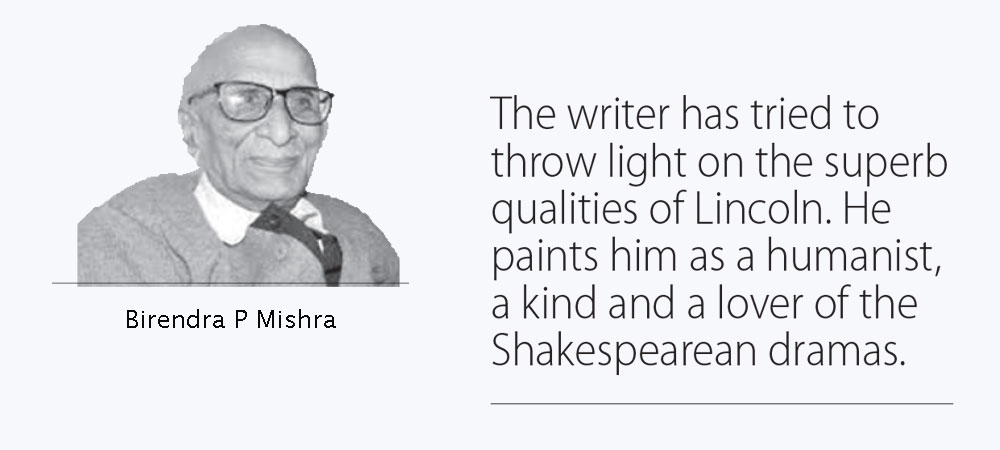
(A former election commissioner, Mishra is associated with Civil Campaign for Democracy.)