- Thursday, 28 May 2026

Dailekh’s famous leather losing identity

Bishal Sunar
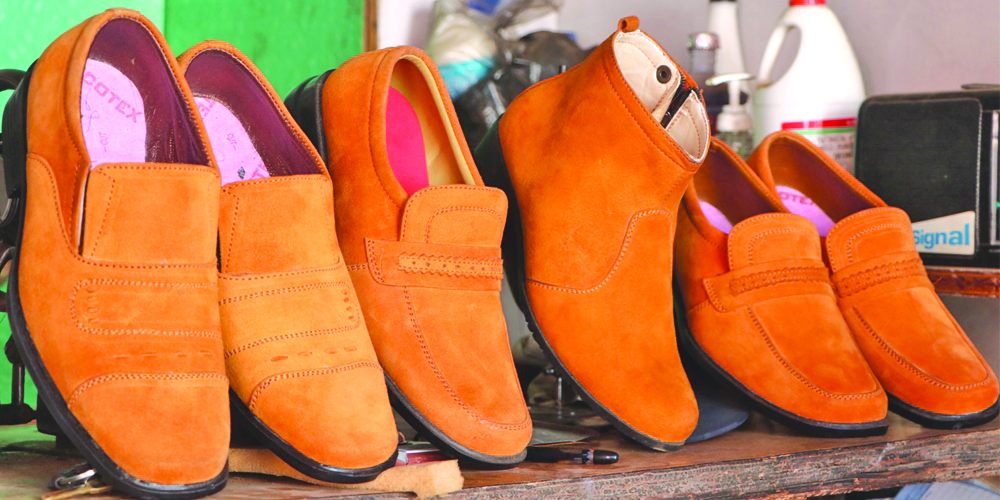
Dullea (Dailekh), Aug 11 : There is a growing concern about the loss of identity of Dailekh’s famous leather (suede). That’s because the items made from suede are having a hard time finding customers.
A Sarki community within the Dalit community of the district has traditionally made a living by making leather shoes and slippers.
The 22 houses of cobblers of Bhagwati Tole of Purano Bazaar located in Narayan Municipality-1 have kept alive the identity of suede.
Nar Bahadur Sarki’s family is believed to have played a special role in the manufacturing and making of popular shoes made from suede. His six sons have elevated the suede to new heights. But now only his third son, Bhadra Bahadur Sarki, is in the business.
Bhadra Bahadur, who is nearing 70 years of age, currently resides in his house in Manghar village of Bhagwatimai Rural Municipality-4. He single-handedly made Dailekh synonymous with suede. But after he retired from the business, the identity of suede is teetering on the brink of disappearance.
This family, which has been in the business for generations, is slowly drifting away from suede production. Sher Bahadur Bishunke, a local resident, says that suede’s identity is about to reach a crisis point due to the lack of a new generation joining the field, legal complications, and production and processing problems.
Suede is a very special type of leather. It is made from the skin of cows, oxen, buffaloes, deer, or other quadrupeds. The basic method is to remove the skin before it is made, then put it in a pit and process it.
The best suede is made from the deer’s skin. Suede has a high price and demand in the world market. It can be manufactured in different colors and is flexible, durable, and attractive, so its demand is high in the market.
According to suede entrepreneur Dal Bahadur Sarki, there is a natural way of imprinting different colors in suede. The bark of Maiwa, Uttis, Kafal, Raach, Anger, etc. is crushed and dyed. He said that it is multi-purpose because it has high-quality leather and attractive color and that not only shoes and slippers but also hats, jackets, ascots, welds, handbags, covers for weapons, and even covers for mobile phones can be manufactured.
A large hole is needed for large skins to make suede. The natural process of leather processing is very long and complicated. Rawhide is ready in five to eight months from the start of the processing process. It takes a long time to remove the bad smell, hair, and fragrance from the skin. Skin hair is removed using limestone quarried from local mines.
Suede has also received national-level awards several times during the exhibitions of the materials produced from suede. Dal Bahadur Sarki also managed to win the 15th National Small Entrepreneur Award in 1999 at Suede’s Shoe and Leather Exhibition. It is also available as a sample in the shoe shops of Dailekh market.
It has become a tradition to receive and give a pair of shoes or slippers as a gift to visitors or guests who come to Dailekh.
According to DB Nepali, who has been researching suede, suede is also given as a gift because it is usually made for the special dresses of high-class families. He expressed his concern about the lack of attraction among the new generations, the increasing legal complexity, the increasing grip of multinational products even in small markets, the death of skillful generations, and the danger of suede disappearing for a lack of skill transfer.
After the promulgation of the National Parks and Wildlife Protection Act in 1973, the legal hurdles started after deer and barking deer were included in the list of protected wild animals.
Antelopes enter the village when there the forests in the high land areas are covered in snow. Their skin is obtained after their natural death or after falling prey to the villagers. Because it takes a long time to produce and that too in limited quantity, availability of suede is rare. And because of its rarity, it is valuable.
Bakhat Bahadur Nepali, president of Shilpi Samaj Dailekh, said that the laws enacted by the government have hit the community hardest. He added that the new creations are also dying as the traditional professions gradually migrate away.
Ganesh Bahadur Thapa, chairman of Bhagwatimai Rural Municipality, says that it is a matter of pride to have traditional skills and art in our own municipality. According to him, there is a plan to protect the skills and arts, but due to the legal hurdle, it has been difficult to translate that plan into reality.