- Saturday, 11 April 2026

TRN Online

A New Age Of Party Democracy
Emilija T. Gjorgjievska , The results of the first round of the French presidential election have echoed the late Peter Mair’s ground-breaking claim, published in 2013, that the ‘age of party democracy has passed. The expert on European politics did not assume that parties would disappear—rather new parties or movements would arise in contemporary democracies, such as we have witnessed with La République En Marche (LRM), the Five Star Movement in Italy or the Pirates and ANO in the Czech Republic. A common thread is what Mair called the ‘hollowing’ of democracy, reflected in a void of disengagement between citizens and their states.The latest electoral result adds to this worrying trend. France’s two long-dominant center-right and center-left parties, Les Républicains (in the most recent incarnation) and Le Parti Socialiste respectively, traded power for most of the six decades and more since the ‘fifth republic’ was established, have collapsed. Between them, they won only 2.3 million out of more than 35 million votes cast.TechnopopulismBut much longer-term societal and political transformations, as elaborated by Christopher Bickerton and Carlo Invernizzi Accetti, have led to a new way of doing politics—‘tech populism’. The fragmentation of contemporary societies makes it very convenient for party leaders to build electoral strategies by staking a claim to expertise, as with Emmanuel Macron using LRM as his vehicle, or by appealing to ‘the people, as with Marine La Pen and her Rassemblement National—the candidates left standing to contest the second round. Indeed, in the logic of tech populism, the two pitches are combined.What should prevent the detachment of individual citizens from their societies are political parties which serve citizens and build social trust, rendering concrete abstract notions of the state, civil society, and their interrelationship. Starting within their own organizations, parties demystify the notion of political accountability. In the absence of structured party democracy, with strong intermediary bodies and a requirement of account-giving, contemporary political leaders who morph into governmental elites can just keep doing ‘whatever it takes to gain and regain power.Dominant political leaders are operating self-referential rules, ostensibly justified by the technical exigencies of effectiveness, modernization, and fast adaptation to external demands, all in the service of ‘the people’. Macron is forever inventing new ways to do European or national politics, whether by reliance on purportedly neutral external expertise—in his administration’s frequent resort to consultancy from McKinsey & Co—or in his transformation of the traditional civil service, replacing the National School of Administration (ENA) with a new Institute of Public Service (ISP) whose graduates’ skills could be put at the service of the private sector as well.This recalls in many ways the approach advanced in the United Kingdom by the former prime-ministerial adviser Dominic Cummings. A managerial, ‘business’ logic seeks to mitigate risks and avoid conflicts, rather than accept public scrutiny or challenge by the political opposition. Indeed a ‘beyond left and right’ bypass of party value systems would be preferred, without recognizing the significance of political alternation.This very much echoes how Mark Rutte won (again) last year’s election in the Netherlands, adopting an ostensibly pragmatic and non-ideological approach that has won him favorable comparisons with the former German chancellor, Angela Merkel. It is a way of doing politics that absorbs rivals on the left, rather than engaging in political contests, leading to a ‘normalization’ of policies for which his own center-right party would not normally stand.The logic of tech populism, whether via the elevation of technical expertise to the political level or the appeal from there to ‘the people’ as if this were free of ideology, leaves an empty space in politics in which leaders no longer accountable to parties can design and run political competitions based on their own beliefs and competences, which can quickly be adapted to a changing environment. Le Pen’s new focus on le pouvoir d’achat (the cost-of-living crisis) in her 2022 campaign, rather than on identity and immigration as in 2017, follows this logic. Alienation Feeding this logic of doing politics, however, has its consequences. One is further alienation among citizens, reflected in abstention from voting and indicators of gradual erosion of social trust. While self-empowerment is evident in the form of social movements, protests and so on, the collective empowerment in which political parties should have the central role is simplified to electoral cycles and strategies in which citizens remain disengaged. Rather than articulate their own collective choices, they are stuck with the choices the political leaders have already made for them.This risk to contemporary democracies requires reinventing the role of party organizations and a new impetus for collective actions which would reflect the needs of societies and their citizens. Such party democracy would assume that political leaders are recruited from within and are held to account by the party itself, including by its base in its members. The logic of account-giving would require parties once more to translate such abstractions as the rule of law or the common good into concrete, intermediated spaces in modern political systems operating at the service of the citizens.(The author is a lecturer in contemporary European politics at Charles University in Prague.)
Promote Value System
Parmeshwar DevkotaAs the local election is nearing, political parties are intensifying their activities nationwide. They are busy holding closed-door parleys to pick the candidates recommended by the lower committees. At the same time, the parties have also formed strategic alliances to gain more votes. This has naturally impelled the foot soldiers to launch a door-to-door campaign to woo the hearts of electorates, thereby setting the tempo for the May 13 local elections.The poll fervour has gripped both rural and urban constituencies. Local intelligentsia, teachers, labourers and farmers are assessing the past activities of the parties. The common voters seem to be making up their minds to shift their political allegiance.A person vying for the ticket of ward chairman in a municipality on the outskirts of the Kathmandu Valley admitted that if his party picked him as the candidate for the same post, he would borrow a huge amount of money to splurge in the polls. When asked if he would use the money to influence the voters, he replied in the negative. But he added that the voters demand to spend for sports clubs, community welfare and charity institutions. This is like a financial trap set up by the voters, he lamented. He went on to say that even the family members of the candidates have a tendency to get involved in collecting donations. He indicated that without money, nobody was ready to move for the election campaign. Recently, CPN Maoist Centre chairman Pushpa Kamal Dahal Prachanda, speaking in a TV talks show, complained that the elections have unbearably become an expensive affair. Some online media have claimed that some political leaders are seeking donations from potential mayoral candidates. If the party tickets are sold to those with fat wallets, it will have a detrimental impact on political culture and democracy. This will eventually spawn Socratic pessimism. In his book ‘A Critical History of Greek Philosophy’, W.T. Stace argues that Socrates was pessimistic about democracy. According to him, demagogues, smooth-talking people and wealthy and charismatic ones alone prevail in the elections because they can easily bribe the meek and uneducated voters. Common voters will elect a sweet-shopper rather than a doctor, eroding the basic freedom of the civilians. So, the political parties and leaders must work to establish a value system. They should judge their workers by their past performance. Candidates must be selected on the basis of their dedication rather than the financial contributions they make to the parties. It is our responsibility to prove that Socrates was wrong. The voters should also stop forcing candidates to pay for votes. They should evaluate candidates based on their past deeds, political ethics, commitment to the wellbeing of society and establishment of a value system. Candidates and voters must strive to prove that democracy is the best form of governance that alone can lead the nation towards stability and prosperity.
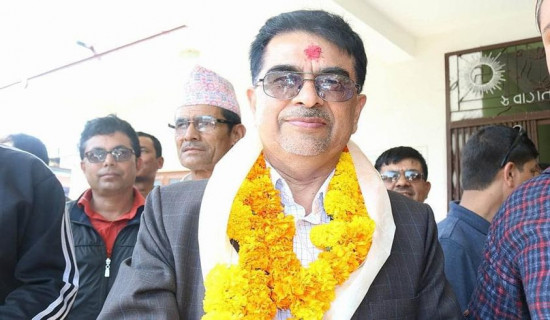
Alliance needed to safeguard constitution, Chief Minister Pandey says
Addressing the 16th annual general assembly of Manmohan Memorial Hospital in the Capital City on Saturday, Pandey added the coalition was required in defense of constitution, federalism and inclusive democracy.
Visiting foreign tourists urged to pay for on-arrival visa in cash
It opted for this as e-payment was cumbersome and sometimes there were glitches in the system, said TIA Manager Prem Nath Thakur.
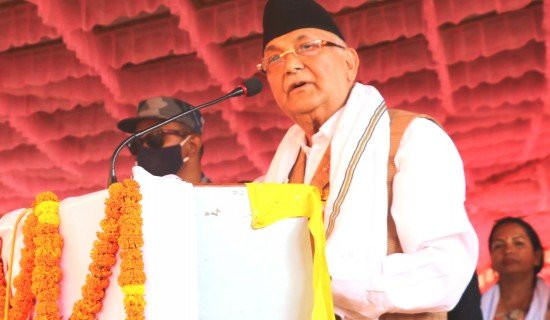
Oli vows to address Madhes issues
On the occasion, Oli said the citizenship bill tabled by the UML-led government could not pass despite it was brought targeting the citizens without citizenship.
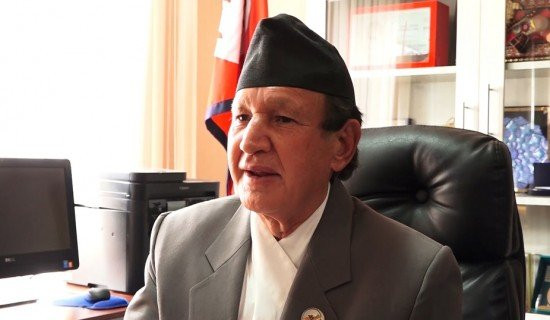
Japanese govt support to Nepal crucial: Minister Khadka
Minister for Foreign Affairs Dr. Narayan Khadka said the Japanese government's assistance to Nepal was very important for the development of Nepal.
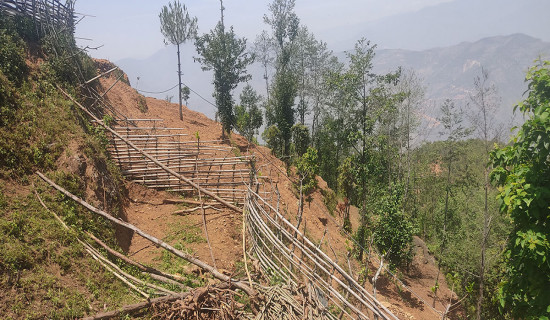
Foreign employment returnee Rai turns barren land into productive field
"I have a plan to utilise the remaining piece of land for growing fruits such as oranges and lemon," Rai said, adding, "I have already started rearing goats here."
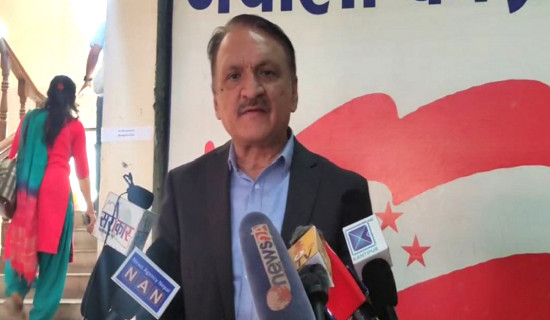
NC will not forge electoral alliance with UML : Spokesperson Dr. Mahat
"We have strictly instructed the party committees at the local levels for not forging an electoral alliance with the CPN (UML) even in the event that electoral alliance is not forged among the ruling parties,"
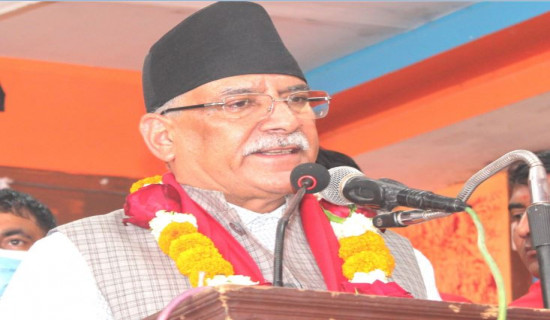
Naiton will lose if Maoist Center loses election: Chair Prachanda
"This election is a battle for us. If we win, the nation will win and the vice versa," he said, "If the Maoist Center loses the election, it will be like the loss of the republican set up, which in turn will be the loss on part of the oppressed women, dalit, indigenous nationalities, persons living with a disability."

Nepal Airlines conducting direct flight to Saudi Arabia from April 22
The national flag carrier, Nepal Airlines, is conducting a direct flight from Kathmandu to Riyadh city of Saudi Arabia from April 22. The Nepal Airlines (NA) informed that the wide-body A 330 plane was launching the flight to Saudi Arabia.

Six new cases, 44 recoveries in 24 hours
In 1,986 Real-Time Polymerase Chain Reaction (RT-PCR) tests done in the past 24 hours, a total of six people were found infected with SARS-CoV-2, informed the Ministry of Health and Population (MoHP) in its regular update.
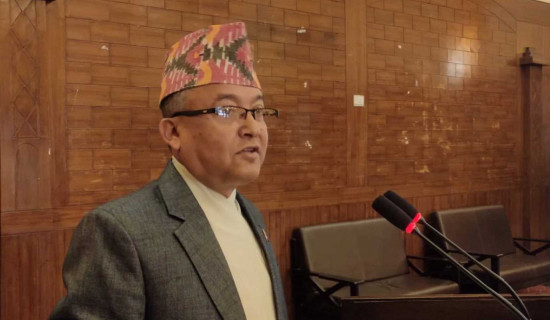
Civic poll on scheduled date: CEC Thapaliya
Chief Election Commissioner (CEC) Dinesh Kumar Thapaliya said the free and fair election would be held in the stipulated time.
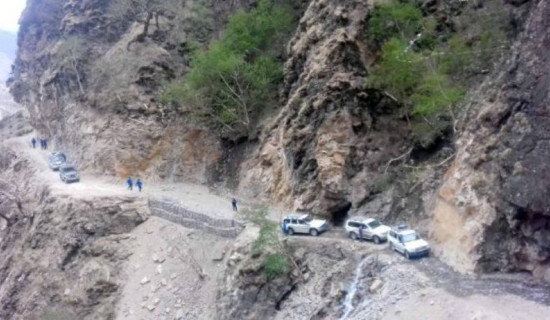
Beni-Maldhunga road to be closed for five hours daily
Myagdi, April 16 (RSS): Beni-Maldhunga road would remain closed for five hours daily from today. Vehicular movement along the road section would be closed from 11:00 am to 4:00 pm daily till May 8 in order to upgrade it. The road section connects Myagdi and Mustang districts with the national highway. According to the Beni-Jomsom-Korala road project, the Beni-Maldhunga road would be closed in order to accelerate the construction activities of the road section in a smooth and easy manner. The Beni-Jomsom-Korala road project and the construction company had proposed the District Administration Office to close the vehicular movement along the road section after road expansion activities were affected due to pressure of vehicles. Earlier, the road section was also closed for five hours daily from December 30, 2021 to January 28, 2022. Proprietor of assistant construction company, Omkareshwor, Amrit Dahal, said that they had demanded the District Administration Office to close the vehicular movement along the road section in order to expedite road construction activities. Activities related to upgrading and expanding the 13-kilometer road linking Maldhunga of Kushma municipality-1 and Beni of Myagdi to two-lane are underway at the cost of Rs 528 million.
Commitment to prioritize child rights issues in upcoming election
Kathmandu, April 16 (RSS): Leaders of major political parties have pledged to prioritise issues and concerns related to children and child rights in their manifesto for the upcoming local level election. The local level election is slated for May 13 in a single phase. At a political discourse organized by the Children as Zones of Peace National Campaign here today, they assured to take concrete steps for implementation and protection of child rights enshrined as the fundamental rights in the Constitution of Nepal. CPN (UML) general-secretary Shankar Pokharel said that his party had been championing the cause of child rights and called for declaring schools as a peace zone since insurgency. "There is no doubt that the State should lay its focus on children to ensure the bright future of the nation," he noted. Similarly, the ruling Nepali Congress's assistant general-secretary Jivan Pariyar shared that they had been addressing many concerns related to children by holding discussions and consultations during the promulgation of the constitution. "Nepali Congress is committed to enforcing the policies and laws formulated to guarantee child rights." He lamented that the issues of child rights were neglected even in educated families. Likewise, CPN (Maoist Centre)' leader Shakti Bahadur Basnet spoke of the need to walk the talk instead of confining child rights issues to sloganeering. He viewed the current constitution as child-friendly as he argued that it was promulgated by the elected people's representatives. Child rights defender Gauri Pradhan said that the political parties, as well as the State, should prioritize concerns of child rights such as smooth registration process for childbirth, free education and free enrollment, sports, entertainment and protection of child rights. Advocate Indu Tuladhar pointed out the need to adhere to the provision in the election code of conduct that bars mobilizing children in the election promotion and forbids the use of the school for election promotion. Rajesh Sharma from the host organization urged all political parties to prioritize issues of children in their manifesto.
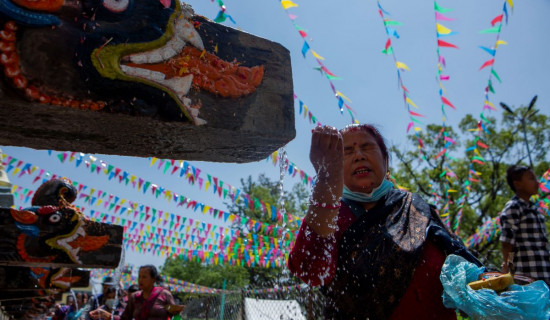
Balaju Bais Dhara Jatra in pictures
Hindu devotees celebrated the Balaju Bais Dhara Jatra (22 water spouts festival) on Saturday. The festival is celebrated every year on the day of Chaitra Sukla Purnima.