- Thursday, 14 May 2026


Modnath Dhakal
Parties stress ‘balanced, equal’ foreign policies in manifestos
Major political parties have promised in their manifestos that they would maintain a 'balanced' and 'equal' foreign policy with all friendly nations.
Party manifestoes laced with unrealistic claims to lure voters
Political parties in Nepal don’t seem to have learnt from the past experiences in election and have continued with the ‘baseless’ and 'ambitious' plans and commitments in their election manifestoe

Biratnagar industries see whopping rise in production costs
More than 29 per cent industrialists in the eastern industrial city, Biratnagar, said that the production cost per unit has increased unnaturally – by more than 75 per cent – due to national and international factors.
New urban policy in offing
The Ministry of Urban Development (MoUD) has finalised a new urban policy and sent it to the Cabinet for the approval. The new policy has included measures to address climate change, urban resilience and Sustainable Development Goals (SDGs) apart from the regular issues of infrastructure development, waste management and social services such as health and education.

NRNA calls to amend foreign investment laws
The Non-Resident Nepali Association (NRNA) has urged the government to implement the non-resident Nepali citizenship provision at the earliest and amend the foreign investment related laws to remove the ceiling on the Foreign Direct Investment (FDI).
Lax monitoring breeds ‘anarchism’ in cooperatives
Nine years ago in 2013, Oriental Cooperative embezzled the depositors’ money to the tune of Rs. 6.86 billion. Approximately, Rs. 11.41 billion fund deposited at the organisation was at risk and its chairman, Sudhir Basnet, had used t 60 per cent of the money by himself. He had invested the money in various housing and real estate projects. Likewise, Guna Saving and Credit Cooperative was also fell into problem then. Responding to the public outcry, the government in October 2013 had formed a commission to investigate the problematic cooperative organisations dealing in savings and credits. By May 2014, the commission led by Gauri Bahadur Karki, former Chairman of the Special Court, received 22,170 complaints from 12,962 individuals against 162 cooperatives. The total claim was Rs. 10.08 billion including Rs. 2.40 billion interests on the deposits.
Branding local liquor can boost tourism, expand economy
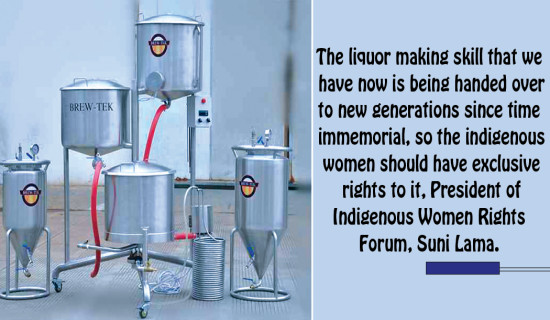
Nepal imports alcoholic beverages worth more than Rs. 1.5 billion a year. However, illegal import and gifts could increase the amount. Meanwhile, 'Chyang' touted as indigenous alcohol is being imported from China and South Korea. But producing alcohol other than for religious and domestic purposes is illegal in the country. Nepal police destroys millions of litres of home-made liquor every year in Nepal. For example, it destroyed 10,000 litres of illegal alcohol and 80,000 litres raw materials in Gadhimai Municipality in Bara district. According to the police, it had seized the items from various houses and taverns in Ward No. 3 and 10 of the municipality. Interestingly, police found concrete underground tanks with the capacity of about 12,000 litres especially made to store liquor at a house there.
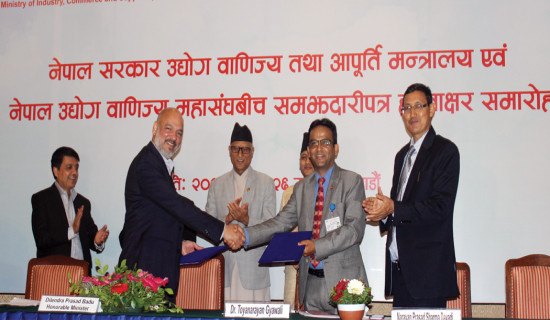
Govt, private sector sign deal to build economy worth $100 bn by 2030
In a rare event in Nepal's private sector history, the Federation of Nepalese Chambers of Commerce and Industry (FNCCI) has succeeded in getting endorsement of the government for its Nepal Economic Transformation (NET) 2030 – a vision of national development for this decade. The business body and the Ministry of Industry, Commerce and Supplies signed a Memorandum of Understanding (MoU) on Thursday to implement the Vision 2030. Hailed as the government-private sector partnership, this would bring together the two pillars of the economy together at a platform to achieve the target to build an economy worth US$100 billion by the end of 2030 and lead it to a middle-income country.
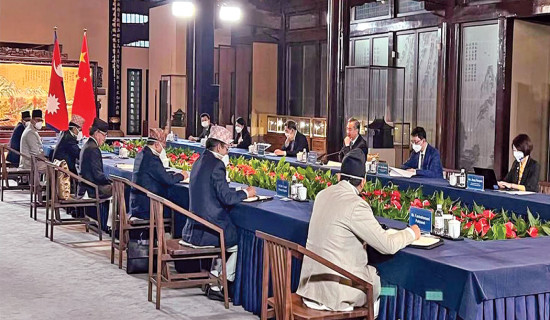
China agrees to expedite development projects in Nepal
China and Nepal have agreed to expedite the implementation of China-assisted projects in Nepal. The former has assured the Nepal that China will soon start the construction works of the second phase of Kathmandu Ring Road Improvement Project, the Embassy of Nepal in Beijing said in a statement issued Wednesday evening.
Qatar to help Nepali migrant workers to build homes
Qatar has expressed interest in supporting Nepali migrant workers in the Gulf nation to build their houses. Ambassador of Qatar to Nepal Yousuf Bin Mohammad Al-Hail said in a meeting with journalists the other day that his country is ready to support returnee Nepali migrant workers to build their own houses. For this, he proposed to create a labour bank in Qatar and depo

How to distribute mountaineering, telecom revenues? not legal’
The Office of the Auditor General (OAG) has asked the government to clear the confusion regarding the distribution of the revenue generated from mountaineering and telecommunication. Nepal Mountaineering Association (NMA) is collecting the royalty from 27 snowcapped peaks measuring above 6,000 metres and distributing the revenue to various levels of the government. In FY 2019/20, the NMA deposited 55 per cent of the collected royalty to the federal consolidated fund and kept the remaining 45 per cent to itself while in 2020/21, it deposited 50 per cent to th
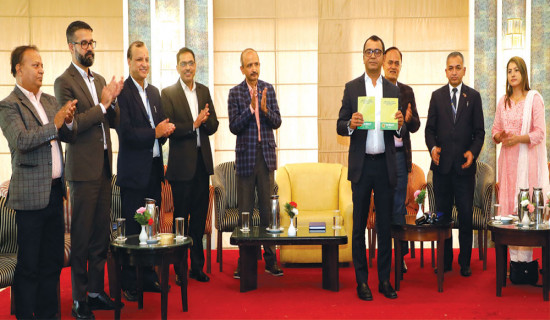
SEBON to increase number of share brokers and stock dealers
The Securities Board of Nepal (SEBON) has unveiled its Policy and Programmes on Securities and Commodities Market for Fiscal Year 2022/23, with plans of expanding the number of share brokers and stock dealers.

Nabil Bank begins to groom entrepreneurs
Should the banks and financial institutions (BFIs) that play an instrumental role in the development of business, industries and infrastructure through the mobilisation of finance put their efforts to create entrepreneurs by themselves? While many BFIs have concentrated their policies and practice to enhance their lending and deposit portfolio, Nabil Bank has taken a different route to create and nurture entrepreneurs and startups in the country. The profit-seeking private sector bank has been implementing a programme to create entrepreneurship to develop social enterprises to solve everyday problems of the people.
Capital spending below halfway mark
Government capital spending has remained the worst this compared to the past many years except the period of the coronavirus pandemic in 2020 and 2021. Total mobilisation of the capital allocation for the current fiscal year 2021/22 has reached just 46.22 per cent by Friday, according to the report of the Financial Comptroller General Office (FCGO). The number is about 8 per cent less than the development spending in the last FY 2020/21 when the government had spent about 54 per cent of the budget earmarked for development works. Then the county was under the threat of COVID-19 and businesses had been trying to recover from the damages caused by the pandemic.
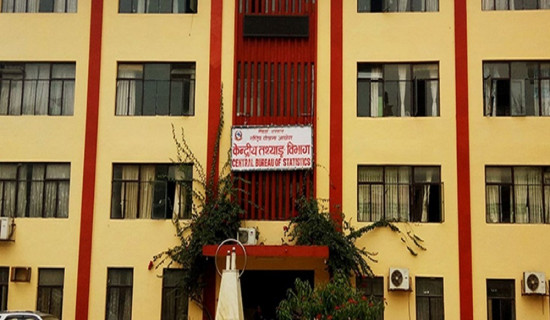
Domestic industries yield 42% value addition
Kathmandu, July 9: The number of industrial enterprises in Nepal has reached 60,185 by March 2020, concluded the National Industrial Survey 2020 published by the Central Bureau of Statistics (CBS) on Friday.There are 56,611 enterprises in industrial manufacturing, 356 in mines and minierals, 994 in electricity, gas and air-conditioning, and 2,224 in water supply, sewarage, and waste management and its treatment. The CBS said that 491,227 people are involved in these industrial enterprises – 6485 in mines and minerals, 444,964 in manufacturing, 21,593 in electricity, gas and air-conditioning, and 18,185 in water supply, waste management and treatment sector.However, the number of employees and workers getting regular salary and wages is only 381,687. All the industrial establishments have spent about Rs. 107.89 billion in salaries and wages – including cash, goods and other facilities – in the reference year 2020. Of the total amount paid for the salary and wages to the employees and workers, enterprises in mines and minerals sector mobilised Rs. 1.8 billion, industrial manufacturing Rs. 95.77 billion, gas and air-conditioning Rs. 6.92 billion and water, sewarage and waste management Rs. 3.4 billion. Likewise, the enterprises with the fixed assets worth Rs. 619.5 billion have produced goods and services of Rs. 1201.17 billion by spending Rs. 846.66 billion cost investment. It means, the total value addition was Rs. 354.51 billion – about 42 per cent. Capacity utilisation About 76 per cent enterprises had run for more than 270 days, 19 per cent 180-269 days, 4 per cent 90-179 days and 1 per cent less than 90 days. But only 39.9 per cent industries had run in their full capacity and 18.7 per cent enterprises utilised 75-99 per cent of their capacity while 29.1 per cent of them ran in 50-74 per cent capacity. About half of the industries (46 per cent) cited lack of demand and market for their inability to optimise the maximum capacity of the production plants. Similarly, insufficient raw materials (10 per cent), lack of resources (8 per cent) and shortage of skilled manpower (8 per cent) were other reasons. Access to financeThe survey has found that the small manufacturing enterprises – having less than 10 workers - have poor access to finance with only 34 per cent of them obtaining loan from the financial institutions. One per cent of them have received the commitment for loan mobilisation while 5 per cent are in the process of receiving loans. Number of large industries has increased by 23 per cent in a decade. There were 4,076 large enteprises in 2010 which has gone up to 5,017 in 2020. Likewise, the number of people involved in these institutions has increased by 41 per cent in the past 10 years to reach 288,170. The average number of people involved in an enterprise is 57. It was 50 in 2010. Deputy Director General of the CBS Dr. Hem Raj Regmi said that although the reference year was set for 2020, the survey was conducted in the last fiscal due to the COVID-19 pandemic. The report also revealed that the first lockdown in 2020 caused the complete closure of 63 per cent enterprises, 24 per cent could run partially and only 13 per cent were operated in full capacity. Likewise, about 17 per cent employees and workers were forced to leave their work without any facility.
