- Tuesday, 26 May 2026

Beautiful Poems In Metre
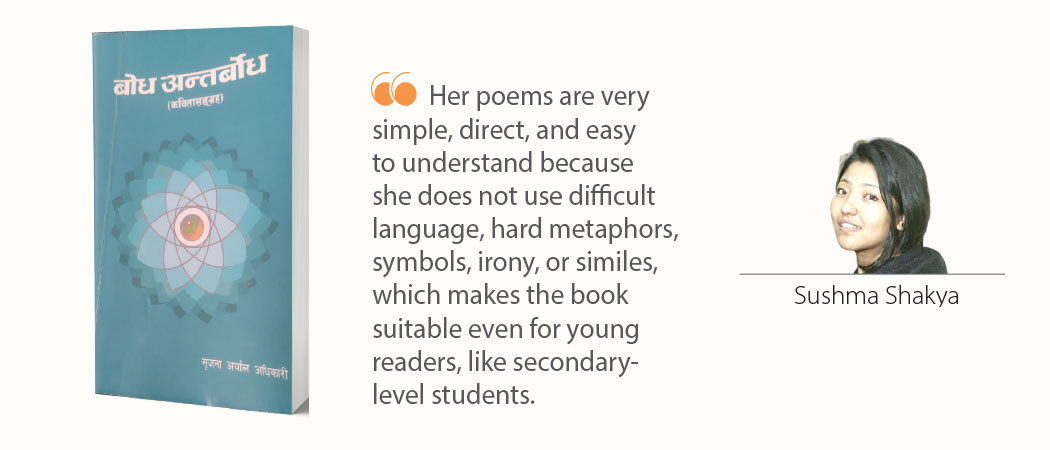

Bodh Antarbodh is a poetry collection written by Srijana Aryal Adhikari, who is a thoughtful, hard-working and knowledgeable poet. Also a playwright and lyricist, Aryal is a well-known and respected poet in the field of poetry in metre. Using traditional literary styles and classical rhythms, she has been practicing and writing poetry for many years with great dedication and passion.
Her poems mainly focus on important social issues. She often writes about the suffering and struggles faced by women in society. Through her poems, she raises her voice against injustice and unfair treatment. She also writes about love for the nation and encourages people to feel proud of their country. Nationality and patriotism are important themes in her work.
From this book, we can clearly understand that the poet has a wide knowledge of poetic metres or chhanda because she has used many different chhandas such as Shikharini, Sardulbikridit, Malini, Upajati, Mandakranta, Indrabajra, Bansashtha, Bhujangaprayaat, Gitika, Druta, Baishabdevi, Shragbini, Basantatilka, Shragdhara and many others, and she has also mentioned the Sutra and Gan of the poems, which shows her serious study of poetry.
Bodh Antarbodh's poems extend beyond mere imagination, establishing a robust connection with real life and contemporary society. Readers can easily relate to most of the poems, as they reflect contemporary issues and problems that people face today. The poet has written poems on social issues like brain drain, where young people leave the country in search of a better future, political instability, corruption, the pain of common people, the corona pandemic, gender discrimination and feminist ideas. She makes readers think deeply about these issues and inspires them to bring positive change.
Her poems also teach people about social responsibility and the importance of working together for the betterment of society. One of the most emotional and meaningful poems in this collection is Mero Antim Ichhya, which presents the sad reality of today’s society where many children go abroad for happiness and success and leave their old parents alone in the village or at home. The poem shows how the country slowly becomes a place where old people are neglected, and it beautifully expresses the last wishes, pain, and loneliness of such parents, which touches the heart of the reader.
In many poems, the poet expresses anger, frustration and pain towards an unjust society, and her strong voice against social anomalies makes the poems powerful and meaningful. Her poems are very simple, direct, and easy to understand because she does not use difficult language, hard metaphors, symbols, irony, or similes, which makes the book suitable even for young readers, like secondary-level students. A clear feminist feeling can also be seen in some of her poems, such as Burka Lagau Aba, where the poet raises questions about women's freedom, identity and position in society and tries to make readers think about gender equality.
Patriotism is another important theme in this book, and poems like 'Gaau Farkera Aau', ‘Aau Surakshya Gara’ and ‘Antim Ichhya’ express love for the nation and request people to protect their country and return to their roots. The poem Aama, written in Vidhata Chhanda and Anustup Chhanda are simple in language but very emotional and touching, as they show deep love, respect and attachment towards a mother, which every reader can feel. The last line of 'Gaaro Chha Aama Huna' feels realistic, deep and emotionally touching.
The line says, 'Sewamai chha samasta jiban tehi vetinchha aafnopan
Sochda swarga yatharthama, tara nikai gaaro chha aama huna.
These lines carry very emotional and profound meaning. Indeed, a mother spends her whole life serving and caring for her family, and through her love and sacrifice, we feel warmth, safety, and belonging. Although we imagine heaven as a joyful and peaceful place, the poem tells us that being a mother is actually very difficult.
Although the poet has successfully used many chhandas, some chhandas like Sardulbikridit Chhanda may not seem very attractive or interesting to general readers, but poems written in Indrabajra Chhanda are engaging and captivating from the very beginning.
The poem Kahani Xa Baaki written in Bhujangaprayaat Chhanda is especially entertaining to read and listen to, and its lines express hope, togetherness and love by saying that people should live and die together, and even if difficult times have passed, there is still a bright future ahead as long as loved ones are together, showing that life’s story is not yet finished.
However, the book also has some technical weaknesses, including a few typing and naming mistakes regarding the chhandas. For example, a poem is referred to as Shikharini Chhanda when it is actually written in Bidhunmala Chhanda, and an example of Shikharini Chhanda is incorrectly given in Panchachamar Chhanda. These errors slightly affect the book's technical accuracy.
Despite these minor errors, Bodh Antarbodh is a meaningful and socially aware poetry collection that successfully combines classical poetic forms with modern themes and issues, reflects the pain, hope and reality of contemporary society, and leaves a strong impact on readers, making it a valuable and suitable book for students and general readers who want to understand poetry connected with real life.
Through her poetry, she tries to spread awareness, encourage equality, and inspire people to build a better and more just society.
(Shakya is a Kathmandu-based freelance writer.)