- Friday, 29 May 2026

Manifestos Must Prioritise Education

As the nation moves closer to another election, political activities have intensified across the country. Leaders of major political parties are busy visiting voters, addressing gatherings, and making verbal promises. However, one important democratic practice remains largely absent: the timely publication of clear, comprehensive, and credible election manifestos. This absence raises a serious concern, especially when voters are expected to make informed decisions about the future of the country.
In many parts of Nepal, electoral choices are influenced less by long-term national vision and more by immediate local interests. Voters often assess candidates based on their ability to bring infrastructure projects to their constituency, their access to power, or their potential to become influential ministers. In some areas, especially where awareness levels are low, the capacity of a candidate to spend heavily during the election period also becomes a determining factor. As a result, controversial or less competent leaders sometimes emerge victorious, not because of their policy vision, but because of money, influence, or narrow local considerations.
National policy
This trend weakens the essence of representative democracy. Elected leaders are not meant to be mere agents of local development projects. Their primary responsibility lies in shaping national policy, reforming laws, ensuring checks and balances, and safeguarding the rights and interests of citizens. While participation in executive power is important, law-making and policy reform should be their first priority. Unfortunately, this foundational role is often overlooked in practice. In developed democratic systems, political parties place great importance on their manifestos. These documents clearly outline policy priorities, reform agendas, and long-term plans that guide governance if the party comes to power.
In Nepal, however, manifestos often receive little attention, both during elections and after. This needs to change, and education reform must be placed at the very centre of these documents. Education is the foundation of all development. Yet, despite political changes and constitutional reforms over the decades, Nepal’s education system continues to operate under outdated legal frameworks. Even after the promulgation of the new constitution, the Education Act has not been fully revised to align with constitutional provisions. Much of the education sector is still governed by laws and practices rooted in the Panchayat era, which no longer reflect current social, economic, or global realities.
The constitution clearly states that basic education is free and compulsory, and secondary education is free. However, the reality on the ground tells a different story. There is a deep and growing gap between public and private education. Children do not receive equal learning opportunities, and quality varies widely depending on economic background and location. This dual system is producing two different types of human resources, leading to feelings of inequality and discrimination among citizens. Investment in education remains insufficient, and even the allocated budget is often not used effectively. In some secondary schools, teachers are available but students are absent, while in other areas students are eager to learn but teachers are lacking.
This imbalance reflects weak planning and poor implementation. Political parties must acknowledge these structural problems and clearly outline practical solutions in their manifestos. Another pressing concern is the mass migration of young people. After completing Grade 10 or 12, many students choose to go abroad for higher education or employment. A large number of them leave as unskilled or semi-skilled workers. As a result, villages are becoming empty, agricultural productivity is declining, and even cities are facing social and economic strain. When a country continuously exports its youth without building skills or retaining talent, a fundamental question arises: who will develop the nation, and for whom?
This issue is closely linked to the declining quality and relevance of higher education within the country. Universities are losing students every year, yet government policy seems disconnected from this reality. Instead of improving quality, emphasis has been placed on increasing the number of universities. Today, Nepal has a growing number of universities offering largely similar courses, without specialisation, innovation, or strong research orientation. This uncontrolled expansion has led to unhealthy competition among universities to attract students, sometimes through questionable practices. As a result, academic standards are declining, and public trust in higher education institutions is eroding.
Rather than increasing numbers, universities with similar programmes should be merged, and the total number should be limited to a manageable few with clear academic identities and strong quality assurance. University education must be practical, market-oriented, and aligned with the needs of the 21st century. Unfortunately, many teachers and professors lack opportunities for professional development. Research culture is weak, and academic updating is often neglected. At the same time, political interference in educational institutions has become common. Professors and administrators are frequently affiliated with political groups, undermining academic independence and merit-based governance.
Education is an intellectual sector and should remain free from political influence. Every political party must clearly commit, through its manifesto, to ending political practices within schools and universities. Without academic freedom and professionalism, meaningful reform is impossible. Merely allocating more projects or promising promotions and permanent positions will not solve the deep-rooted problems of the education sector. Structural reform, accountability, transparency, and long-term planning are required.
Absence of quality services
Education, health, and employment opportunities within the country are constitutional rights, but in practice, citizens continue to struggle to access quality services. If education is improved, positive change will naturally follow in other sectors. A well-educated population contributes to better health outcomes, stronger governance, economic growth, and social harmony. Therefore, education should not be treated as just another sectoral agenda; it must be the top priority of all political parties seeking public trust.
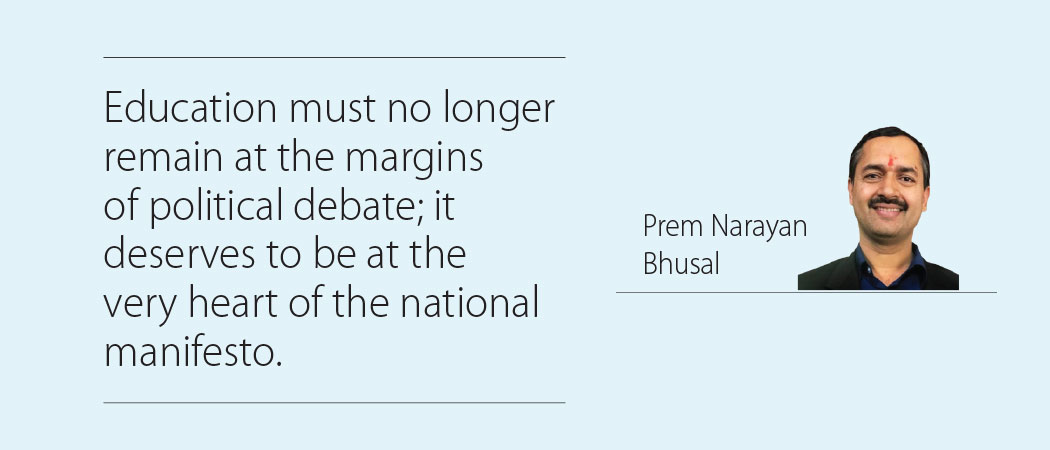
Finally, election manifestos should not be symbolic documents meant only to attract votes. They must serve as binding policy guidelines for governance after elections. Voters, too, have a responsibility. Parties that present clear, realistic, and sincere education reform agendas should be supported. Only then can Nepal move towards sustainable development grounded in knowledge, equity, and opportunity. Education must no longer remain at the margins of political debate; it deserves to be at the very heart of the national manifesto.
(Bhusal is a psychological counselor.)