- Tuesday, 26 May 2026

EC recognises Gagan Thapa-led Nepali Congress leadership
.jpg)

By Pallav Bhusal,Kathmandu, Jan. 17: The Election Commission has formally recognised the leadership elected by the Special General Convention of the Nepali Congress. With this recognition, Gagan Kumar Thapa is the President of the Nepali Congress, the oldest and largest party of Nepal.
A meeting of the Election Commission held on Friday decided to update its records with the details of the office bearers elected from the Special General Convention, concluding that the event was conducted in accordance with the law and the party statute.
With the Commission’s decision, all resolutions passed by the Special General Convention (SGC) held from January 11-14 have gained legal recognition.
The long-standing claim by the faction led by Sher Bahadur Deuba that the SGC could not be recognised has, as a result, been effectively dismissed. The decision has also meant that all actions taken by the SGC group, including organisational decisions and direct nominations, will now be treated as official party acts.
The recognition has further rendered the previous Central Working Committee, headed by Sher Bahadur Deuba, invalid, bringing its authority within the party to an end. This marks a decisive shift in the balance of power inside the Nepali Congress, which has been embroiled in internal disputes for months over leadership legitimacy, party statute and the timing of conventions.
Issuing a statement following the Commission’s decision, Nepali Congress President Gagan Kumar Thapa welcomed the move, saying it was made in line with the Constitution, prevailing laws and the party’s own statute.
He said the outcome reflected the collective efforts of party members and well-wishers seeking fundamental reforms within the Nepali Congress and long-term prosperity for the country. According to Thapa, the decision reaffirmed that the party is guided not only by its leadership but also by the will of its general members,
signaling a return to its core values and ideals.
Calling for unity, Thapa urged leaders and cadres at all levels, both within the country and abroad, to remain calm, responsible, and united. He stressed that internal disagreements should not be seen in terms of victory or defeat, but as part of a broader process of transformation.
He said the party had entered a new phase with renewed energy and pledged to move forward without factionalism, focusing on preparation for the upcoming elections and building a democratic, people-oriented organisation aligned with public aspirations.
Following the Commission’s recognition, Nepali Congress Vice President Bishwo Prakash Sharma announced that the party would contest the next elections with Gagan Thapa as its prime ministerial candidate.
Speaking via Facebook Live, Sharma said the Congress would break from past practices by going directly to the people to present its prime ministerial candidate before the polls. He said the decision reflected both the sentiment within the party and wider public opinion, and was consistent with resolutions passed by the party’s delegates. Sharma urged party workers celebrating the decision across the country to see it as a step towards building a new Nepali Congress, grounded in unity, political stability and a clear roadmap for governance.
The controversy that preceded the EC’s decision centred on whether the SGC held in Kathmandu earlier this month had the authority to elect a new leadership, or whether the Central Working Committee elected at the party’s 14th general convention in 2021 remained the sole legitimate body.
The dispute came into the open after the Thapa faction approached the Election Commission, informing it that an SGC held at Bhrikutimandap from January 11 to 14 had unanimously elected new leadership and endorsed amendments to party policies and statutes.
In response, leaders aligned with Sher Bahadur Deuba also approached the Commission, arguing that the existing Central Working Committee was the only legally recognised authority under the party constitution. They maintained that only the Central Working Committee had the mandate to convene any form of convention and that the process initiated by the rival faction was therefore invalid.
Representatives of the Thapa group countered this claim by citing provisions in the party statute that allow for an SGC to be called if demanded by a majority of general convention delegates. They argued that the convention had been organised strictly in line with these provisions, after more than half of the delegates formally submitted a petition demanding such a gathering.
The Deuba faction, meanwhile, sought legal advice from senior lawyers before submitting documents to the Commission, claiming that a significant number of delegates had withdrawn their signatures from the original petition supporting the SGC. Purna Bahadur Khadka, the outgoing acting president who led the delegation, described the rival convention as unconstitutional and warned of protests if any decision went against what he described as the party statute, existing laws and the Constitution.
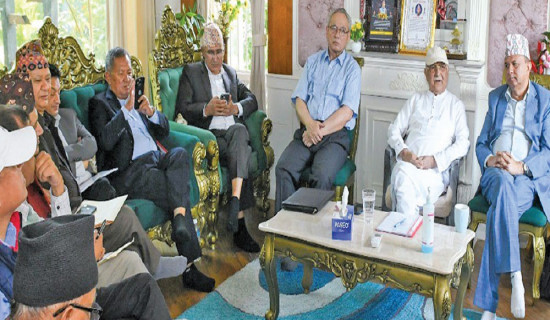
Later, Khadka reiterated his position at a press conference at the party’s central office in Sanepa, stating that the party statute grants exclusive authority to the Central Working Committee to make decisions related to conventions at all levels. He said the demand for a special convention had effectively lapsed once preparations for the regular general convention had begun.
The Thapa faction rejected these assertions, with leaders accusing the previous leadership of failing to meet legal and organisational responsibilities, including delays in active membership renewal and obstruction of the regular convention process. They also dismissed claims about the withdrawal of delegate signatures, arguing that objections raised after delegates had already participated in the SGC were politically motivated.
The current developments are rooted in a lon ger history of SGCs within the Nepali Congress. The second SGC was held in Kathmandu under the slogan, “To change the Congress, to change the country through a transformed Congress”, with the aim of reforming leadership structures, policies and statutes. The first such convention was held in Biratnagar in May, 1957, when founding leader Subarna Shamsher handed over the party presidency to BP Koirala. That period of unity later translated into electoral success, with the Nepali Congress securing a two-thirds majority in the 1959 general elections.
In the present case, 2,488 delegates, representing 54.58 per cent of general convention members, had submitted a petition demanding a special general convention. Although the outgoing Central Working Committee later fixed dates for the party’s 15th General Convention, the Thapa–Sharma group proceeded with the special convention in the absence of the Deuba faction, arguing that the demand of the majority could not be ignored.
Despite the Election Commission’s recognition, the Deuba faction has maintained that the decision is invalid. Khadka has argued that it violates the Constitution, the Political Parties Act and the party statute, and has indicated that a legal challenge may follow. Senior party leaders, including former office bearers and central figures, have publicly backed this position.
The Commission’s decision has nevertheless given formal legitimacy to the new leadership and brought a temporary conclusion to one of the most intense internal disputes in the Nepali Congress in recent years. Whether the recognition leads to lasting unity or further legal and political confrontation remains to be seen, but it has undeniably reshaped the party’s internal power structure ahead of the general elections.