- Monday, 4 May 2026

Raja Vidya: Lord Krishna's Gift To Humanity

With the birth of a human being, countless questions are also born. Therefore, no person can live a life entirely free from curiosity. The Vedanta-sutra thus instructs that after receiving this rare human birth, one must enquire into the Absolute Truth—Brahma-jigyasa, the search for the origin of this vast universe.
In Bhagavad Gita as it is (7.16), Lord Shri Krishna declares that four types of people approach him: those in distress, those seeking knowledge, those desiring wealth, and those searching for absolute truth. From this, we learn that a curious seeker is most noble (jijnasuh sreya uttamam).
Take, for instance, Arjuna's situation in the Mahabharata. He continuously voiced his doubts to Lord Krishna: "How can I fight against my grandfather and teachers? Wouldn't it be better for me to retreat to the forest?" From a material perspective, his concern seemed valid. But that material truth could not withstand the gaze of the ultimate reality.
Arjuna, being a Kshatriya and in the presence of the Supreme Lord, had a duty to uphold Dharma, protect the righteous, and safeguard the devotees. When Arjuna was emotional and unable to discern right from wrong, he surrendered to Lord Krishna, saying, "sisyas te ham sadhi mam tvam prapannam"—"I am Your disciple. Please instruct me." From this, we understand that asking the right questions to the right person opens the door to true surrender to God.
Krsnadssa Kaviraja Goswami writes in Chaitanya Charitamrta, "jivera svarupa haya nitya-krishna-dasa,” meaning the eternal nature of the living entity is to serve Lord Krishna. Just as one feels pride in serving a prestigious company, how much more glorious is it to be in the service of the Supreme Lord, the master of the universe?
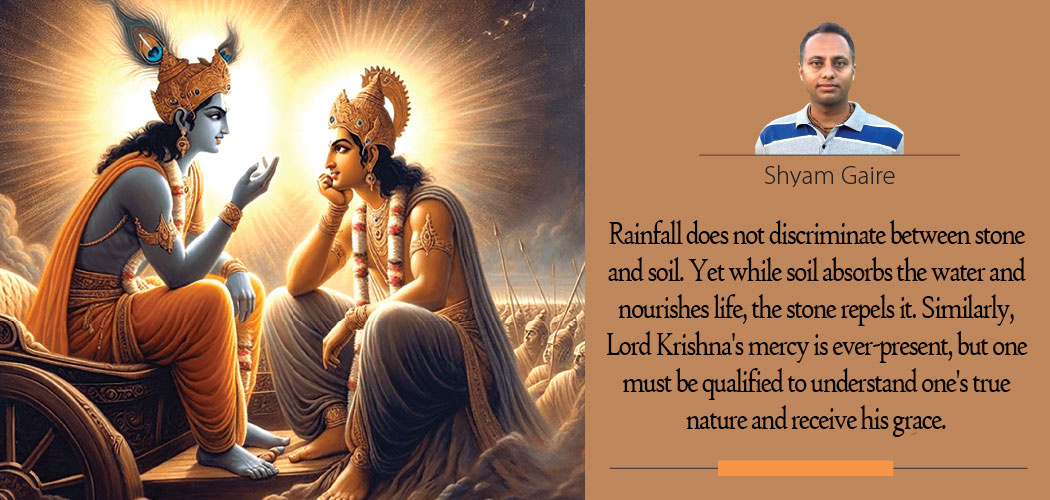
Rainfall does not discriminate between stone and soil. Yet while soil absorbs the water and nourishes life, the stone repels it. Similarly, Lord Krishna's mercy is ever-present, but one must be qualified to understand one's true nature and receive his grace. Lord Krishna revealed his universal form (virat-rupa) to all on the battlefield of Kurukshetra—but only Arjuna could truly perceive it. Why? Because Arjuna possessed the necessary qualification.
It is said that the amount of water one can collect from the ocean depends on the size of the vessel. Likewise, the wisdom of the Bhagavad Gita spoken by Lord Krishna to Arjuna over 45 minutes on the battlefield is extraordinary. Just as the sinner Ratnakara chanted "Mara Mara" and it became "Rama Rama", similarly, the word "Gita Gita Gita" transforms into "tyagi tyagi tyagi" (the renounced one). The essence of this teaching is found in Bhagavad Gita (18.66): "sarva-dharman parityajya mam ekam saraṇam vraja, aham tvam sarva-papebhyo moksayisyami ma sucah", meaning, "Abandon all varieties of duties—be it personal, national, social, or familial—and simply surrender unto me. I shall deliver you from all sinful reactions. Do not fear."
The Bhagavad Gita, found within the Bhisma-parva of the Mahabharata, is the true manual of human life. Just as Arjuna, confused and hesitant, found the right direction amid war. Similarly, every person can find clarity in life's dilemmas by studying Krishna's teachings. That's why Raja Vidya—the king of knowledge—is the greatest gift for humanity.
The Gita is called the Raja Vidya, or "The King of Knowledge". ISKCON founder-acharya A.C. Bhaktivedanta Swami Prabhupada explained that Bhagavad Gita is the king of knowledge because it transcends all mundane topics and elaborates on the soul, the body, and the Supreme Soul.
Sambandha-jnana refers to establishing one's original relationship with the Supreme Personality of Godhead, abhidheya refers to acting according to that constitutional relationship, and prayojana is the ultimate goal of life, which is to develop love of Godhead. Without understanding these three aspects of life, a person cannot achieve spiritual success.
The real identity of the living being is the soul (atman), which is indestructible, immeasurable, and eternal—known in scientific terms as the living force. Hence, even when the body dies, the soul does not perish; it simply changes bodies, as Bhagavad Gita explains (2.22): "Just as a person discards old clothes and puts on new ones, the soul similarly takes on new bodies."
This is why physicist Albert Einstein once remarked, "Death is not the end of life." In Bhagavad Gita (2.23), Krishna declares, "The soul can never be cut by weapons, burnt by fire, moistened by water, nor withered by wind."
Lord Krishna explains five fundamental subjects in the Gita the living entity (jiva), God (ishvara), nature (prakriti), action (karma), and time (kala).
Think about the pen I'm using to write this. Who manufactured it? What is the source of its ink? Nature. If making a pen requires intelligent design, how can the vast, perfectly designed universe exist without a creator?
Hence, to answer such profound questions and understand the purpose of life, every human must study Lord Krishna's teachings—the Srimad-Bhagavad Gita.
In Bhagavad Gita (4.2), Krishna says, "This supreme science was thus received through the chain of discipline, and the saintly kings understood it in that way. But in time, the succession was broken, and therefore the science appears to be lost." Thus, Lord Krishna revived the tradition by imparting this wisdom to Arjuna on the battlefield.
The authorised knowledge of Bhagavad Gita was passed down from Lord Krishna to Brahma, to Narada, Vyasa, Madhvacharya, Padmanabha, and ultimately to Srila Prabhupada.
However, just as the statement "Ashwatthama is dead" was used deceptively in the Mahabharata, today, many false saints manipulate Lord Krishna's teachings for personal material gain. Their misinterpretations have misled millions and jeopardised faith, devotion, and spiritual insight. India has become a factory of gods, with over 750 commentaries on the Bhagavad Gita, many of which are biased and misleading—spreading confusion and even hatred.
Thus, we must now turn to the original, authorised Bhagavad Gita from the unbroken discipline (guru-sisya-parampara). Only by doing so can we experience the exact sentiments Lord Krishna intended to convey to Arjuna on the battlefield of Kurukshetra.
In turn, all our spiritual enquiries will be addressed, and we will know our relationship with God, the path to reach him, and the purpose of life. This is the essence of Lord Krishna's teaching—the Raja Vidya, the supreme knowledge, is the most tremendous boon for human civilisation.
(The author is a researcher, chemist, and spiritual seeker.)