- Monday, 4 May 2026

Advancing Anthropology Of Development

In the 21st century, the world is still grappling with pressing issues such as deepening poverty, rising social inequality, climate change, and degrading planetary health. People's social worldviews, ethos, and value-orientations are consciously changing in an increasingly interconnected world. They go far beyond advancing human development, health, education, economic empowerment, and rapid scale of science and technology. In such a transition of societal change that has occurred since human history and civilisation, anthropologists are broadly interested in further exploring the larger social and cultural impacts of such changes on local people and their communities.
In recent years, the anthropology of development is appealing in many ways. Because it views development from a critical yet holistic perspective, it is always at the forefront of understanding diverse cultures, societies, and human behaviours within and across time. Over the decades, anthropologists have provided critical insights into local cultures and societies while planning, implementing, monitoring, and evaluating community development and research projects.
Moreover, they question the relevance and effectiveness of development interventions and the dominant development discourses and practices. They usually advocate for equity, diversity, and inclusive development policy and practice. They aim to ensure development interventions are grounded in local cultures and contexts, respecting the growing aspirations of people and their communities. Undoubtedly, the scope and contributions of anthropologists in sustainable human development are substantially profound and on the rise.
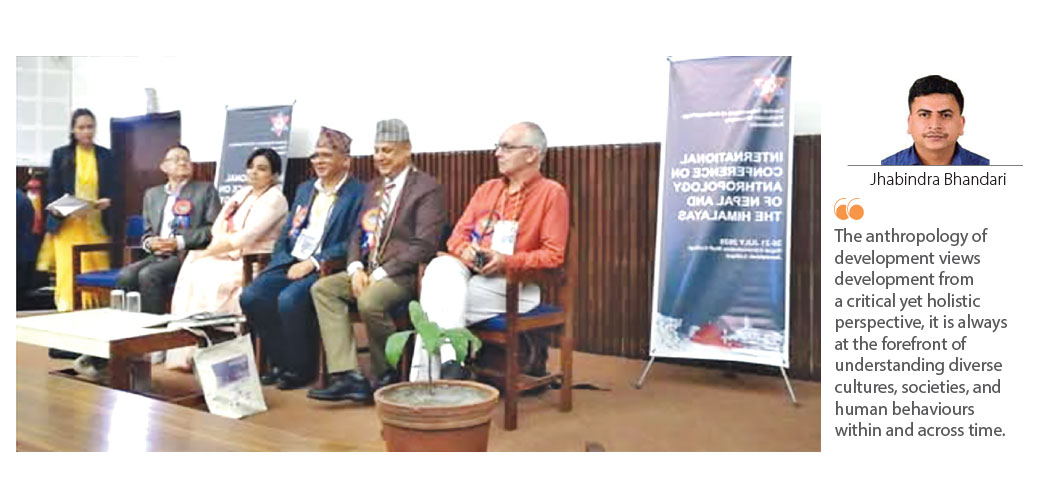
In the early first week of June this year, it was an immense pleasure for me to receive an invitation letter from Prof. Dr. Binod Pokharel, Head of Department from Central Department of Anthropology (CDA), informing me that my abstract for the International Conference on Anthropology of Nepal and Himalayas was accepted, among many others. As an anthropology student, I was excited and nervous to present my paper on the ethnography of health and illness narratives in front of distinguished scholars, senior faculty, and practitioners. This was a part of my ethnographic field research in Chainpur of Raksirang Rural Municipality. I aimed to explore the Chepangs' access to health care and how their embodied experiences of health and illness are socio-culturally constructed.
So far, I was well prepared for the presentation at the conference. More importantly, I was enthusiastic to listen to my interests' plenary and other thematic sessions, including medical anthropology, disaster, gender, identity, and culture. When I reached the Nepal Administrative Staff College in Jawalakhel, I was delighted to see the faculty from the CDA, volunteers, and participants busy welcoming chief guests, presenters, and registering. A few of us volunteered to provide essential logistics to ensure the audience and presenters are well informed about the schedule and feel comfortable during the panel discussions.
Participated by more than 300 scholars, researchers, practitioners, and faculty in-country and abroad, the conference provided a unique opportunity to share, learn, and network with a range of anthropologists and other social scientists in different thematic sessions of interest and engage in critical discussions and reflections from anthropological perspectives.
The majority of the critical and thought-provoking papers were presented from the anthropological and comparative perspectives. I liked the conference as the heart of all discussions, critiques, and insights were anthropologically focused, enriched, and brilliantly debated. To my surprise, young and early career scholars were actively engaged and encouraged in the presentations, discussions, and comments over the papers.
Meeting Prof. David Gellner from the University of Oxford, UK, as a keynote speaker was an exciting and memorable coincidence. I had heard lots about him, but it was my first time seeing him for his impressive and insightful lecture. And, of course, it was one of the motivations to listen to his lecture, research experiences, and anthropological insights in Nepal. Indeed, it provided a platform for exchange of learnings and experiences as it included a variety of topics such as social identity, culture, digital governance, climate change, disasters, indigenous knowledge ecosystems, health, cultural belonging, and so forth.
In light of changing societies, the anthropological approach aims to delve into the historical, social, cultural, economic, and political dimensions of Nepal and the Himalayas. This has harnessed both the essence and power of anthropology at its core. Moreover, such an inclusive discourse has helped enlarge the scope of anthropology and its applications in wider development fields. "The research papers and discussions were largely around the human development issues of anthropological relevance. I learned more about Nepal and social worldviews of people and their communities in their everyday life," says a scholar of anthropology from China with a smile.
Similarly, the encouraging observation and experience of other participants from abroad. "This is truly a sharing, learning, and networking opportunity for researchers by engaging them in anthropological discourses from different perspectives and cultural realities," says a young scholar from Bangladesh who visited Kathmandu for the first time.
Another participant from Japan comments: "I am engaged in a research project in Nepal, and such a conference adds value to enrich my knowledge and experiences for shared understanding and reflections. I want to learn more about anthropology as an academic field and its methodological approaches for my research. I find it interesting and stimulating as ever."
In particular, the leadership of the CDA has been very impressive and praiseworthy. The faculty and students did intensive preparations together to ensure the successful convening of the conference. "We received support from the University Grants Commission (UGC), Madan Bhandari Foundation, and a few other organisations in convening the conference. Moreover, our students in the CDA were very supportive in this process. This is our idea and self-initiative to convene the conference, which will further enhance anthropology's scope, visibility, and diversity as a discipline in the larger social, cultural, and historical contexts of development," says Prof. Dr. Binod Pokharel at the CDA.
Associate Professor Dr. Suresh Dhakal at the CDA adds: "This is an important opportunity for our students to present their research and learn from others in advancing their anthropological research, knowledge, and understanding. The participation of our young students and scholars has been overwhelming, as it shows their keen interest and ambitions for learning to advance their academic journey."
"In reality, it is our students who have been instrumental in supporting us to convene this great conference," says Associate Prof. Dr Janak Rai at the CDA, who played an essential role in coordinating with the faculties, experts, scholars, volunteers, and presenters. It is worth mentioning that the conference concluded on 20 to 21 July with a huge success. The media coverage of the conference was excellent. This exemplary effort of the CDA was deeply appreciated by all participants, presenters, keynote speakers, and the senior officials from Tribhuvan University.
Another beauty is that the CDA periodically convenes colloquiums in its seminar hall to share the research projects, book reviews, and other thematic issues where anthropology as a discipline is always at the heart. This has been an interesting opportunity for scholars, researchers, practitioners, and the academic community of anthropology to foster a shared discourse and practice in the everyday life of people living in different ecological regions.
Once again, such public discourses are primarily concerned with the various dimensions related to the larger trends of thought with which I am particularly interested and concerned. The concern here, again, is with elucidating relations. The first concern is to explore patterns of cooperation, reciprocity, and solidarity in the everyday life of people and their communities. The second concern is the increasing need to advocate for including anthropological understanding and perspectives in research and development at all levels.
Anthropology as a discipline greatly appreciates development as a cultural process. The methodological approach, such as ethnographic fieldwork, provides deeper insights into the lived experiences and local realities of people and their communities. Unfortunately, these are sometimes overlooked in many ways.
Among many others, we can take a case study of health care development in Haiti, where Paul Farmer demonstrated the interconnectedness of health and poverty. His anthropological perspective gives rise to a new visibility and urgency of social determinants of health. Similar contributions include disaster, climate change, identity, indigeneity, gender, border belonging, democracy, and more. Despite remarkable advancements in the discipline, much work remains to be done.
(Bhandari is a health policy analyst interested in anthropology.)