- Thursday, 21 May 2026

TRN Online

Ensure Right To Internet Access
Rakshya KhanalThe internet has been steadily changing people’s way of living and communicating with each other. Developing inseparable relation with human rights, it has impliedly become a key element for complete fulfillment of human rights. It has become an enabling right to attain numbers of human rights, including right to education, right to expression of views, opinions and ideas and right to peaceful assembly and association. COVID-19 and its fallout have exposed the importance of internet access in individual’s life. It has also shown a bitter reality that not everyone has access to it. It has made the government and other stakeholders realise that it is important to ensure protection of offline as well as online rights. DisparitiesHuman potentials of creativity and innovation and their development started getting platform online more than offline. Internet and human rights encounter in number of ways. It directly determines the ability or disability of people to have access to news and information, people’s opinions, belief and knowledge. This has brought world forum into a concern about prevalence of disparities between people in respect of inequality in access to resources. This might again entrench the existing conflicts over resources, the concerns on discrimination and mistreatment leaving specific group in status quo. The accessibility of internet would start determining the class and thereby giving rise to dialectics. The gap among haves and have-nots in terms of connectivity and growth may increase. On top of that, despite increasing concerns about internet right, developing countries are often victimised for not having enough resources and finance to ensure the rights. Respect and observance of individual freedom has always been the core concern of national and international human rights instruments. Now that these concerns have extended to digital world, access to internet has become another matter of discussion. Internet is no more a matter of luxury, it is a tool, a platform, a technology, and an enabler of human rights to progress society as a whole. Protecting offline rights online and providing right to internet access are two completely different things. Nepal government would still manage to safeguard rights in the internet world with development of technologies and strategic improvements of human resources to assist in safeguarding those rights. That calls for intensive research and development, allocation of federal budgets and other numerous resources. But, can right to internet ever become a subject of human rights in Nepal? The United Nations Declaration on Human Rights, the milestone instrument in protecting and promoting human rights, has been amended acknowledging that “internet is a catalyst for the enjoyment of human rights, most notably, the right to freedom of expression”. It addresses that the internet has become ‘a key means’ by which individuals can exercise their right to freedom of opinion and expression. However, the amendment didn’t explicitly recognise the internet as human rights. The UN obliges its member states to promote and facilitate enjoyment of right to freedom and expression wherein the states must take an appropriate action to recognise internet as enabler right. Nepal evidently has geographical and financial constraints to effectively materialise the vision of ensuring internet access as human rights. The geographical structure of Nepal doesn’t allow internet providers to supply internet in every corner. But since, internet is becoming a growing need from individual level, the government should work to find a way out to expand internet services to possible extent. Adhering to the UN call to take step up to secure offline rights online, India, through judicial interpretation, has declared that access to the internet is a fundamental right and it comes under the preview of freedom expression. Fostering internet rights requires coordinated actions between individual, government and other stakeholders. The present growth and use of internet have brought digital future before us. The government should come up with policies and strategies to educate internet users and providers about the equal application of human rights online and offline. To ensure the access to and best use of internet with thorough observance to internet-related protocols and rules, the government should prioritise the digital sector. Policies and laws concerning internet right must satisfy the needs of citizens, offering them protection against violation of internet rights. A global dialogue between the states to extend technical collaboration, expertise and other supports should be initiated by the government.New billThe Information Technology Management Bill that faced criticism after it was tabled has not yet been passed by the parliament. The debate includes the concerns over right to freedom of speech and expression in digital media. Amid this concern, the noteworthy step of the UN on recognising internet as enabler of other human rights should be taken into account. As a party to the UN Declaration on Human Right (UDHR), Nepal should rethink about the provisions of the bill. The parliament should start considering enacting new laws or amending ICT provisions to govern the internet rights and obligations. It should start doing its homework on drafting laws ensuring online and offline rights with all protective and defensive measures. (Khanal is an advocate and writes on contemporary legal issues. rakhyakhanal97@gmail.com)
Politics Turns Into A Lucrative Business
A Greek politician, George Papandreou, once said: ‘I never thought of politics as a profession.’ Many politicians and academia from around the world still agree with Papandreou’s view and take politics just as a social work. But the case of developing nations like Nepal is somewhat different. A large number of political leaders are found dedicating their whole life to active politics in these parts of the world. Few families in Nepal, too, have been in politics for generations. They want even their coming generations to continue with politics as a profession. So, such people appear to be grooming their offspring to stay in politics.
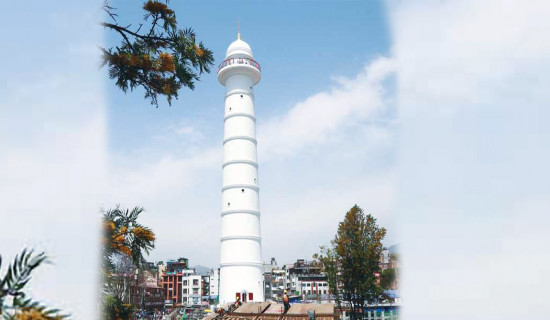
A year after inauguration, Dharahara project yet to complete
As he watched the news of Dharahara’s inauguration on television, Suresh Pradhan thought back to his childhood days. Back then, the nine-storeyed tower that collapsed in the massive earthquake of April 25, 2015, used to only open to the public once a year during Dashain.
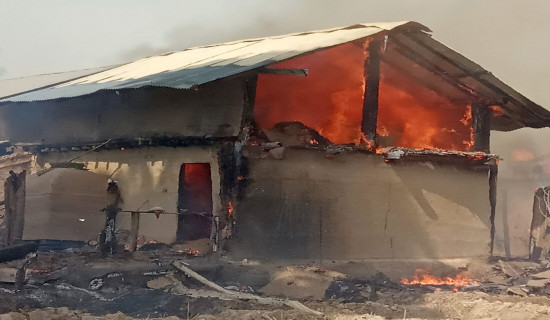
More than 50 houses gutted as fire engulfs freed-Kamaiya camps in Kailali
A fire broke out at the freed-bounded labourer (Mukta Kamaiya) camps in Kailari Village Municipality -7 of Kailali district.
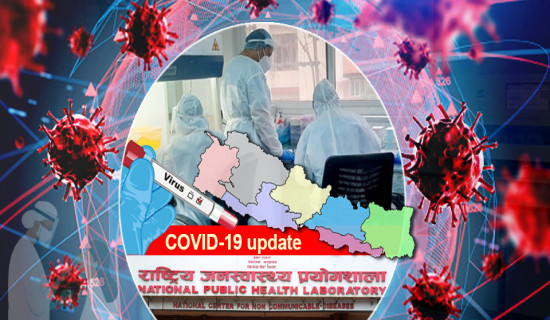
11 new cases, 25 recoveries in 24 hours
In 3,144 Real-Time Polymerase Chain Reaction (RT-PCR) tests done in the past 24 hours, a total of 11 people were found infected with SARS-CoV-2, informed the Ministry of Health and Population (MoHP) in its regular update.

Lama elected unanimously to head Football Players Association
Three Star Club’s captain Bikram Lama has been elected the President of the Players Association under the All Nepal Football Association (ANFA). A general assembly of the Payers Association held today unanimously elected the new leadership headed by Lama unopposed.
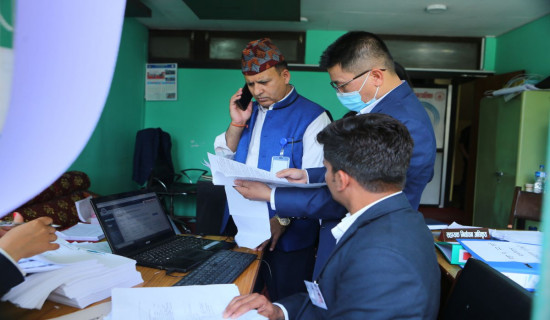
Registration of candidacies for local level election commences (Photo Feature)
The registration of candidature for the upcoming Local Level Election, 2079 BS has started throughout the country today.

Three dead in separate incidents in Salyan
Three people were killed in separate incidents in the district. Two including a driver are the victims of an excavator accident that occurred today at Bagchaur municipality-6, police said.

Two killed in motorcycle accident in Kathmandu
Two people have died in a motorcycle accident that occurred at Kathmandu Metropolitan City-32 today.
Grade 12 exam to start from 8am
The Office of the Controller of Examinations, National Examinations Board, has made some changes to the schedule of Grade 12 board exams taking place from coming May 30 to June 8.
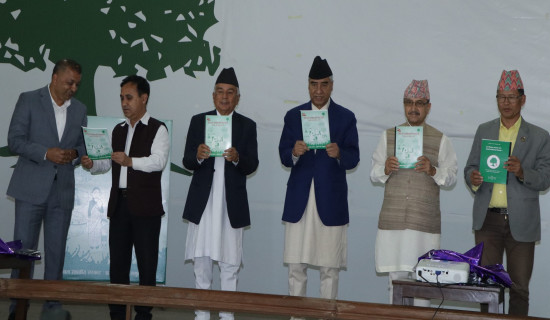
Congress unveils local level election menifesto
Nepali Congress has made public its manifesto for the local elections.
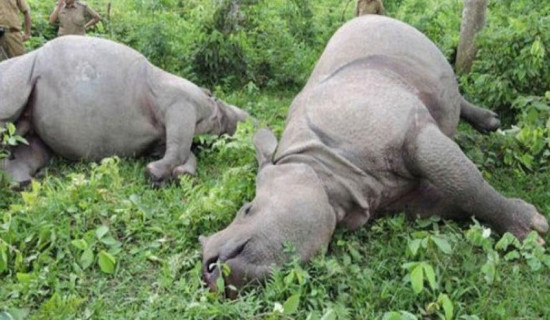
CNP reports deaths of 34 rhinos since mid-July
Of them, two died due to poaching while remaining due to other reasons.
Nepal's land divided in 11 categories
The government has classified the land into 11 different categories. Based on the National Land Cover Monitoring System (NLCMS) which was launched Saturday by the Ministry of Forests and Environment, the land has been categorized as forested land, agricultural land, grassland, bush, marshland, snow land, glacier, rock, flood land, shelter land and vegetation-less land.
FCAN announces construction holiday
The Federation of Contractors' Associations of Nepal (FCAN) has announced a 'construction holiday' reasoning the lack of an environment conducive for construction due to price increment in construction materials.
WHO says at least one child has died after increase of acute hepatitis cases in children
The World Health Organization said that at least one child death had been reported following an increase of acute hepatitis of unknown origin in children and that at least 169 cases had been reported in children in 12 countries.