- Wednesday, 8 April 2026

TRN Online

Bhanubhakta Zoological Garden to count bird number
Damauli, April 15 : Bhanubhakta Zoological Garden located at Byas municipality in Tanahu district is to count number of birds. The Zoological Garden is going to carryout bird census on the occasion of Wildlife Week. Conservation Officer of the Garden, Bhojraj Pantha, said that number of birds would be counted at the forest areas covered by the Garden. Birds of 185 species have been spotted in the Garden so far, he added. Record of bird spices found in course of monitoring of birds is kept. The Zoological Garden that spans on 425 hectares of area has incorporated 13 forest areas. Meanwhile, 27th Wildlife Week has begun in Tanahu from Thursday. The Bhanubhakta Zoological Garden has organised the Wildlife Week under the slogan 'Human-Wildlife Co-Existence: Our Common Responsibility'. Inaugurating the Wildlife Week, Chief District Officer Bishwo Prakash Adhikari, stressed that human should accept coexistence of wildlife. Saying conflict between human and wildlife takes place due to non-acceptance of human-wildlife existence, he added that existence of both- human and wildlife is equal. Adhikari laid the emphasis on the need of launching public awareness programmes for human-wildlife coexistence. The Zoological Garden would organise various programmes for a week on the occasion of Wildlife Week.

Anti-virus shutdowns in China spread as infections rise
BEIJING Apr 15 , (AP) — Anti-virus controls that have shut down some of China’s biggest cities and fueled public irritation are spreading as infections rise, hurting a weak economy and prompting warnings of possible global shockwaves.Shanghai is easing rules that confined most of its 25 million people to their homes after complaints they had trouble getting food. But most of its businesses still are closed. Access to Guangzhou, an industrial center of 19 million people near Hong Kong, was suspended this week. Other cities are cutting off access or closing factories and schools.Spring planting by Chinese farmers who feed 1.4 billion people might be disrupted, Nomura economists warned Thursday. That could boost demand for imported wheat and other food, pushing up already high global prices.The closures are an embarrassment to the ruling Communist Party and a setback for official efforts to shore up slumping growth in the world’s second-largest economy. They come during a sensitive year when President Xi Jinping is expected to try to break with tradition and award himself a third five-year term as leader.Beijing has promised to reduce the human and economic cost of its “zero-COVID” strategy, but Xi on Wednesday ruled out joining the United States and other governments that are dropping restrictions and trying to live with the virus.“Prevention and control work cannot be relaxed,” Xi said, according to the official Xinhua News Agency. “Persistence is victory.”The risk that China might tumble into recession is increasing, Ting Lu, Jing Wang and Harrison Zhang of Nomura warned in a report.“The logistics crunch is worsening,” they said. “The markets should also be concerned about the delayed spring planting of grain in China.”The government reported 29,411 new cases Thursday, all but 3,020 with no symptoms. Shanghai accounted for 95% of that total, or 27,719 cases. All but 2,573 had no symptoms.A health official warned Wednesday that Shanghai didn’t have the virus under control despite its easing restrictions.Some 6.6 million people were allowed to leave their homes in areas that had no new cases for at least a week. But at least 15 million others still are barred from going outdoors.Most people have obeyed despite grumbling about shortages of food, medicine and access to elderly relatives who need help. But videos on the popular Sina Weibo social media service show some trading punches with police.Grape Chen, a data analyst in Shanghai, said she was panicking about getting medicines for her father, who is recovering from a stroke. She called police after getting no response from an official hotline but was told quarantine rules bar officers from helping.“We are willing to cooperate with the country,” Chen said. “But we also hope that our lives can be respected.”The city government of Suzhou, a center for smartphone manufacturing and other high-tech industry west of Shanghai, told its 18 million people to stay home when possible.Taiyuan, a blue-collar city of 4 million in central China, suspended inter-city bus service, according to the official China News Service. Ningde in the southeast barred residents from leaving.A restaurant cook in Taiyuan said his family has been confined to their apartment compound since April 3 after cases were found in neighboring compounds.“Our lives will be seriously affected if the restrictions last long,” said the cook, who would give only his surname, Chen.“My wife and I are earning nothing,” Chen said. “We have three children to support.”All but 13 of China’s 100 biggest cities by economic output are under some form of restrictions, according to Gavekal Dragonomics, a research firm.“The intensity is increasing,” Gavekal said in a report this week.The volume of cargo handled by the Shanghai port, the world’s busiest, has fallen 40%, according to an estimate by the European Union Chamber of Commerce in China. Automakers have suspended production due to disruption in deliveries of supplies.Restrictions on areas that produce the world’s smartphones, consumer electronics and other goods are prompting forecasters to cut expectations for this year’s economic growth to as low as 5%, down sharply from last year’s 8.1% expansion.The ruling party’s target is 5.5%. Growth slid to 4% over a year earlier in the final quarter of 2021 after tighter official controls on debt triggered a collapse in home sales and construction, industries that support millions of jobs.Even before the latest shutdowns, the ruling party was promising tax refunds and other help for entrepreneurs who generate wealth and jobs.Premier Li Keqiang, the No. 2 leader and top economic official, called this week for “quicker rollout” of aid for businesses that face a “key juncture for survival,” China News Service reported.Under a strategy dubbed “dynamic clearing,” authorities are trying to use more targeted measures to isolate neighborhoods instead of whole cities with populations bigger than some countries. But some local leaders are imposing more sweeping controls.Shanghai leaders were criticized for trying to minimize economic damage by ordering testing but no shutdown once cases were found last month. A citywide shutdown was ordered with only a few hours’ warning after case numbers soared.That was in contrast to Shenzhen, a tech and finance center of 17.5 million people near Hong Kong that closed the city March 13 after an outbreak and ordered mass testing. It reopened a week later and business returned to normal.Guangzhou has imitated Shenzhen. Most access to the city of 19 million was suspended Monday and mass testing ordered after 27 infections were found.Li Guanyu, a 31-year-old woman in Guangzhou, said residents can leave her apartment compound only once every other day to buy food but stores are well-stocked.“This happened a bit suddenly,” said Li. “Maybe the Shanghai situation is so bad that Guangzhou started mass testing and lockdowns as soon as cases were discovered.”
-original-thumb.jpg)
3 months after volcanic eruption, Tonga slowly rebuilds
By NICK PERRY , WELLINGTON, New Zealand Apr 15 , (AP) — Samantha Moala recalls she was taking a shower at her home in Tonga when she heard what sounded like a gunshot so powerful it hurt her ears.As she and her family scrambled to their car to drive inland, ash blackened the sky. The world’s biggest volcanic eruption in 30 years sent a tsunami around the globe, and the first waves washed across the road as Moala drove to safety at the airport with her terrified husband and two sons.A volunteer with the Tonga Red Cross, Moala, 39, was soon attending to the cuts other people had suffered as they escaped, and giving them psychological support. She said about 50 of them stayed for two days at the airport until they got the all-clear to go back home.“People were all shocked,” she said. “But I got to mingle with them, help them, get them to be confident. It’s a small little island, and we got to know each other in two hours.”Three months after the eruption, Tonga’s rebuilding is slowly progressing, and the impact of the disaster has come into clearer focus. Last week, the prime minister handed over the keys to the first rebuilt home of the 468 the government plans to reconstruct across three islands as part of its recovery program.Some 3,000 people whose homes were destroyed or damaged initially sought shelter in community halls or evacuation centers. Eighty percent of Tonga’s population was impacted in some way.In the first few weeks after the eruption, Moala helped out by putting up tents and tarpaulins, and then by cooking food for other volunteers.It took five long weeks for Tonga to restore its internet connection to the rest of the world after the tsunami severed a crucial fiber-optic cable. That delayed some families from abroad from being able to send financial help to their loved ones.Three people in Tonga died from the tsunami and a fourth from what authorities described as related trauma. The sonic boom from the eruption was so loud it could be heard in Alaska and a mushroom plume of ash rocketed a record 58 kilometers (36 miles) into the sky.The World Bank estimates the total bill for the damage is about $90 million. In the small island nation of 105,000 people, that’s equivalent to more than 18% of gross domestic product.The bank noted that many coastal tourism businesses — which bring in vital foreign revenue for Tonga — were particularly hard hit, with tourist cabins and wharves destroyed. The agriculture industry also suffered, with crops lost and reef fisheries damaged.The ANZ bank says Tonga’s GDP will likely contract by 7.4% this year, after it had been expected to grow by 3.7% before the volcano erupted.The international community has been helping out, with Tonga able to secure $8 million in funding from the World Bank and $10 million from the Asian Development Bank, as well as aid assistance from many places including Australia, New Zealand, Japan, the European Union, the U.S. and China.But progress has been hampered by the nation’s first outbreak of COVID-19, which was likely brought in by foreign military crews who raced to drop off supplies as the ash cleared. The outbreak prompted a series of lockdowns, and the country remains in a state of emergency.Moala is among the more than 8,500 Tongans who have caught the coronavirus since it began spreading through the islands. Eleven people so far have died. Moala said the outbreak had affected many businesses, including her husband’s work as a tattoo artist.But as the outbreak ebbs and the rebuilding progresses, the islands’ familiar rhythms are returning for many people.Among those who remain most affected are the 62 people who lived on Mango Island and about another 100 on Atata Island who may never be able to return home.The islands are located very close to the Hunga Tonga Hunga Ha’apai volcano, and the villages were completed wiped out. Residents have now been offered land by Tonga’s king to relocate onto one of Tonga’s two main islands.Sione Taumoefolau, the secretary-general of the Tonga Red Cross Society, said there is a lot of work to be done relocating the residents.It’s also been slow-going getting supplies to people on other far-flung islands, he said. Many of them remain without internet access after a domestic fiber-optic cable was also damaged and will likely not be repaired for months.“Three months later, people are starting to get back to normal,” Taumoefolau said. “But we can see they still need psychological and social support, those that were really impacted, especially those who have to relocate.”

Liverpool reach semis to raise quadruple hopes
APLiverpool, Apr 15 : A place in the Champions League semifinals secured. The dream of an unprecedented quadruple of trophies still intact. Key players rested amid a hectic schedule.Liverpool is in a good place entering the home straight of what could turn out to be the club’s greatest ever season.Even conceding two late goals to draw 3-3 at home to Benfica couldn’t take the smile of Jurgen Klopp’s face. “The day we qualify for the semifinals of the Champions League and I’m not happy, please come here and knock me out,” the Liverpool manager said Wednesday after seeing his team advance from the quarterfinals 6-4 on aggregate.With Liverpool inflicting significant damage by winning the first leg 3-1 in Lisbon last week, Klopp was confident enough to rest stars like Mohamed Salah, Sadio Mane, Virgil van Dijk and Trent Alexander-Arnold for a return match against Benfica that turned into a wild, end-to-end contest at Anfield.Roberto Firmino’s second-half double put Liverpool 3-1 ahead on the night and 6-2 ahead on aggregate, only for Klopp’s team to ease off the pace. Benfica took advantage by getting behind Liverpool’s makeshift defense to score through substitute Roman Yaremchuk and rising star Darwin Núñez, but the gap was too much to make up. “It was pretty comfortable,” Liverpool captain Jordan Henderson said, “but we’re disappointed with the goals we conceded.”Ultimately, Liverpool has coasted into the last four of Europe’s top club competition and is there for the 12th time — tying the record for an English team with Manchester United — and the first since the last of its six title triumphs in 2019. Villarreal awaits Liverpool in the last four. Ibrahima Konaté followed up his goal in the first leg — his first both for Liverpool and in the Champions League — with another header to open the scoring off Kostas Tsimikas’ outswinging corner.Gonçalo Ramos made it 1-1 in the 32nd minute — keeping Benfica in with the unlikeliest of chances — with a goal that had a hint of fortune about it. The ball ricocheted to the 20-year-old forward from a tackle by Liverpool midfielder James Milner and his finish from the edge of the area was emphatic past Alisson. Firmino is no longer first choice for Liverpool following the arrivals of Diogo Jota and Luis Diaz but the Brazil striker staked his claim for a starting spot in the team’s big upcoming games with a double in the space of 10 minutes.His first goal came after mistakes from goalkeeper Odysseas Vlachodimos, who fumbled as he attempted to gather a through-ball, and center back Jan Vertonghen, who hurried his resulting clearance. Jota drove the ball back into the middle of the area and Firmino applied the finish in the 55th. The Brazilian volleyed in Tsimikas’ free kick to make it 3-1 but Liverpool let Benfica back into the match.
Para Sports Must Not Suffer
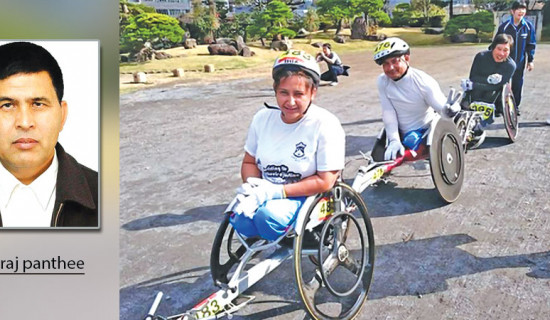
Meenraj PantheeThe Winter Para Olympics-2022 successfully concluded a few weeks ago in Beijing, reiterating loudly that sports remain a basic human right issue of every individual irrespective of their status in society. President of the International Paralympics Committee (IPC) Andrew Parsons made a pertinent statement during the opening ceremony of the Beijing Winter Paralympics: "At the IPC, we aspire for a better and more inclusive world, free from discrimination, hate, ignorance and conflict." President Parsons made an immensely persuasive message before the world that articulated a whole-hearted aspiration and feeling of the athletes gathered there representing 46 different countries and disability communities around the world as a whole. The practice of “One Bid, One City” for organising Olympics and Paralympics has taken place since 2001, in which every city that bids to host the Olympics will also bid to hold the related Paralympics, which vindicates the equal importance of both competitions. Since 2001 the Paralympics is held in the same city encompassing the same facilities, spirit and enthusiasm related to the corresponding Olympic Games. Under IPC's disability classification categories for Paralympics, athletes compete in six different disability groups - amputee, cerebral palsy, visual impairment, deafness, spinal cord injuries, and intellectual disability. Apart from this, there are some other categories, in which an athlete does not fit into one of the other categories, such as dwarfism. Within each group, athletes are further divided into classes based on the type and extent of their disabilities. Individual athletes may be reclassified at later competitions if their physical status changes. The size and diversity of the Paralympic games have increased significantly over the years due to an increased demographic range of the athletes. For example, the Paralympics in 1960 hosted 400 athletes from 23 countries participating in 8 sports, the summer Paralympics held in London 2012 had 4,200 athletes representing 164 countries participated in 20 sports, the Tokyo summer Paralympics had a total number of 22 sports with 550 events with badminton and taekwondo being added for the first time. Para Sports In NepalThe evolution of Nepal’s Para sports movement has witnessed many twists and turns. These forms of sports remained in the grip of certain powerful people who served their interests. The participation and representation of persons with disabilities from Nepal in various international tournaments commenced in the late 1970s under the initiation of one of the pioneer organisations, initially called Nepal Association for the Disabled and Blind. Several disabled athletes such as Surya Kumari Gurung Mahattara, and Laxmi Subedi did not only take part in various international tournaments but also were able to win international medals for Nepal even before the restoration of multi-party democracy in Nepal in 1990. Surya Kumari Gurung, one of the medal winners, recalls their diligent preparation before competing. Nepal’s participation in the International Special Olympics events is a source of great pride. An exciting period was witnessed when the Nepal Paralympics Committee (NPC) officially opened its doors after fulfilling all requirements to be a legal entity back in 1995 under the initiation and leadership of persons with disabilities and their parents. The NPC possesses a strong commitment and dedication following the motto, "nothing about us without us", which develops the potential of persons with disabilities in sports activities in Nepal. Gradually, the NPC was gaining popularity as it pledged a variety of tournaments to be conducted continuously making a level playing field at various levels in a systematic way for the first time despite facing financial and other resource constraints. Consequently, the NPC was thereby officially authorised and recognised by the country's sports governing body, Nepal Sports Council to develop and advance sporting activities for persons with disabilities. In the course of this evolution, other sports organisations, even disability-specific sport-related organisations came into being, and have jointly with the NPC been engaged in achieving their set objectives, i.e. Nepal Cricket Association of the Blind, Table Tennis Association for Persons with Physical Visual and Hearing Disabilities, Spinal Cord Injury Sports Association etc. Though NPC and its Member organisations were continuously engaged in organising sports events and preparing athletes to compete at national and international sports competitions, the above developments were not always able to continuously flourish. Parasports have often been embroiled in the ongoing conflict between NPC and NPSA since then as NPSA fails to respect the court verdict and law of the land along with forging consensus among concerned stakeholders until now. The problem is further exacerbated while the IPC is continuously supporting NPSA to represent Nepal, without being informed of the decision of the Supreme Court and without having the official support of the government.Thus, on one hand, the government has authorised the NPC to play a lead role to deal with Para sports development and on the other hand, the NPSA has been representing athletes in international events causing a lot of confusion and demotivation amongst athletes with disabilities. Experienced SportspersonsThe experienced sportspersons with disabilities argue that due to the conflict the process of training and sending qualified athletes from Nepal to take part in international games has suffered a setback. Instead of sending the competitive athletes to international events, those less deserving have gone to the Paralympics games for the past 18 years, depriving the qualified and deserving athletes of Nepal to take part in those events. As a result, the participation of athletes from Nepal in the Paralympic competitions in the past has been quite limited, despite the availability of many Paralympic categories to compete. Nepal's participation in Tokyo's Paralympics last summer was limited to only one athlete while none of the Nepali para-athletes participated in Beijing Winter Paralympics. It shows the level of dysfunctional nature, lack of commitment and accountability on the part of the NSC and Paralympic committee. A significant amount of budget has been allocated and invested in the recent years for the advancement of para-sporting activities through the Ministry of Youth and Sport. SetbacksOther setbacks restricting the Para movement could be a dearth of technical and financial resources, centre based patchy programs, a low priority from the government and development partners, and split and fragmented attitudes among stakeholders rather than making an effort combined. Hence the government is required to introduce an appropriate policy and programme complying with Article 30 of the UN Convention on the Rights of Persons with Disabilities and domestic sports development-related legislation to address para-sporting activities at various levels, eg local, provincial, national and international. It is now imperative for the NSC, the Youth and Sports Ministry and the government to ensure the involvement of all pertinent stakeholders alongside disabled people's organisations making a concerted effort in the concerned sector. The government and the IPC are to be responsible to redefine the para-sports movement in compliance with the verdict of the Supreme Court of Nepal. Indeed, sports have emerged as one of the best tools to empower and tap the unlimited potential of children and adults with disabilities. Sports help for their rehabilitation, both socially and functionally. (Panthee is a freelance writer)
Bridging Cities With Fashion
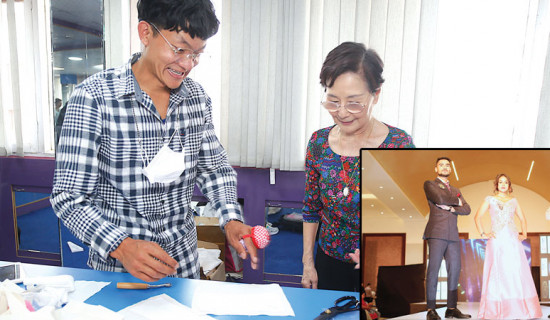
Persijs Muiznieks , When I first met fashion designer Hisako Kasuya from Japan, she seemed to me a quiet, peaceful, not very talkative woman, but when I saw her working with students at the Dream Wear Fashion Institutes in Kathmandu, my opinion changed instantly. She was unstoppable in generously sharing her life's experiences. Even the language barrier failed to make her calmer. It is quite uncomfortable for a middle-aged woman to reveal her age, but when I dared to do so, I realised that I had been wrong- she appeared twenty-five years younger than she really was.Yes, this esteemed eighty-two-year-old Japanese woman demonstrates her knowledge of fashion in Tokyo, where she was born and educated. Despite her busy schedule, she kindly took the time to share her childhood memories, the time when her first dreams of becoming a fashion designer were born.Favourite OccupationsMany girls in their childhood usually play with dolls. Hisako Kasuya was no exception, and her favourite occupation was making clothes for dolls that later, out of love, turned into a vocation and a professional job for a lifetime.In the beginning, the necessary skills for working with scissors and a needle had not yet been found, but the diligence of the work prevailed, which allowed us to overcome all difficulties. Her craving was for professional advice on how to make a cut and handle tailor's supplies. The parents observed the child's inclination to work and did not interfere with its progress. Patience and love led to the result, and when all the neighbours and domestic dolls were clothed in the world of her fantasy of costumes, more serious work had to be done. The first fashion victims were their parents, who were not ashamed to show their daughter's first success, which was soon noticed by neighbours. Hisako was enthusiastic when the first offers to embroider costumes came.Up to professional skills was a long way to go. Nor should daily school life be disrupted. However, the difficulties did not stop the young person from choosing her future profession. Hisako was well aware of this and did not dare to charge for the first orders. The start-up period was quite difficult, as money had to be found to survive.Starting a family took extra care, which took away a lot of free time. Only then did she understand the benefits of her chosen profession. Free working time style, independence, freedom of imagination.., what could have been better for the lady. She was overwhelmed with happiness and satisfaction. It's a great profession that gives a woman a chance to get rid of other addictions, she says. Hisako's life was full of surprises alternating with disappointments. Ten years ago, she was struck by a severe heart attack that gave her little hope of survival. Overwhelmed with despair, she turned to God, begging to live for at least five years, so that she could pass on her knowledge to the next generation. And a miracle happened. She seems to have been heard. The hardship of the gloomy life set the goal of meeting people from poor families and training them as tailors. The Sati Foundation was taken to help, discovering Hisako's roads to Nepal. The first studies and basic training as a tailor will soon be organised here.Although the two countries are on the same continent, there are significant cultural differences. Japan is more monolithic in social terms and cannot be proud of its ethnic / caste group composition compared to Nepal. A rhetorical question aroused curiosity in this regard. What could Nepalese students inherit in the above context? You are right. Japan is not so fragmented, neither ethnically nor linguistically, but the peculiar colour scheme is quite rich, which we are proud of. New ElementsThe 21st century brings new elements to everyday life and fashion sometimes distorts fundamental national values. That is why I am here in Nepal to instil respect for the basic values of fashion. In Japan, this issue is being honoured. However, much is being westernised and our traditional Kimono is losing its appeal. I want to bring up a master's student here in Nepal. As I said, this is a world of fantasy that has no boundaries and must be allowed to express itself, only then can you become a master of your profession. Tailor's tools alone are not enough. Let's start with the basics. And namely, how to handle a tape measure, scissors and a sewing machine. The first sketch is created on paper, then body measurements are made. Based on the layout, a cut is created. Using our training standards, each student has the opportunity to embroider his clothing. This is a high-quality training technique that we use in Japan. In the beginning, it is difficult and sometimes incomprehensible for your students. I noticed that the studio here is based on a fair sex student among whom there is one guy, 28 years old, named Binaya Rai. Are there the same trends in Japan? It's basically a woman's job, Hisako adds.Here, the guy is very diligent, works with love and I see talent in him. I am interested in organising young people from villages, those who want to study but lack financial assistance. According to my observations, such a selection shows more dedication to training. I usually teach once a year, but due to the great interest, I will be forced to come more often. Age also does not allow us to be as active as in youth. I was fascinated by her concern for the students, seeing how she generously gifted them. The heavy suitcase, brought from Tokyo, was about 18kg. in weight and each student was gifted with tailor's supplies to get started. I felt an atmosphere of friendship and love in the studio. Combining the pleasant and the useful things, the management of the Holy Himalaya Hotel invited me and the Japanese design delegation to attend the Grand Finale Fashion Show, which took place on April 2, 2022. in Kalimati, giving broader insight into this field of business. We each had our rating scale. It was the new generation. Athletic statures, hairstyles, and tall guys showed that they were going seriously, as they say, with a bit of a western flavour. The boys' black costumes were quite depressing and sometimes boring, which did not differ by each subsequent act unless one of the embellishments changed the location of the suit. However, under the influence of music and dazzling light, the shadows of boredom were dispelled. Where did the Nepalese take the long-legged girls who captivated the audience in their transparent evening dresses? In general, we expected to see avant-garde, modernism, and stylism. Nothing was surprising. All these opera is visible in everyday life, so the four-hour show made it quite boring. The Japanese guests also hoped for more. However, this did not deny the hope that the Japan-Nepal fashion bridge will further serve in the field of closer cultural cooperation. Hisako Kasuya promised to visit Nepal later this year, surprising students with something new in the fashion field, adding that she wants to host a Japan-Nepal fashion show in Kathmandu. May her dream come true! (The author is a photojournalist based in Nepal)

Artificial Intelligence And Humanity
Narayan Prasad Ghimire , Currently, I am going through a new book on Artificial Intelligence (AI). It is, 'The Age of AI and Our Human Future', written jointly by Henry A. Kissinger, Eric Schmidt and Daniel Huttenlocher. The three writers are formidable figures. Their joint work is a lucid book on one of the most engaging issues of our time, AI. Earlier, I had read a similar book– the one by Rajiv Malhotra, 'Artificial Intelligence and the Future of Power: 5 Battlegrounds'. While reading the book by the triumvirate, one of the arresting sentences in the book is, 'Created by humans, AI should be overseen by humans.' Similarly, they, explain further, 'The AI age needs its own Descartes, its own Kant, to explain what is being created and what it will mean for humanity. Moreover, talking about artificial pleasures and emotions, Malhotra writes: 'By manipulating hormones, neurotransmitters, neural networks, and eventually artificial memories, machines are rigging out human physiology to produce pleasure and avoid pain. Certain kinds of private experiences are already being technologically engineered to alter individual emotional states.'What Makes a human?The above excerpts from the seminal books may be thrilling and appalling and horrible at the same time. Going through the denotation and connotation of the points they raised, every aware person is forced to think: Where are we heading? What's the destination? Who is our guide? How is the guide behaving with us? What makes humans human? Both books are genuine efforts to bring the technical glitch, the term of the geeks- AI, to the general public. There is no denying that they have aimed at throwing light on how the general people and policymakers should understand the most defining feature of technological advancement. The trepidation of the future on the one hand and techno-optimism and utopia on the other are contrasting points through which the present world is undergoing. The present world is undoubtedly the age of digital disruption.Let's ponder - why are we called human? Humans have emotion and reason- these faculties control and direct humans to act as per time and context. They have the feeling- love, hatred, liking, disliking, sympathy, empathy etc; and a conscience that helps them judge the situation. We can not deny that with the ability to use reason, human behaviour is different from other animals. Humans are supreme. In absence of reason or conscience, any person can be dubbed unfit or emerge awkwardly to his/her family and societal norms. In many cases, the absence of reason in a human being may result in the commission of lawlessness, which takes him/her behind the bar. Similarly, the faculty of emotion is equally imperative to make one's life balanced and social. Love and logic seem distant opposites but are inseparable from our lives. Emotional Hijacking Technological advancement has brought us to such a state that our agencies are exploited in a way that we had never imagined. The technological facilities or let's say, digital gadgets have explored every nook and corner of human life. It is time Facebook knows well about what makes us happy than our mothers and loved ones know! It is said once we take to Facebook for 55 minutes, it perfectly measures our emotional status- knows our likings, dislikes and others. Similar it is in the case of Google. The time we spend on the content on YouTube is studied so meticulously that we are chased frequently by these platforms. For example, once you listen to Shiva Strotra or Bhajan on Monday morning on YouTube, it would be the same on the top to serve you next Monday morning. What is behind this? What reads our brain? Yes, it is artificial intelligence that tech companies employ. The data that we produce day to day while working/playing on digital gadgets are the major resources for tech companies to expand algorithms and adopt AI. So simple these seem, but the 'Like' and 'Love' buttons on Facebook have a huge capacity to sway human emotional state. One may however argue that clicking 'Love' is simply a click on the Love button and not the expression of love. At the same time, an argument may surface that those clicking the 'Love' button are expressing love. Then, is the digital expression of love identical to the physical or normal expression of love?! If it is different from physical, or let's say, human and natural, to what extent it is different? Moreover, when a media is live-casting a political leader giving a speech, one can see the Facebook comments. There is a brawl, oodle of invectives, incendiary allegations and so on. Even the love and like are there. Human psychology is spilt on digital platforms. The anger and frustration, protest and opposition, panegyric and eulogy, what not! Similarly, some people are becoming platform populists, garnering Love, Like, and Comments. A new norm of digital popularity has emerged at the cost of human psychology. Is digitally rich (many Likes, many Love, many Comments) satisfied in his real life? These points warrant the study. Huge psychological research can be done.Once the things that are served on digital platforms guide the human emotional state, isn't it the machine rigging out human physiology to produce pleasure and avoid pain as writer Malhotra said? Isn't it the manipulation of hormones and neural networks? Intelligence On Fruition? The brain is to think- good and bad; right and wrong etc. The brain is for balancing the binaries. It is the most wonderful organ and asset of human life. This very decision-making capacity of the brain, or let's say, intelligence has separated humans from the animal. Intelligence is not only for a particular individual but for family and society. It is essential for norm building. Control of societal, national and international affairs rests entirely upon human intelligence. As the binary actor, both creation and destruction are guided by the brain. Human beings are therefore responsible for both the mess and development in the world. Artificial intelligence (AI) is the product of the same natural intelligence as the human brain. What a magic and miracle it was when humans invented the computer, the internet, and AI. The creation of AI is itself an extraordinary achievement. A miracle happened in 1997- world chess champion Gary Kasparov lost the game to the machine. Kasparov was defeated by an IBM supercomputer, Deep Blue. The machine turned master over human (mind), the original master who built the computer! Wasn't it a tragedy for the human brain? Or, was it the unprecedented gain in human life? Since this epoch-making event, scientists have added new dimensions to AI. AI-run robots are now becoming commonplace. AI has indeed come from easing life to pleasing life. Need for human-centred AINow, let's check the emphasis of the triumvirate: 'Created by humans, AI should be overseen by humans'. It means AI can not be left alone and scot-free. It needs to be guided by its master. AI must not be mastering the human mind, but the reverse. Scientists in recent years have been repeatedly stressing to tame AI. They are advocating for the supremacy of the human brain or the mastery of the human mind. Once the continued new dimension or the advancement in the AI chases away and dominates the human mind, the master, does the world run normally? The mastery of AI over the human brain is rendering humans subordinate where the machine is on top and the human in the second. Isn't it the new hierarchy? It is therefore compelling that the AI age needs its own Descartes. We are well aware of 'Cogito Ergo Sum' or 'I think therefore I'm', which was propounded by philosopher Rene Descartes in the seventeenth century. Descartes' philosophy of 'reason' (thought) is a central feature of the Age of Enlightenment. The Age of Enlightenment is the celebration of the human mind or the reason, conscience. A similar formidable figure of the time is Emmanuel Kant who also underscored rationalism. Why is a human? Human is human because he thinks, reason, judge, or he has a brain. Finally, AI, as the creation of human intelligence, can not be avoided but nurtured together where mastery of human intelligence prevails. It is not only impossible and impractical but also sheer unwise to avoid AI from modern life. Belittling AI capacity is reversing the pace of science and technological advancement. It is therefore time for human-centred AI, which is for the future of humanity.(A journalist at RSS, Ghimire is an internet governance enthusiast)
A Canvas Of Life’s Struggle
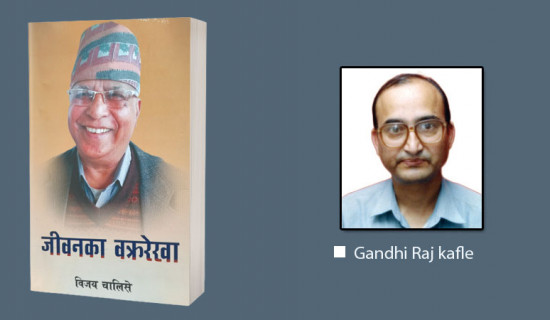
Gandhi Raj Kafle , If life had been geometry, it would have an interpretively simple definition under the lesson of straight or not straight lines etc. But, life is not like this. So, the Bakrarekha here carries multi-dimensional meanings. And, unlike geometry, where learners enjoy the luxury of having textbooks and well-educated teachers or gurus to acquire systematic knowledge; life's textbooks and gurus are life only and it is unpredictable. Jeevan ka Bakrarekha, or zigzag lines or paths of life, tells a lot. This is true for everyone. But here we have senior author and journalist Vijaya Chalise, who tells us how extensive and unpredictable it had been in the past. So, his under-review book entitled "Jeevanka Bakrarekha” is a creative attempt to describe his life's beauty, accepting all the virtues of Bakrarekha's ways of his past struggle. This is a 312-page book and the author claims it is autobiographical writing. That is true, too, because he is the central point of the description. He has tried to surround so many themes that influenced him describing how they turned out to be effective to develop his personality. Somewhere in the context of this writing about his childhood or boyhood, the author has scantily mentioned about impacts of good feelings, especially about some challenges, which he felt with the privilege of being a son of a well-known literateur Ramesh Bikal (real name Rameswor Sharma). He says his father had no time to listen attentively to the details of family affairs as he was extremely busy with literary writings and activities of socio-political awareness. Yet he also fondly mentions that his father's care and inspiration are instrumental to him. Such things in biography writing are matters of importance and Chalise has written them nicely. There comes a period for everyone when a mother gives berth and this very important arrival and a few years after this remain either unknown or if known it only remains in hazy forms. Chalise has tried to express this part, too. He has entered into this with society's eyes because society holds the importance of perennial existence, and is helpful to guess even about unknown memories of childhood after berth. It is said that the beauty of life lies in struggle and author Chalise has given due importance to describe this part. His struggle began right from the beginning of school education and it started to become hard since he aimed to acquire higher education. Not only this, but he also faced challenges to continue jobs and he had mentioned how strenuous it was to come and go from his residence, which was then popularly known as Kantha (Outskirts of Kathmandu city). Many of the 'Kantha', which our past generation described as uncivilised parts of Kathmandu, is now posh areas and they enjoy all the basic amenities of the city like convenient transportation, health facilities, and door-step schools and colleges, telephones and internet services. Past stories, however, were quite different. In this backdrop, Chalise is telling facts to his readers that the bus beyond Gaushala-Chabahil was unimaginable then and they had to go on foot to reach their homes. This book entitled “Jeevanka Bakrarekha" (zigzag lines of life) is not exactly so, individually; it is the same nationally and politically also. We all know what happened to the nation in the past. The people know the Rana regime, then the declaration of democracy in 1951 AD, then the general elections and formation of B.P. Koirala-led government and the coup against it, a series of struggles to restore democracy, the rise of the communist movement, the 2046 BS, the 2062-63 and until the declaration of the historic democratic republican constitution in the country. Author Vijay Chalise’s background, as he has mentioned, is left-leaning. Being a book of autobiographical nature, he had mentioned its contexts to contexts. His association with the teaching profession and the media is long. He has written about how he joined Gorkhapatra daily as a sub-editor at the beginning and then served as the Corporation's executive chairman, which also shed light on the zigzag path of his life. The book in the later chapters heavily enters into political events and interpretations. But, the author has beautifully talked about people, who have mattered in his life. He has fondly remembered the Gorkhapatra’s noted editors like Bhairab Aryal, Keshab Raj Pindali, Narayan Bahadur Singh, Gokul Prasad Pokhrel and Bharat Dutta Koirala. And, similarly, he has also not forgotten to note some of the bitter experiences of life also while serving the Corporation. In essence, plenty of meritorious things is found in this book. Author Chalise has provided a deep focus on myths, cultures, local traditions and socio-economic dynamism of society beautifully while writing his self-memoir. Similarly, he has also discussed political matters, somewhere briefly and somewhere in detail. In fact, facts are facts, but interpretations may differ. Yet, our experiences tell us: Politics is a dominant subject.
Russia’s damaged Black Sea flagship sinks in latest setback
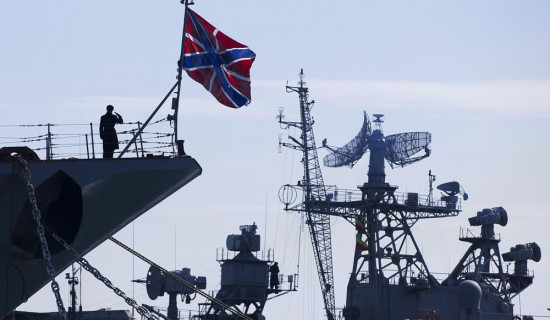
By ADAM SCHRECK KYIV, Ukraine Apr 15 , (AP) — The flagship of Russia’s Black Sea fleet, a guided-missile cruiser that became a potent target of Ukrainian defiance in the opening days of the war, sank Thursday after it was heavily damaged in the latest setback for Moscow’s invasion.Ukrainian officials said their forces hit the vessel with missiles, while Russia acknowledged a fire aboard the Moskva but no attack. U.S. and other Western officials could not confirm what caused the blaze.The loss of the warship named for the Russian capital is a devastating symbolic defeat for Moscow as its troops regroup for a renewed offensive in eastern Ukraine after retreating from much of the north, including the capital, Kyiv.In his nightly video address to the nation, President Volodymyr Zelenskyy alluded to the sinking as he told Ukrainians they should be proud of having survived 50 days under attack when the Russians “gave us a maximum of five.”Listing the many ways Ukraine has defended against the invasion, he noted “those who showed that Russian warships can sail away, even if it’s to the bottom” of the sea. It was his only reference to the missile cruiser.The Russian Defense Ministry said the ship sank in a storm while being towed to a port. Russia earlier said the flames on the ship, which would typically have 500 sailors aboard, forced the entire crew to evacuate. Later it said the blaze had been contained.The Moskva had the capacity to carry 16 long-range cruise missiles, and its removal reduces Russia’s firepower in the Black Sea. It’s also a blow to Moscow’s prestige in a war already widely seen as a historic blunder. Now entering its eighth week, the invasion has stalled amid resistance from Ukrainian fighters bolstered by weapons and other aid sent by Western nations.During the first days of the war, the Moskva was reportedly the ship that called on Ukrainian soldiers stationed on Snake Island in the Black Sea to surrender in a standoff. In a widely circulated recording, a soldier responded: “Russian warship, go (expletive) yourself.”The Associated Press could not independently verify the incident, but Ukraine and its supporters consider it an iconic moment of defiance. The country recently unveiled a postage stamp commemorating it.The news of the flagship overshadowed Russian claims of advances in the southern port city of Mariupol, where Moscow’s forces have been battling the Ukrainians since the early days of the invasion in some of the heaviest fighting of the war — at a horrific cost to civilians.Russian Defense Ministry spokesman Maj. Gen. Igor Konashenkov said Wednesday that 1,026 Ukrainian troops surrendered at a metals factory in the city. But Vadym Denysenko, adviser to Ukraine’s interior minister, rejected the claim, telling Current Time TV that “the battle over the seaport is still ongoing today.”It was unclear how many forces were still defending Mariupol.Russian state television broadcast footage that it said was from Mariupol showing dozens of men in camouflage walking with their hands up and carrying others on stretchers. One man held a white flag.Mariupol has been the scene of the some the war’s worst suffering. Dwindling numbers of Ukrainian defenders are holding out against a siege that has trapped well over 100,000 civilians in desperate need of food, water and heating. David Beasley, executive director of the U.N. World Food Program, told AP in an interview Thursday that people are being “starved to death” in the besieged city.Mariupol’s mayor said this week that more than 10,000 civilians had died and the death toll could surpass 20,000, after weeks of attacks and privation left bodies “carpeted through the streets.”Mariupol’s capture is critical for Russia because it would allow its forces in the south, which came up through the annexed Crimean Peninsula, to fully link up with troops in the Donbas region, Ukraine’s eastern industrial heartland and the target of the coming offensive.The Russian military continues to move helicopters and other equipment together for such an effort, according to a senior U.S. defense official, and it will likely add more ground combat units “over coming days.” But it’s still unclear when Russia could launch a bigger offensive in the Donbas.Moscow-backed separatists have been battling Ukraine in the Donbas since 2014, the same year Russia seized Crimea. Russia has recognized the independence of the rebel regions in the Donbas.The loss of the Moskva could delay any new, wide-ranging offensive.Maksym Marchenko, the governor of the Odesa region, across the Black Sea to the northwest of Sevastopol, said the Ukrainians struck the ship with two Neptune missiles and caused “serious damage.”Russia’s Defense Ministry said ammunition on board detonated as a result of a fire, without saying what caused the blaze. It said the “main missile weapons” were not damaged. In addition to the cruise missiles, the warship also had air-defense missiles and other guns.The Neptune is an anti-ship missile that was recently developed by Ukraine and based on an earlier Soviet design. The launchers are mounted on trucks stationed near the coast, and, according to the Washington-based Center for Strategic and International Studies, the missiles can hit targets up to 280 kilometers (175 miles) away. That would have put the Moskva within range, based on where it was when the fire began.Launched as the Slava in 1979, the cruiser saw service in the Cold War and during conflicts in Georgia and Syria, and helped conduct peacetime scientific research with the United States. During the Cold War, it carried nuclear weapons.In 1989, the Slava was supposed to host a meeting off Malta between Soviet leader Mikhail Gorbachev and U.S. President George H.W. Bush, but gale-force winds moved the talks to the docked cruiser Maxim Gorky.On Thursday, other Russian ships that were also in the northern Black Sea moved further south after the Moskva caught fire, said a senior U.S. defense official who spoke on condition of anonymity to discuss internal military assessments.Before the Moskva sank, Yuriy Sak, an adviser to Ukraine’s defense minister, told AP its removal would mean “we can only have a sigh of relief.”While the U.S. was not able to confirm Ukraine’s claims of striking the warship, U.S. national security adviser Jake Sullivan called it “a big blow to Russia.”“They’ve had to kind of choose between two stories: One story is that it was just incompetence, and the other was that they came under attack, and neither is a particularly good outcome for them,” Sullivan told the Economic Club of Washington.Russia invaded on Feb. 24 and has lost potentially thousands of fighters. The conflict has killed untold numbers of Ukrainian civilians and forced millions more to flee.It has also further inflated prices at grocery stores and gasoline pumps, while dragging on the global economy. The head of the International Monetary Fund said Thursday that the war helped push the organization to downgrade economic forecasts for 143 countries.Also Thursday, Russian authorities accused Ukraine of sending two low-flying military helicopters some 11 kilometers (7 miles) across the border and firing on residential buildings in the village of Klimovo, in Russia’s Bryansk region. Russia’s Investigative Committee said seven people, including a toddler, were wounded.Russia’s state security service had earlier said Ukrainian forces fired mortar rounds at a border post in Bryansk as refugees were crossing, forcing them to flee.The reports could not be independently verified. Earlier this month, Ukrainian security officials denied that Kyiv was behind an air strike on an oil depot in the Russian city of Belgorod, some 55 kilometers (35 miles) from the border.
Adjustment of public transportation fare in Bagmati province
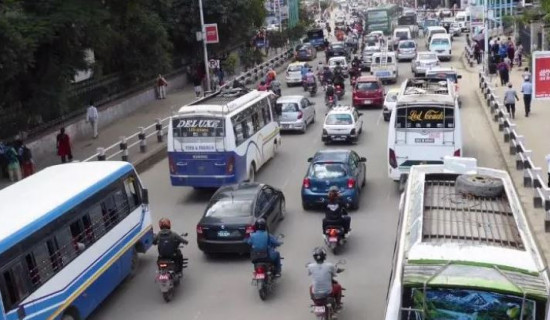
Hetauda, April 15 : Fare of taxi and public transportation has been increased in Bagmati Province. The fare of taxi and public transportation has been hiked in the Province including the Kathmandu Valley from Thursday. As per the new transportation fare, one has to pay minimum Rs 20 to travel five kilometers in public transport against Rs 20 in the Kathmandu Valley. Similarly, passengers have to pay Rs 25 to travel up to 10 kilometers, Rs 30 up to 15 kilometers, Rs 33 up to 20 kilometers and Rs 38 above 20 kilometers. Likewise, the minimum charge of taxi has been fixed at Rs 50 and the passenger will be charged additional Rs 10 every 200 meters of travel. Waiting charge for a taxi has been determined at Rs 1.20 per minute. Waiting has been limited to maximum 30 minutes. In the context of night taxi operating its service from 9:00 pm to 4:00 am, a passenger will be charged Rs 13 every 200 meters of travel. The fare of public transportation and taxi was hiked as per the decision of the Ministry of Labour, Employment and Transport Management of the Bagmati Province. According to the Ministry, card will be used in public transportation in order to make it cashless in coming fiscal year.

Short Take On Mithilanchal Culture
Seigfried Lienhard, professor emeritus of Indology at the University of Stockholm, once said that Dr Ram Dayal Rakesh had all the qualifications necessary for introducing the reader to the culture of Terai, many aspects of which are still unknown. He also called him a prolific writer and editor in Nepali, Maithili, Hindi and English. Keshab Poudel, the editor of the New Spotlight news magazine, also acknowledged the arduous efforts Dr Rakesh has made over the years to shed light on the often-overlooked facets of Nepali literature with the words: "His representations of the Maithili and Hindi literary traditions in Nepal are as comprehensive as they are cogent."These are but a few of the numerous praises and accolades that have been heaped on Rakesh and after reading his latest book ‘Salhesh and Other Village Deities,’ it is not hard to see why.The Vedic gods have a prominent place in the social and cultural life of Nepal and Nepalis. They have been extensively studied and researched and, thanks to the global presence of India, have been promoted around the world. However, the same cannot be said about the indigenous gods – the folk deities, to use Rakesh's terminology. They are an integral part of the communities they are worshipped in and some even pre-date the arrival of Vedic Hinduism in their areas. Yet, they lie under the shadows.Similarly, the definition of Nepali culture has been monopolised by Kathmandu. The rulers of the past advertised the art, architecture, lifestyle and festivals of the communities living in the capital as the “native Nepal” while overlooking everything and everyone else. In the centralised state of yesterday, the seat of the government was the only thing that got attention.Through his literary works, Dr Rakesh has tried to change both these things.With ‘Salhesh and Other Village Deities,’ the writer introduces the readers to Shailesh, the king of the mountains (whose name got corrupted to Salhesh), his brothers Motiram and Budhesar, his sister Banaspato and his niece Karikanha. By doing so, he also familiarises the readers with the caste groups that worship them such as the Dusadh and highlights the cultural significance of spots that, to many, may seem mundane such as Pakdiyagarh. Many people may not even have heard the name of this place located in the Siraha district where Salhesh first worked as a watchman in the palace of the local king.What the book does best is that it humanises Salhesh. By describing his physical features, his jobs, his family and his virtues, Rakesh firmly separates the legend from the person and brings the god into the human realm. And through this, he, perhaps unintentionally, highlights the caste hypocrisy present in our society. The Dusadhs are considered 'untouchables' in Madhes. They are shunned, discriminated against and pushed to the margins of society. But because the writer establishes, with facts and references, that God Salhesh came from this community, it shows how absurd our beliefs about the supposed social hierarchy are. On the one hand, we accept a member of a particular group as being superior to us while on the other, refuse to consider the larger group as even equal to us.A similar double standard is also applied to the pastoral castes of the plains. Lord Krishna, a cowherd, is worshipped and celebrated but the community he belonged to is viewed with contempt. In the hills too, the so-called high castes have no qualms about praying to a god named Bishwokarma but hesitate to let a man with the same name enter their kitchen.Rakesh, throughout the book, also details other village deities like Shokha, Malang, Bhuiyan Baba, Goraiya and Per Devta to name a few.This book is short and simple. For people unfamiliar with the cultures and societies of Mithilanchal, this book can serve as an introduction. However, the language leaves a lot to be desired.There are too many punctuation errors to forgive and the sentence structures are off. The author seems to have written as he thought and it shows. Unfortunately, a published book featuring the name of a writer as prolific as Rakesh reads like a first draft. 'Salhesh and Other Village Deities' would have benefitted greatly from a few months in the editing room. Even the quotes on the book's back cover have grammatical errors and that is just unacceptable from someone of Rakesh's calibre who has set such a high bar for himself with his previous works.Similarly, had the writer or design team chosen to present the pictures of the unique village gods and goddesses it lists or pictures of the rituals associated with the deities then it would have made the book more interesting and informative for the lay readers.Rakesh’s passion and love for the culture he is writing about try to shine through but are eclipsed by his lack of attention to linguistic clarity.
People throng Ruru to celebrate New Year 2079
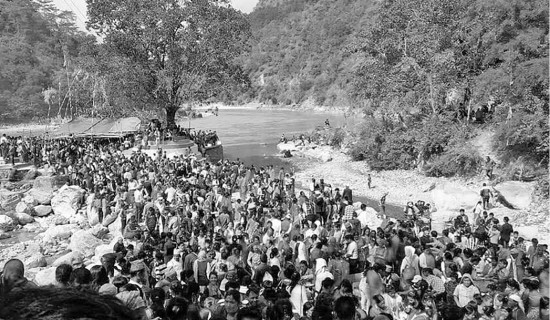
BY TILACHAN PANDEYTamghas, Apr 15 : People thronged Setibeni and Ridi to worship Shila Shaligram and take a bath in the Kali Gandaki River on the occasion of the beginning of Nepali New Year (NY), Thursday.The places are situated on the bank of the confluence of Ridi River and the Kali Gandaki River separating three districts – Palpa, Gulmi and Syangja. “Bathing in the Kali Gandaki washes away the sins. It is why there is a crowd at Ridi,” said Brihaspati Basyal, a 65-year-old from Paiyun Rural Municipality of Parbat.The confluence of the three districts falls under Ruru Kshetra, also known as Ridi, one of the four major religious sites of Hindus in Nepal. Sage Devdatta is said to have meditated in Ruru Kshetra centuries ago.Basyal added, “Those arriving at the river also worship the Shila Shaligram, the biggest Shaligram (stone) in Asia, in Setibeni, tri-junction of the three districts.”Other than the New Year Day, pilgrims arrive at the river to take bath on different other religious occasions and fairs organised on the river bank annually.Many people also visit Rishikesh Temple in Ruru Kshetra to pay their homage. Fairs are organised in the area during the Nepali New Year, Asare Ekadashi, Kartike Ekadashi and Maghe Sankranti among others. On the occasion of the first day of Nepali New Year 2079 B.S. on Thursday, a fair was organised in Ridi and pilgrims celebrated the day by taking a dip in the river, worshipping the temples and singing prayer songs.People were also seen setting up small shops in the fair and selling local products like bamboo baskets (doko), flat tray (nanglo), and broom (kuchho) among others.Meanwhile, some senior pilgrims argued that the love for culture and tradition had declined among the new generation.“The festivals on the bank of Kali Gandaki were a sight to behold in the past. Nowadays, youths are not active to learn and celebrate their culture. I request the new generation to give some time for their identity,” said Khimlal Pandey, a 78-year-old from Ward No. 1 of Kaligandaki Rural Municipality of Syangja.In a bid to manage the crowd and make the celebration safe, the police have also intensified their security.“During the fair, many people get drunk and vehicles carry excess number of passengers due to which we have increased surveillance in the fair and checking in the roads,” said Superintendent of Police (SP) Bhim Bahadur Dahal of Gulmi District Police Office.
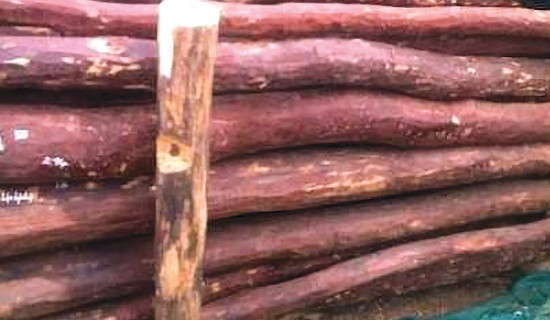
Seized sandalwood hard to manage
By Purushottam P. KhatriKathmandu, Apr 15 : A team of the Armed Police Force Nepal (APF) can be seen cordoning off the area near the premises of the Department of Forest and Soil Conservation at Babarmahal for the past 15 years just for two red sandalwood-loaded trucks. These sandalwoods seized while being smuggled from India to China via Nepal has become a matter of headache for the government. Chief of the Division of Participatory Forest Office and the Joint-Secretary of the Ministry of Forest and Environment, Dr. Sindhu Prasad Dhungana, said the seized red sandalwood has become almost a ‘headache’ for the government. “We have been providing security here to these seized goods for the last 15 years,” said Dhungana. “These illegal goods have really become a matter of worry for the government. We are not allowed to use it, nor can we earn revenue by auctioning it. But we have been providing security here,” Dhungana said.He said, “Despite repeated decisions of the Cabinet meetings asking India, the country of their origin, to take back the sandalwood, the country has shown no interest in taking it back.”In 2006, a temporary post of the Armed Police was set up on the premises of the Forest Department for their security. Three years later, the Forest Department Security Base Camp of APF was set up on September 23, 2009 with 30 Armed Police Force under the command of the Inspector of Police. The base camp is still there. But for the past two years, only 10 APF personnel have been guarding the area under the command of the Deputy Police Inspector.“We have been told to protect the sandalwood which were dumped in two containers,” the in-charge of the base camp told The Rising Nepal on condition of anonymity during the field visit this week. The two containers – one with a number plate “Na 2 Kha 4867” and the other with illegible number plate – have been kept covered by the tarpaulins since then. “We haven’t really opened the truck yet, we don’t even know the amount of wood there,” he said.Red sandalwood seized in six districts – Kathmandu, Lalitpur, Bhaktapur, Kavrepalanchowk, Sindhupalchowk and Rasuwa – has been kept on the premises of the Department. According to the data provided by Surendra Prasad Adhikari, Assistant Forest Officer of CITES (Convention on International Trade in Endangered Species of Wild Fauna and Flora) Branch of the Department, a total of 88,542 kg of sandalwood lie on the premises. Of that, 30,551.6 kg was recovered from Sindhupalchowk, 73,319.25 kg from Kathmandu, 619 kg from Lalitpur, 49 kg from Bhaktapur, 57 kg from Kavrepalanchowk and 13,946.8 kg from Rasuwa.211,054 kg of sandalwood across the countryAccording to the data provided by the Department, 211,054 kg of red sandalwood seized from 20 different districts has been kept in Nepal. According to Adhikari, all of them were seized while being smuggled from India to China via Nepal. “Nepal is just a transit hub to smuggle these goods to China from India,” he said. He said that still court cases are pending in various courts of the country regarding settlement of 16,487 kg of the wood. According to an employee of the Department, the price of red sandalwood in the international market is up to Rs. 8,000 per kg. On that basis, red sandalwood worth more than Rs. 1.68 billion is going down the drain. For the purpose of fixing the fine in the court, the assessment is done at the rate of Rs. 800 per kg, which is many times less than the actual price.The person concerned has not taken back their 8,459 kg of red sandalwood which should have been returned to the person who had won their court cases. “Reason for this is that it neither can be sold nor be auctioned now,” the officials said. Since no one can buy it even during the auction, it has been put on hold without any auction.Red sandalwood has also been seized in Chitwan, Sarlahi, Dolakha, Jhapa, Nawalparasi, Taplejung, Kapilvastu, Dhading, Terhathum, Rupandehi, Bajhang, Gorkha, Sankhuwasabha and Saptari, districts where the armed forest guards of the Division Forest Office haven been protecting it.

Election Security
The government is fully committed to holding the upcoming local level elections in a free, fair and fearless manner. This is reflected on preparations being made for the polls slated for May 13. Elections can be conducted in a fearless environment only when a vigorous security system is put in place. Proper mobilisation of security personnel for polls could help prevent possible illegal activities like rigging and capturing of poll booths. To ensure that there will be no security lapses during the local polls, the government is preparing to deploy an adequate number of security personnel belonging to different security agencies. With its unified poll security plan, the government aims to mobilise a total of 165,000 police personnel. With an addition of 100,000 temporary police, the total number of security personnel to be deployed in all the 753 local levels is going to exceed 265,000. In view of possible security threats, a meeting of the National Security Council held on March 24 had endorsed the Local Level Election Integrated Security Plan-2078. Under this plan, Nepal Police, Armed Police Force (APF), Nepali Army (NA), National Investigation Department (NID) and temporary police are being mobilised for local elections. About two weeks ago, the National Security Council recommended to the government for deploying the NA personnel for the local polls. Recently, President Bidya Devi Bhandari, on the recommendation of the Council of Ministers, approved the proposal regarding the mobilisation of the army. This has paved the way for the NA to deploy its troops in all the local levels to help conduct the polls in a free and fair manner. According to the NA spokesperson, over 71,000 army personnel are going to be mobilised for poll security. They will work in close coordination with the concerned District Security Committees and the office of the District Chief Election Officer to ensure a full election security. The security plan with the deployment of the intelligence personnel associated with the NA, NID and APF is expected to contribute towards holding the elections in a dignified manner. Periodic local polls are the key to strengthening and institutionalising the grassroots democracy. It is the free polls that alone can create a congenial environment for voters to exercise their franchise freely. With such elections, there are higher chances for the honest, dedicated and visionary candidates being elected to lead the important local government. It works closely with the people. In the existing federal governance system, the local government enjoys executive, legislative and semi-judiciary powers. So, it can strengthen the service delivery system and carry out development activities as per the needs and aspirations of the people. Under the local poll security plan, the NA has more than a dozen roles to play. It has to ensure security of ballot paper printing and their transportation. Besides, it needs to coordinate with other security agencies for the security of prisons, airports and other crucial structures across the nation. The NA has been assigned to transport ballot papers, along with ballot boxes and other poll materials. The Election Commission of Nepal (ECN) has set altogether 10,756 polling booths and 21,955 polling centres for the local polls across the country. Of the total number of polling centres, 20,945 are regarded as highly sensitive, 4,420 sensitive and 3,391 general from the security perspective. So, the security agencies have a crucial role to play in conducting the polls in a trustworthy manner.

Europe’s Economy On A Knife Edge
Barry Eichengreen Europe’s economy is finely poised between recession and growth. The knife edge is sharp because European policymakers have exactly zero control over the outcome. Before Russian President Vladimir Putin’s attack on Ukraine, Europe’s recovery from the damage wrought by the COVID-19 pandemic was solidifying. Industrial production rose in January, and retail trade rebounded. Economic sentiment improved in the first half of February, surpassing pre-pandemic levels. But then the war dented consumer confidence by heightening uncertainty and raising energy and commodity prices. In mid-March, the European Commission’s consumer confidence indicator fell to its lowest level since the start of the pandemic. So far, however, the data show only a mild softening of demand and limited disruptions to supply. They signal nothing remotely resembling the collapse in activity that accompanied 2020-21 pandemic lockdowns. The OECD’s weekly tracker of economic activity, which uses machine learning and Google Trends data to infer real-time changes, similarly points to only a mild slowdown. Box office receipts are stable. Restaurant receipts are stable. Data from the navigation service TomTom do not suggest much decline in mobility-related activity.Energy shockIn response to the war and energy shock, the European Central Bank, appropriately, has downgraded its forecast for eurozone growth in 2022 from 4.3 per cent to somewhere in the 2.3 per cent to 3.7 per cent range, depending on what happens to oil and gas prices. Nonetheless, even its “severe scenario” of sustained high energy prices still anticipates above-trend growth in 2022. More costly energy will no doubt be a drag on growth. But if Russian gas continues to flow, higher prices will not bake in a recession. Inevitably, profits will be squeezed by more expensive inputs. Even so, European producers can take steps to economise on energy use and keep the wheels turning.But using less gas is one thing; using none at all is quite another. In the latter scenario, gas-powered factories won’t be economising; they will be shutting down. Over time, US natural gas can be substituted. But Germany has no liquefied natural gas terminals and will need the rest of 2022 to install its first floating LNG terminal – a converted supertanker – even if all goes according to plan. In the meantime, German gas consumption will fall by 30-40 per cent. Even assuming that the monetary and fiscal authorities respond forcefully to prevent second-round business-cycle effects, this could drive German growth in 2022 from 1.8 per cent, the most recent forecast of the German Government Council of Economic Advisers, into negative, recessionary territory.And here Europe’s lack of control comes into play. Whether gas supplies are suspended depends entirely on Putin, who could decide to terminate shipments in retaliation against Western sanctions. He may need the revenues, but this would not be the first time that anger and pride trumped economic logic. If the West makes payments not to Gazprombank but into escrow accounts, Putin will lose his last remaining incentive to keep the gas flowing. He knows that those accounts will ultimately be used to finance Ukrainian reconstruction rather than topping up Russian government coffers.Above all, if Putin allows his army to continue committing atrocities against Ukrainian civilians, Western European publics and policymakers will unite against him. Given their country’s history, Germans will not be able to sit back comfortably, in homes heated by Russian gas, in the face of this monstrous behaviour. If Chancellor Olaf Scholz won’t lead, then other members of his coalition, such as Defence Minister Christine Lambrecht, almost certainly will step in. And at some point, the German people will drag Scholz along with them. Whether it comes to this depends on Putin’s next steps.It is easy for an American, heated by natural gas from Texas and the Dakotas, to say that Europe should endure a recession in order to ratchet up the pressure on Putin. But if President Joe Biden’s administration and the US Congress think it crucial to intensify the pressure on Russia, then they can make it worth Europe’s while.Post-war reconstructionEurope will take the lead in Ukraine’s postwar reconstruction. The logistics are easier. Ukraine is in Europe’s neighbourhood, as Ukrainian President Volodymyr Zelensky reminds us. The European Union can deploy its cohesion funds, trans-European transport and other infrastructure projects, and common energy policy even without – or preferably before – admitting Ukraine.But if Europe is the logical party to do the legwork and administer the aid, then the United States can provide the bulk of the finance, beyond that portion financed by escrow accounts and Russia’s other external assets. This will be an appropriate humanitarian gesture once the war is over. But a US commitment now to compensate Europe for the steps it must take, starting with a ban on imports of Russian oil and gas, is also a way to incentivise it to help bring the war to an early end.(Eichengreen is a Professor of Economics at the University of California, Berkeley.)