- Saturday, 28 March 2026

TRN Online
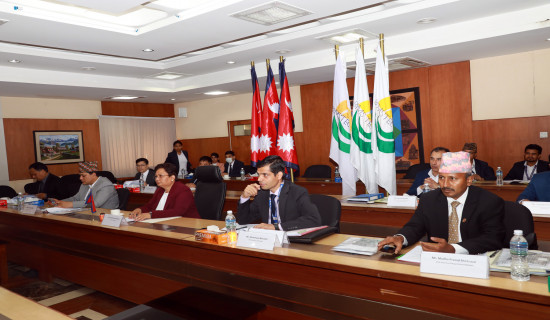
Nepal insists on collective commitments for energy security
Kathmandu, Apr. 20 (RSS): Nepal has emphasized that collective commitments were necessary for energy security. During a third meeting of energy ministers from the Bay of Bengal Initiative for Multi-sectoral, Technical and Economic Cooperation (BIMSTEC) here today, Minister for Energy, Water Resources and Irrigation, Pampha Bhusal, highlighted the need for mutual trust, clarity in future endeavors and sincerity in objectives to address the serious issues in the energy sector, bearing in mind the future of 1.7 billion people of BIMSTEC nations. The meeting was assisted by video conferencing technology. Expressing her hope that the meeting would contribute to enhancing mutual energy cooperation among the BIMSTEC nations, the Minister stressed the need for adequate fiscal mobilisation and technology handover to advance toward the path of energy security. She took time to say that increasing inter-relations among the BIMSTEC member states on all fronts would help further promote the spirit and sentiments of regional cooperation. Talking about the Memorandum of Understanding (MoU) for the establishment of the 'BIMSTEC Grid Interconnection' signed at the fourth BIMSTEC Summit held in Kathmandu, the Minister said, "Energy trade is a significant issue and it is capable of addressing the problem of electricity waste and mitigating the risk of energy crisis in the region." "Energy is always the area of priority of BIMSTEC," the Minister said, explaining that relentless efforts were made to promote energy cooperation in the sector. The Minister further stressed the need for mutual cooperation, coordination and facilitation in the energy sector by encouraging the culture of experience sharing, increasing capacity enhancement and promoting best practices. Also addressing the meeting, Ministry Secretary Devendra Karki was of the view of proving the COVID-19 crisis as a take-off for a green, safe and more sustainable Bay of Bengal. " There is opportunity in every crisis." For this, a consolidated and renewable regional partnership in energy would be of importance, he asserted. -

13 new cases, 25 recoveries in last 24 hours
Kathmandu, Apr. 20 (RSS): Thirteen new cases of COVID-19 have been reported in the country in the past 24 hours. This was revealed in a total of 3,877 tests carried out in various laboratories in the country, according to the Ministry of Health and Population.During the same period, 25 more people have recovered. The recovery rate is 98.7 percent.Likewise, no casualty was reported. The death toll remains stagnant for the past few days at 11,951 so far. Also today, 138,182 people were vaccinated against COVID-19. Currently, the number of active cases of COVID-19 is 318, with 314 in home-based isolation and four in institutional isolation, four in ICU and one with the support of ventilator.
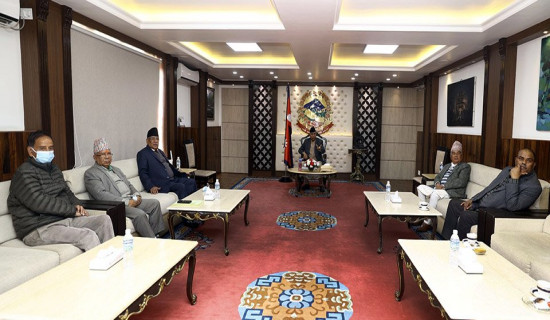
Ruling parties finalise seat sharing in metropolis, sub-metropolis for local polls
The ruling parties have finalized a deal on seat-sharing among them in the metropolis and sub-metropolis across the country.
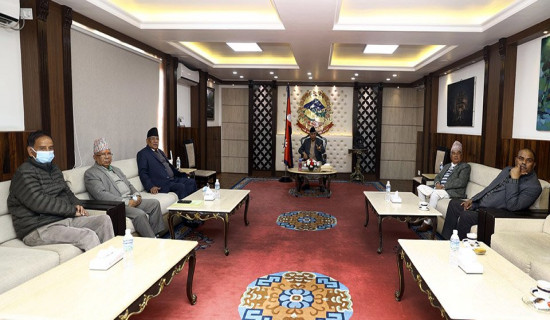
Ruling coalition's meeting underway at Baluwar
The meeting of the ruling coalition is expected to finalise the electoral coordination for the upcoming local level elections in six metropolitan cities and 11 sub-metropolitan cities.
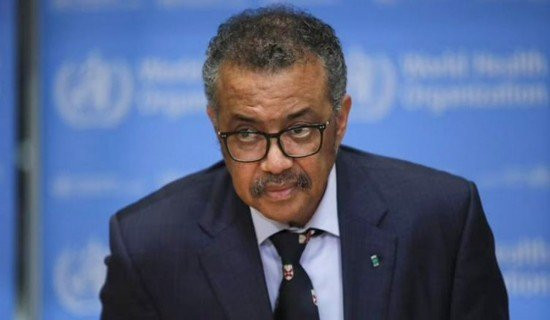
WHO Director-General arriving in Nepal on Thursday
The Director-General is scheduled to land here at 12:15 pm tomorrow. During his stay here, he will pay a courtesy call on President Bidya Devi Bhandari.
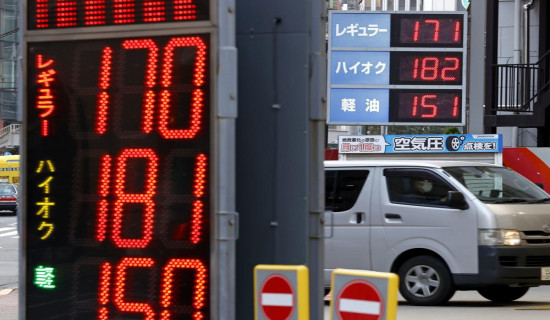
Weaker yen, costly oil push Japan’s trade deficit higher
Preliminary data for the fiscal year that ended in March showed exports jumped almost 24% but were outpaced by imports, which climbed 33%. The fiscal year deficit of 5.4 trillion yen (nearly $42 billion) was the highest in seven years.
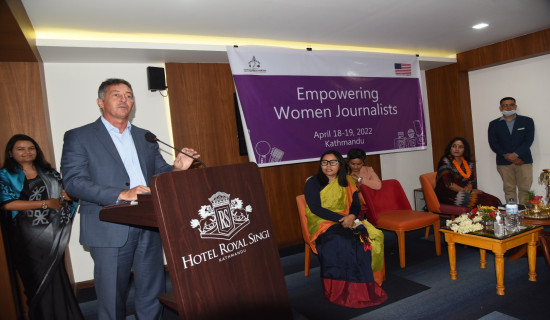
Proportional representation helps society to advance: Ambassador Berry
By A Staff Reporter, Kathmandu, Apr. 20: US Ambassador to Nepal Randy Berry said that no society can advance to its full potential without proportional representation from all sectors.Addressing a mentoring programme on Monday, entitled “Empowering Women Journalists” organised by the Sancharika Samuha with support from the US Embassy, Berry said adequate representation in media could also support it to raise the issues of all sectors.“Such type of programme can be supportive to empower and increase women participation in media,” Ambassador Berry said.The US ambassador to Nepal further urged the media to reveal wrongdoings and abuse of power that will help strengthen democracy. “Journalism must be curious, fair and balanced for the betterment of society,” he said.Journalists must know the code of ethics to produce balanced news so the truth is never distorted, he highlighted.About 20 women journalists from across the country received women leadership training on Monday and Tuesday. And from these participants some selected will get three-month long mentorship for better story writing, Basanti Bastola, general secretary of the Sancharika Samuha, informed. Senior journalists Harikala Adhikary, Mohan Mainali and Yasodha Timilsina will do mentoring over those participants.
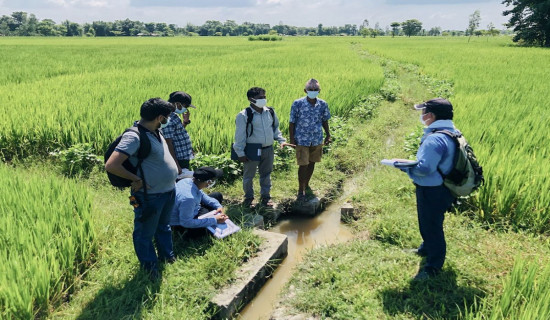
Japan seeks to extend technical cooperation programme for 2022
By TRN Online, Kathmandu, Apr. 20: The Embassy of Japan in Nepal issued a Note Verbale to the Ministry of Foreign Affairs of Nepal to extend the Technical Cooperation Programmes for Fiscal Year 2022.The technical corporation programs, which have been extended to Nepal annually since 2003, have been supporting Nepali governmental officials to obtain Japan’s knowledge, technology and experience by providing them training opportunities in Japan and by sending Japanese advisors to the Nepali government for Nepal’s socio-economic development, said the Japanese embassy in its press release issued today.Technical Cooperation Programs for FY 2022 will be implemented by JICA (Japan International Cooperation Agency) in various fields: namely, more than 50 training courses for medical/health care, governance, private sector development, water supply management, road maintenance, agriculture, education, disaster prevention, climate change, urban transportation and airport development. In addition, eight experts who work as advisors in the Nepali government organizations will be dispatched. The Programs will be beneficial for the further development of Nepali society and the prosperity of the Nepali people, read the press release."The Technical Cooperation Programs for FY2022 include the public health improvement project to prevent infectious diseases, such as the COVID-19 and the project to strengthen resilience to the natural disasters, such as floods that hit Nepal every year. The agricultural sector, in which approximately two-thirds of the population is engaged in, the “Project for the Promotion of Irrigated Agriculture in Terai Plain” and “Strengthening Seed Production, Supply and Quality Control System Project” is set to improve crop yield and its quality". We believe that the technical cooperation programs of the Japanese Government will assist the human resource development of the Government of Nepal for Nepal’s future and support the socio-economic recovery from the COVID-19 pandemic. We hope that they contribute to building stronger bilateral relations between Nepal and Japan to a further extent, the Japanese embassy in Nepal said.

US Congress delegation paying three-day visit to Nepal
According to the Nepali Embassy in Washington DC, the parliamentary team will visit Nepal from upcoming April 22 to 24. The visit is taking place on the eve of the 75th anniversary of the establishment of Nepal-US diplomatic ties.
View-tower and assembly hall construction will be discontinued: Minister Jhankri
Kathmandu, Apr. 20: Minister for Urban Development Ram Kumari Jhankri has said there will be no programmes relating to the construction of the view tower and meeting hall in the government policy and programme for the upcoming fiscal year. The Minister said there would be no budget to construct view -towers and meeting halls next fiscal year as a modality of operation of such structures was missing and it would cause unlimited responsibility on the part of the government, contributing nothing to the improvement of people's livelihood. The Minister, however, insisted on completing the ongoing projects relating to the construction of 32 meeting halls with priority. Besides, as the Minister said, the government will replace the integrated settlement development programme with a new programme for settlement development. " The integrated settlement development programme has turned ineffective in hilly and mountainous areas. And in the case of the Kathmandu Valley and the Terai, land crisis is the issue for its implementation."
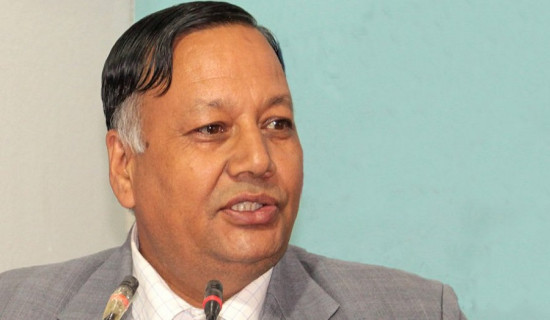
University responsible to improve higher education: Education Minister
Karnali, April 20 : Minister for Education, Science and Technology Devendra Poudel has said university is responsible for improving higher education. Universities should produce competent human resources required for the prosperity of country, he stressed. Minister Poudel said it during the second convocation ceremony of Madhyapaschim University in Surkhet on Monday. He shared the information that he was leading the reform in three fronts of education system- legal/policy, teaching and learning, and physical infrastructures. According to him, a 55-point roadmap was launched for the reform in secondary, higher education and technical and vocational education. "These three sorts of education would be improved to meet international standard," he said, arguing that entire educational restructuring was mulled for quality enhancement. Moreover, the Minister informed that drafts of the acts to manage technical education and institutions, federal education and higher education were also readied by the government. It is time to link education to skill and skill to employment, he viewed. The government, as he said, had initiated process to establish medical college in each province. In the convocation ceremony, Nobel Laureate and activist against child labour, Kailash Satyarthi argued education is the major foundation of development.

Rainfall brings relief to farmers
Mahottari, April 20 : The scorching heat in the first week of New Year had afflicted people much. To this, the rainfall occurred last night became a huge relief. The rainfall not only contributed to decrease heat but also made it favourable atmosphere for farmers to till the land. They are happy to till the cultivable land int he wake of rains. Bindeshwor Yadav from Manahari of Bardibas-7 said they would now begin sowing corn, and millet and planting rice. He further said rain removed the dryness. "It encourages us to till land for summer crops," he added. Earlier, the storm had damaged the fragile plants and vegetables in the district. Chauthi Sardar Bantar from Bhangaha-4 said the storm damaged the litchi and mango trees which had just begun yielding fruits.
Ordeals of students on other side of Ratuwa River
By Hari Prasad KoiralaUrlabari, Apr 20 : Many may find it hard to believe that students in a district as developed and well-connected as Morang have to walk for hours to reach school. After all, it is one of the major industrial hubs of the country and also the capital of Province 1. But that means little to the children of Mirchadangi village in the south-eastern part of Ratuwamai Municipality–3 who have to walk a kilometer every day to reach their school at Pidhali after crossing the Ratuwamai River.Students can only study up to the third grade at the local school at Mirchadangi. They have to travel to Pidhali to continue their education from the fourth grade onward. But to do that, they have to cross the Ratuwa River. The river swells in the monsoon and becomes a sand bog in the dry season. Both of these conditions make it unsafe to cross.Sital Kumari Gangain, a fourth-grader at the Bhanu Basic School, Pidhali, said, “When the river floods, we cannot go to school. Sometimes, it starts raining after we have already reached the school. So, we cannot go home.”Those with the means and resources send their children to live in the Pidhali market so they do not have to cross the river. Some also send their children to Biratnagar. However, students from economically disadvantaged families are forced to walk for an hour and take their lives in their hands when going to school.Nisha Kumari Harijan said, “We are either troubled by rain or dust. It is hard to walk for so long, especially under the summer sun. We have to consider ourselves fortunate if we reach home in the evening safe and sound.”More than 12 students walk from Mirchadangi to Pidhali every day to study. One of those students is Sima Kumari Ganga in who wished the school would provide them with hostel rooms. Priyanka Ganga in is another student who shared that many of her friends and juniors had dropped out completely due to the difficult daily commute.
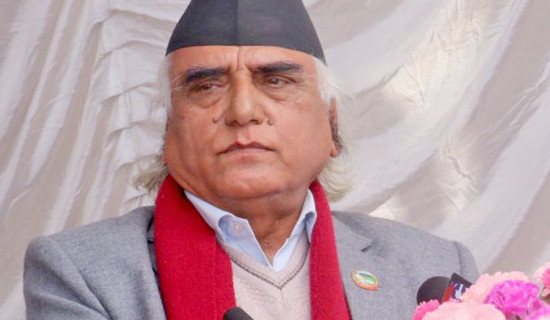
CM Pokhrel blames federal curb for province's failure to work as per expectation
Gandaki, April 20 : Chief Minister of Gandaki Province Krishna Chandra Nepali Pokhrel has said restrictions imposed by the federal government on the exercise of rights guaranteed by the constitution resulted in the province's failure to deliver as per expectation. There is no just financial devolution for the province to work, he added. CM Pokhrel said it during a meeting organized by Gandaki Province Coordination Council here Monday. He wondered how the province could work while most of the resources were concentrated to center and only few coughed up to province and local levels. A huge chunk of the budget is allocated for the central government while only 15 percent of it is allocated to province and local levels each, he argued, adding that it directly impacted on province government's performance to delivering as per people's aspiration and development needs. Similarly, he reminded us that it was a huge challenge for the sub-national governments as the civil service act was not brought by the federal government. "We've now province public service commission. Employees are being recommended after fulfilling the approved quotas. But, the career development of these employees is still uncertain," he shared. Although police administration and peace and security are the sole rights of the province in the region, the police were yet to be brought under the province government. It has questioned the effectiveness and sustainability of peace and security, according to him. The province has sole rights on national forests lying in the province, but the Forest Act is a big obstruction at present, CM Pokhrel reminded. He also blamed that local levels too had not given the province its rights. He urged the local levels to build positive thoughts. On the occasion, Minister for Internal Affairs at Gandaki Province Debate Bishwokarma viewed that only smooth coordination among the province and local levels could help in the effective implementation of federalism.

Nepal's economy not in crisis: CNI
By A Staff ReporterKathmandu, Apr 20 : The Confederation of Nepalese Industries (CNI) claimed that the country’s economy is not in crisis.Making a statement about the present economic situation at a press conference on Tuesday, the CNI said that none of the indicators hinted at the crisis.President of CNI Vishnu Agrawal said the Nepali economy has not been in a crisis situation and stressed on the need to carry out the works related to the economy with caution.There is no need to panic over the economic indicators, he said and urged not to spread the negative messages among the people citing that the country was in crisis.He, however, said that there were some problems in the Nepalese economy due to the decline in foreign currency reserves and the growing balance of payments deficit."Our economy is not in trouble," Agrawal said. But, the government and other concerned bodies should adopt any decision regarding the economy with restraint and not create panic in the market.”Vice-president of CNI Anuj Agrawal also claimed that Nepal's economy would not slide to the level of Sri Lanka."There are unnecessary rumors that Nepal's economy is going to be like Sri Lanka's," Agrawal said. "So, we don't need to worry."He said that there was no crisis in the economy as inflation was not excessive in Nepal, unemployment was not seen at once, demand was increasing in the market and social problems were not seen. "Nepal Rastra Bank has taken various steps after problems started appearing in our economy. We still have to take various steps. We have also appealed to the government for that,” he said.He, however, said that the verbal direction of NRB to stop opening LC has created problems in the market and it would discourage foreign direct investment, reduce government remittance and promote illegal trade.The Confederation has stated that stopping the import of any commodity is not a solution to the problem. It has suggested to pay attention to import management instated of stoppage.Agrawal suggested that foreign nationals should be allowed to buy apartments in Nepal, and foreign nationals seeking to invest in Nepali companies should be allowed to invest, NRNs should be allowed to invest in IPOs, and facilitation should be made to bring remittances through formal channels.The CNI expressed its hope that foreign currency reserves will gradually increase as the flow of foreign tourists has been increasing, imports declining and remittance inflows improving due to increase in the number of migrant workers.