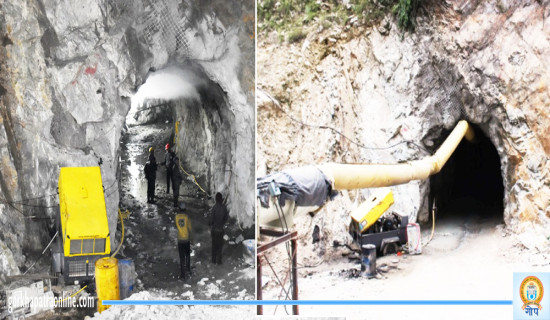
Residents of Hauchur in Rawabesi Rural Municipality-6, Khotang, had first decided to dig a tunnel through Deurali hill in 1987.
The Nepal Airlines Corporation (NAC) has stepped up preparation to make its ticket sale management further effective.
Five persons have been confirmed measles infection in Surkhet. The infected are the residents of three local level units of the district.
The Weather Forecasting Division has urged the general public to adopt precautions as the smog and haze engulfing some parts of Terai since early this morning would generally affect normal life.
Woes of local farmers have increased when the orange stored up in a cooling centre went rotten in Syangja.
As many as 7,900 dengue patients received treatment at the Sukraraj Tropical and Infectious Disease Hospital (STIDH) at Teku during the outbreak of dengue in 2022.
Premier League clubs have broken the record for transfer spending during the January window with a £440 million ($542 million) spree, according to sports finance experts Deloitte.
Singer Prabisha Adhikari gave a musical performance in Dhankuta on Tuesday. The atmosphere of the festival venue became exciting when Adhikari, who is in the limelight after being a judge of The Voice of Nepal, sang a dozen songs.
The 6th edition of Nepal International Film Festival (NIFF) will be held from March 16 to 20 at QFX cinema halls in Kathmandu, Bhaktapur and Lalitpur.
Shree Panchami also known as Basanta Panchami is being celebrated today across the country by worshipping Saraswati, the goddess of knowledge, wisdom, learning, art, music and culture.
Federal and provincial elections, held on November 20 last year, produced a hung parliament, resulting in uncertainty regarding the formation of new government in the centre and provinces. The political parties had contested the polls by forming alliances but both the ruling and opposition alliances were unable to muster majority in the 275-member House of Representatives (HoR). This gave rise to widespread misgiving whether the country will again plunge into the political stability. However, with the formation of new government under the leadership Pushpa Kamal Dahal Prachanda, the country’s politics has taken a right course, ending all sorts of speculations and suspense. Post-election saw the collapse of the old coalition, led by Nepali Congress, and emerg
Although overall macroeconomic indicators are claimed to be on track, revenue shortfalls and funds insufficiency to foot the ex-employees’ pension bill shows that all are not well in the domain of national economy. At a programme organised the other day, noted economists hinted at impending crisis in economy and suggested that the government should implement the cost cutting measures, among others, to address the problems impairing the national economy. To this end, the government should take daring steps and even go to the extent of pruning the size of the state structures from federal to the local level. In fact, the federal governance arrangement in Nepal has been structured by inter-tier assignment of the function
Nepal is the first country in South Asia and the 54th in the world to entirely prohibit corporal punishment of children. However, children being brutally beaten up in schools by teachers and school personnel, makes headlines occasionally. Many such cases have resulted in the death of the victims. Corporal punishment in school is defined as the intentional use of physical force, by teachers or school personnel towards children, to cause physical pain or discomfort of any sort, in response to misbehaviour, disobedience, or offensive acts by children. For example, pressing a pencil between two fingers, forcing one to maintain uncomfortable and painful positions, pulling the ears or the hair from the temples, hitting or spanking with bare hands or with an object, etc. CompensationEvery day, students are subjected to various forms of corporal punishment in schools, despite corporal punishment of children being illegal. The practice persists in the country because students don’t know about their rights, and their parents are also unaware of the law. Article 39 of the Constitution of Nepal, 2015 that deals with “Rights of Child” states that children shouldn’t be subjected to physical, mental, or any form of torture in home, school, or other places and, any violation shall be punishable by law, and the victim is entitled to obtain compensation from the offender. Today, anyone who uses corporal punishment to discipline children can be prosecuted. However, instead of taking administrative and legal actions against the offender, generally, schools mediate cases of corporal punishment by conducting a closed-door meeting between the concerned parents and the offender. The practice of “closed-door mediation” is concerning because when the offender is not held legally responsible and condemned. Such offenders may continue to repeat it in the future, too, and more children will suffer at their hands. On September 18, 2018, Nepal enacted “The Act Relating to Children.” Section 2(j) of the Act defines a child as, “a person who has not completed the age of 18 years.” As per section 66(2)(d) of the Act, “Any person is deemed to have committed violence against the child if the person inflicts physical or mental punishment or behaves in an undignified way whether at home, school, or any other place.” In case of an offence, Section 72(3)(a) of the Act has provisioned a fine of up to Rs. 50,000 and imprisonment for up to one year. Furthermore, Section 67 states that, if an offence against a child is committed by a person working in any public or private organisation, then such a person will get dismissed as per the law, and depending on the severity of the crime, such a person will be ineligible for a maximum of 10 years to be involved in the future in any activity that involves direct contact with the child or to be appointed, nominated, or elected to such a private institution or organisation.At one time, schools could expel children for displaying misconduct or issue transfer certificates at their discretion. Today, in the context of a child acquiring basic education (i.e., from grade 1 to 8), schools cannot even expel or give transfer certificates at their will on ground of misconduct or disobedience. According to Section 10 of the Act Relating to Compulsory and Free Education 2018, a child receiving basic education cannot be expelled for engaging in undisciplined behaviour. The Act mandates that schools must offer such a child access to counselling services and implement psychosocial counselling in collaboration with the guardians. Also, Section 32 of the same act states that, if a child who hasn't finished the basic level of education is wrongfully expelled from the school, the child's guardian can file a petition at the judicial committee of the relevant local level within 15 days. Psychological effectsStudies have shown that corporal punishment leads to counter-productive results such as learning difficulties, behavioural problems, depression, low self-esteem, and low confidence, among others, long-term psychological effects. An expert on the effects of corporal punishment, Elizabeth Gershoff, says, "Hitting children does not teach them right from wrong, and physical punishment might lead to mental health problems in children by increasing their stress levels." This is why corporal punishment, no matter how mild, should not be tolerated in schools or any other setting. Aside from the pain and injuries that often come from corporal punishment, it has also been proven to have detrimental effects on students' mental health, well-being, and academic performance. This is why we should pay meticulous attention and take appropriate actions when children come home hurt or complain about their teachers.When it comes to disciplining children, those entrusted with their care should always use positive and nonviolent methods rather than resorting to physical punishment or abusive language. For example, instead of shaming children when they do wrong, we can praise them whenever they do right. Instead of using children as examples of wrongdoing, we may teach them by not only doing it ourselves but also by showing them how it's done. Similarly, there are a plethora of methods to discipline children. Every child deserves to be treated with love, kindness, and compassion. Children’s rights to dignity and physical integrity must be unconditionally respected. We have both legal and moral obligations towards children because they are the future, and how we treat them today has the potential to shape the world of tomorrow. (Karki is a B.A.LL.B Graduate, Kathmandu School of Law.)
Play is an important part of child development. As children get older, they go through distinct stages of play. Each stage helps the child acquire skills and learn to navigate the environment. At a glance, play is a simple task. But during play, the child acts out his/her conflicts, engages in self-talk and creates an imaginary world. It is a space to relax, develop and learn, both in isolation and with others. Considering the various benefits, it is necessary to establish play as an important part of a child’s routine. Yet, the daily schedule of the current generation of children has limited time for play.
Nepali tourism organisations reached out to European tourists and travel professionals at the International Tourism Fair FITUR 2023 organised in Madrid, Spain, from January 18, Wednesday, to January 22, Sunday. Issuing a press release on Wednesday, Nepal Tourism Board (NTB) informed that it, along with Nepal Association of Tour and Travel Agents (NATTA) and 20 other private travel and trade companies of the country, participated in the fair, which is a global meeting point for tourism professionals, and held interactions with prospective tourists and tour operators. As per the release, thousands of people visited the Nepal stall set up at the five-day event and obtained information about things to do and places to visit in Nepal. Similarly, the private companies also held business meetings with the tour operators present at the programme.