- Friday, 1 May 2026


Ritu Raj Subedi
Unified Socialist Heads To Bumpy Ride
Almost 10 months after its establishment, the CPN-Unified Socialist (US) faced an existential crisis. Though it succeeded to overcome the threat to its internal unity, the fissiparous tendency posed a question to its foundational objectives and ideals. When the party decided to recall its ministers and replace them with a new team, the incumbent ministers challenged the leadership. Altogether 10 lawmakers, including the four ministers, submitted their signatures to the party chair Madhav Kumar Nepal, showing their reservation about its decision to call them back prior to the approval of annual budget by the two Houses of federal parliament.
Plugging Diplomatic Loopholes
With the government’s decision to withdraw from the US State Partnership Programme (SPP), Nepal has ridden out a geopolitical storm, thanks to the broader understanding shown by the government, political parties, civil society and media fraternity. The rejection of SPP indicates that Nepal can forge consensus on the key foreign policy issues that were botched up by ham-fisted approach of political and bureaucratic actors in the past. This has once again reaffirmed importance of non-alignment and balanced policy that shuns any form of adventurism in the country’s international relations. Nepal requires common stand in fixing cracks in foreign policy but divisive and partisan politics has bruised its international image and weakened its ability to deal with mighty neighbours and global powers.
Shun Politics On Garbage
Politics has been often derided as dirty game but these days we have confronted with similar term ‘politics of garbage’ that has exposed the inefficiency of elected officials and tainted the image of Kathmandu as pristine and beautiful city. The ongoing waste disposal problem began to worsen with the recent local election. As the people visited polling booths to cast their vote, they endured the foul smell of garbage heaped and littered at the corners of the streets. The piles of waste dumped on the roads were telltale sign of deficient governance. The disgusting scene was one factor that alienated the voters from the mainstream parties, prompting them to vote for independent candidate Balendra Shah for the post of Mayor of Kathmandu Metropolitan City.
UML’s Premiership Offer: A Red Herring
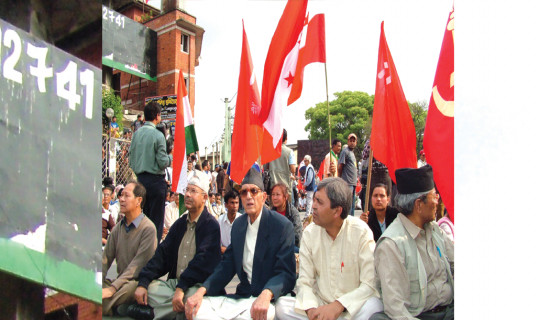
Following the local level polls, the country’s politics has taken a new course. The ruling Nepali Congress has emerged the largest party while the main opposition CPN-UML has been demoted to the second position. This shift in the power balance of the political parties was a foregone conclusion owing to the vertical split of UML and formation of five-party alliance but now political market is currently heated by the ‘proxy offers’ of prime ministerial post to CPN-Maoist Centre chair Pushpa Kamal Dahal Prachanda and CPN-Unified Socialist chair Madhav Kumar Nepal by the UML although both the leaders have refused to rise to the bait.
Making Republican System Robust
On May 28, 2008, the first Constituent Assembly (CA) declared Nepal as federal democratic republic, abolishing the 240-year-old monarchy. The new constitution, promulgated by the second CA in 2015, institutionalised the new political and administrative system. The country ushering in a republican state marks a defining moment for Nepalis as they become the sources of supreme power guaranteed by the national charter.
Local Polls: Outcome And Message
Every election comes with surprises and shocks. As the elections provide citizens an opportunity to express their inner voice through ballots in five years, they never hesitate to stand against the status quo. This year’s local election has also delivered sensational outcomes. Voters in Kathmandu Metropolitan City, the country’s political heartland, have showed their clear disdain for partycracy that tends to undermine popular sovereignty. They voted for an independent candidate and punished mainstream parties for their patronage-based political behaviour and failure to deliver on their promises. This trend is also evident in some other important cities across the country.Independent candidate Balen Sah, who is poised to become a mayor of Kathmandu Metropolitan City, has become a political sensation all of a sudden. His rapper background enabled him to communicate with a large number of youths fed up with traditional political leadership. As a structural engineer, he rolled out development vision for the capital city, drawing the attention of cross-section of population. Ever-spreading digital and social media gave him an effective platform to reach out to diverse segments of people. Wake-up call With the information revolution, the citizens have been so empowered that they no longer need political parties to channel their aspirations and demands. Politics has become personal, substituting the party as an agency to bridge between the government and people. This has indeed brought a crisis to the relevance of parties globally. When the citizens get frustrated with underperforming political parties, they turn to alternative forces or figures to come out of the rut. The craze particularly of young people towards Balen Sah is a wake-up call for the parties for their reform and democratisation.Meanwhile, the local poll has dealt a big blow to the main opposition CPN-UML. Owing to the party’s vertical split and five-party’s electoral alliance, the UML has not only lost a record number of local levels but is also ousted from the leadership of metropolises that will surely hurt its prospect in provincial and federal polls due later this year. Ruling Nepali Congress became the biggest beneficiary of the electoral alliance after it emerged the largest party from the polls. The CPN-Maoist Centre did not only retain its third position but also improved on its electoral performance, winning more than a dozen additional local units. While the NC and Maoist Centre leaders are puffing up the success of alliance, its two constituents – Janata Samajbadi Party (JSP) and CPN-Unified Socialist – have lamented that they did not benefit much from the alliance. JSP and Unified Socialist have become fourth and fifth force from the polls respectively. Given its strength in federal and provincial legislatures, the newly formed Unified Socialist is unable to bag expected seats but its victory in mayoral posts in Pokhara Metropolitan City and Hetauda Sub-Metropolitan City has given it much-needed boost, which it can capitalise on expanding organisation base and increase its stakes in the upcoming elections. It has inflicted a humiliating defeat on the UML, its sworn-enemy, in both cities. With moderate victory, the Unified Socialist has averted its potential existential crisis, dismissing a hypothesis that a splinter party gradually peters out over the years. Even if it failed to garner impressive number of seats, it played a critical role in defeating the UML in many places, which was its main political mission. Unless the UML realises that the party split was the main factor behind its huge loss, it will further suffer in the next polls. Deflated by the election debacle, the UML has decided to end its 9-month-long obstruction in the House of Representatives (HoR) and recognised the Unified Socialist as a political party. One UML leader went on to say that there was no rationale to continuously disrupt the parliament over its demand to sack 14 Unified Socialist lawmakers since the people have acknowledged its very existence. Diversity The local election has rejected the UML’s claim that the country will move on the path of two-party model. It is bizarre that the UML, whose guiding principle is based on ‘People’s Multiparty Democracy,’ is vouching for the Anglo-Saxon capitalist model of two-party system. In a country where social, cultural and ethnic diversities exist, the two-party system does not give alternatives to the people. Political scientists argue that two-party system functions well where society has been crystallised into two ideologies, two classes and two educational systems. It is not essentially bad but it simply does not represent, articulate and mediate cross-cutting interests and values of the Nepali society. With the rise of Maoist Centre as the decisive third force, the NC and the UML have to muster its support for electing their candidates vying for the post of president, vice-president and members of National Assembly.The poll results show the five-party alliance has swept through in most of the places though it had forged alliance only in one-third of them. It would have hit big if the alliance had been made in other local units by recognising the local reality and spirit of local leadership. Nonetheless, the political parties should read new trends and the message manifested by the local poll. Why are independent candidates more popular than that of parties? Why did the voter turnout drop this time as compared with that of local polls held in 2017? Why did the people vote for new faces and dump the old ones? The political parties should take their cue from these developments and take bold measures to sort out the organisational and leadership deficiencies.(The author is Deputy Executive Editor of the daily.)
Local Polls: A Democratic Milestone
Nepal’s federal republican system is set to attain another milestone this week. The country goes for the local elections on May 13 for the second time after it became a federal democratic republic with the promulgation of new constitution in 2015. The local polls deepen the grassroots democracy and decentralised form of governance. Democracy is a bottom-up process and the local election gives momentum to this process by sending the fresh representatives to the public offices. It nourishes popular sovereignty essential for the legitimacy and functionality of the federal set-up.
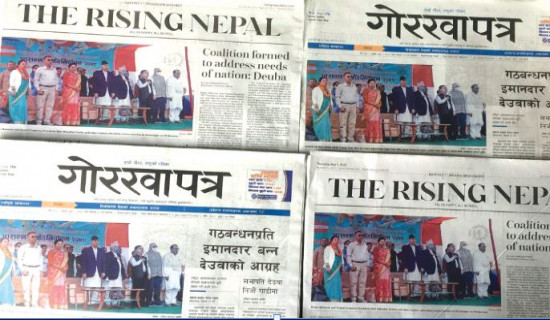
Media Ethics And Gorkhapatra
In 1871, Karl Marx wrote a letter to the Paris Commune. But Le Figaro, a French daily morning newspaper, published a completely different version of the letter with Marx’s signature. It apparently aimed to blow Marx’s thoughts on the international labour movement out of proportion. It reads: “...Then the world will belong to us, for it will be not only Paris, Lyon, Marseilles, which will rise against odious capitals, but Berlin, London, Brussels, St. Petersburg, New York. And before this new insurrection, such a history has yet to be known, the past will disappear like a hideous nightmare; for the popular conflagration, kindled at hundred points at once, will destroy even its memory!”