- Sunday, 24 May 2026

Attracting Visitors To Remote Destinations

Narayan Ghimire
Effective planning, destination marketing and management are essential factors for developing any tourism destination. Further, proper utilisation of tourists’ attractions and tourism resources play a key role to succeed when it comes to develop remote regions through tourism.
A combined effort from private and government sectors is crucial. Thus, development of sufficient tourism infrastructures, marketing, and promotion of key tourists’ attraction, and having long term strategy of sustainable rural development are the key factors for the success of rural tourism.
Nature's Gift
Nepal is gifted with beautiful villages, agricultural farmlands, and hilly region forests, which are essential components for rural tourism development. Agricultural development as well as rural tourism have the potential to eradicate poverty and lower the migration of youth to other cities and foreign countries.
Development of home-stay facilities with improved services ensures further development of villages. Moreover, cash generating activities like chicken farming/hatchery, goat keeping, buffalo rearing, beekeeping, off-seasonal vegetable production, horticulture, and herb production are some of the prospective areas which can attract tourists who are looking for new life experiences.
This case study is based on Sitganga Municipality in Arghakhanchi, Nepal. Apart from the site study and personal observation for this research, the mayor of the municipality, Mr. Surya Adhikari provided in-depth-interview about the current situation of tourism development. After necessary research and in-depth-interview, ´The destination development plan` has been finalized.
Sitganga is newly formed municipality, some tourism activities are there but there is not proper tourism destination planning. This research is carried out to find out its tourism possibilities and challenges. In context of Sitganga Municipality, proper rural tourism development can play a vital role in sectors such as employment creation, income generation and socio-economic growth. It has beautiful hills, mountains, agricultural fields, cattle farming, lakes, beautiful rivers, and religious attractions which are vital for rural tourism growth.
The destination development plan consists of few core ideas. First, before making any strategic plan for the destination development, it is essential for stakeholders to gain some knowledge related to target area.
For this, analysis such as SWOT (Strength, Weakness, Opportunity, and Threat), and marketing mix analysis can help to make informed decisions. Second, it is important to create tourism services and products by targeting current market trends and customers in mind. It is also important to consider the cultural and environmental impacts, and its sustainability.
Next, the creation of destination image, branding a destination and promotional campaigns are some of the factors that generate curiosity for the travellers. However, for the long-term tourism growth, the tourism entrepreneurs have the real ability to make each product and service look attractive and exciting.
This enables visitors to create memories, share it to the world thus, destination can expect increased number of visitors. Therefore, creative ideas of tourism entrepreneurs must be encouraged.
Alike every other industry, tourism industry also needs guidance and supervision from the team of experts. To cope with the existing challenges in rural tourism planning, a solution focused framework DMADMT (Destination management and Destination marketing team) framework has been created.
The framework outlines the main responsibilities of the team to achieve the common goal of long-term tourism growth.
Sustainable Approach
It is necessary for any tourism destination to apply sustainable approach to promote tourism in the long run, maintaining the balanced use of resources. Tourism particularly expands in destinations with natural environment, warm climate, rich cultural heritage. However, the negative impacts such as environmental damage, pollution, over consumption of resources and cultural degradation and negative influence in societies should be monitored.
It is essential that tourism is well planned and managed, embracing the components of destination development. Destination development is a continuous and progressive process, it is important to have active participation of all relevant stakeholders as well as political leadership. It requires consensus amongst wider participants.
Dynamic Role
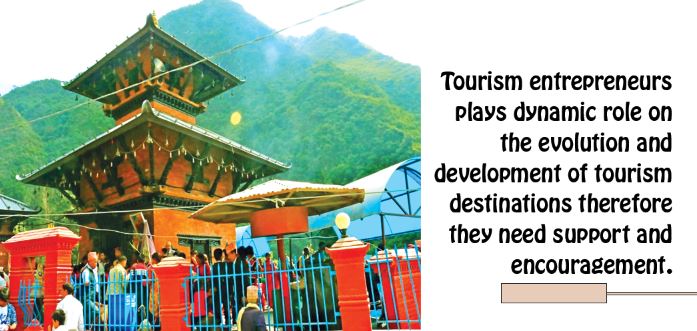
Tourism entrepreneurs plays dynamic role on the evolution and development of tourism destinations therefore they need support and encouragement. Only with tourism entrepreneurship leisure and recreational opportunities can be transformed into profitable businesses. When it comes to the rural tourism development, good transport facilities, additional health service facility, quality accommodations including provision of homestay services (with basic facilities) will contribute to the rapid growth of tourism sector. Further, it is essential to address issues such as reserving natural resources, maintaining authenticity of villages, effective waste management and preserving traditional farming and cattle methods.
(The author is studying Aviation and Tourism in Haaga Helia University of Applied sciences in Helsinki, Finland. narayanbabu88@gmail.com)